
TECHNICAL BUYER’S GUIDE · FOOD-GRADE INK COLOURANTS
A complete guide to choosing the right colourants — solubility, particle size, printhead compatibility, filtration, pH stability and the documentation that separates a usable colourant from a food-approved one.
QUICK ANSWER
A colourant that is legally permitted in food is not automatically usable in an inkjet system. Fitness for an ink formulation depends on the physical form of the colourant — its solubility at use concentration, particle size distribution, filterability, and stability inside the specific carrier, pH and printhead system — as much as it depends on regulatory approval.
Ink manufacturers sourcing colour for food-contact and edible printing applications face a narrower problem than most food colour buyers: the colourant has to survive a nozzle, not just a recipe. A pigment that disperses acceptably in a beverage or a confection can still be the wrong choice for a printhead with a 20–30 micron orifice, because the failure mode in an ink system is mechanical — clogging, misfiring, drift in droplet volume — before it is ever a taste or appearance problem.
This guide sets out what determines whether a food-grade colourant is actually usable in an inkjet formulation: the physical and chemical properties that matter at nozzle scale, how those properties interact with thermal and piezo printhead technology, what changes between direct food printing and printing on an edible substrate, and what documentation a manufacturer should request before committing to a supplier for ongoing production.
What are food-grade inkjet colourants?
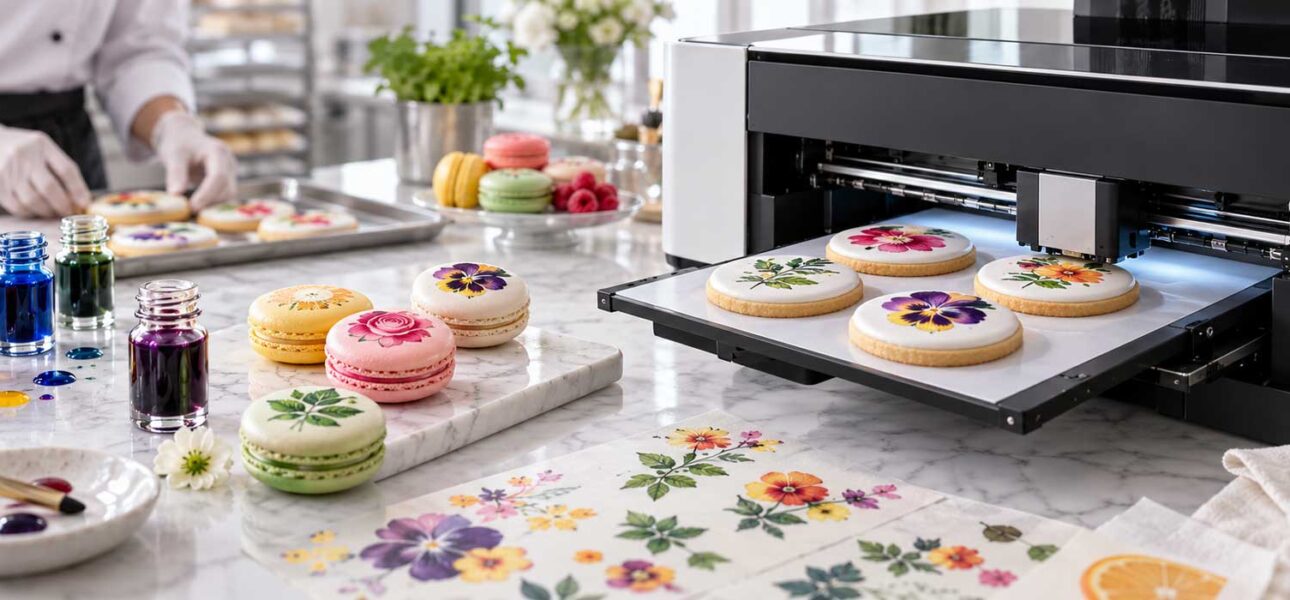
Food-grade inkjet colourants are colourants — dyes, water-soluble synthetic colours, or finely processed natural extracts — supplied in a form suitable for use in an ink that will be jetted through a printhead and applied to food, an edible substrate, or a food-contact surface. The distinction from a general food colourant is in the form, not necessarily the chemistry: the same colour index entity can be food-approved and still unsuitable for jetting if its particle size, purity profile, or solubility behaviour was not controlled for that purpose.
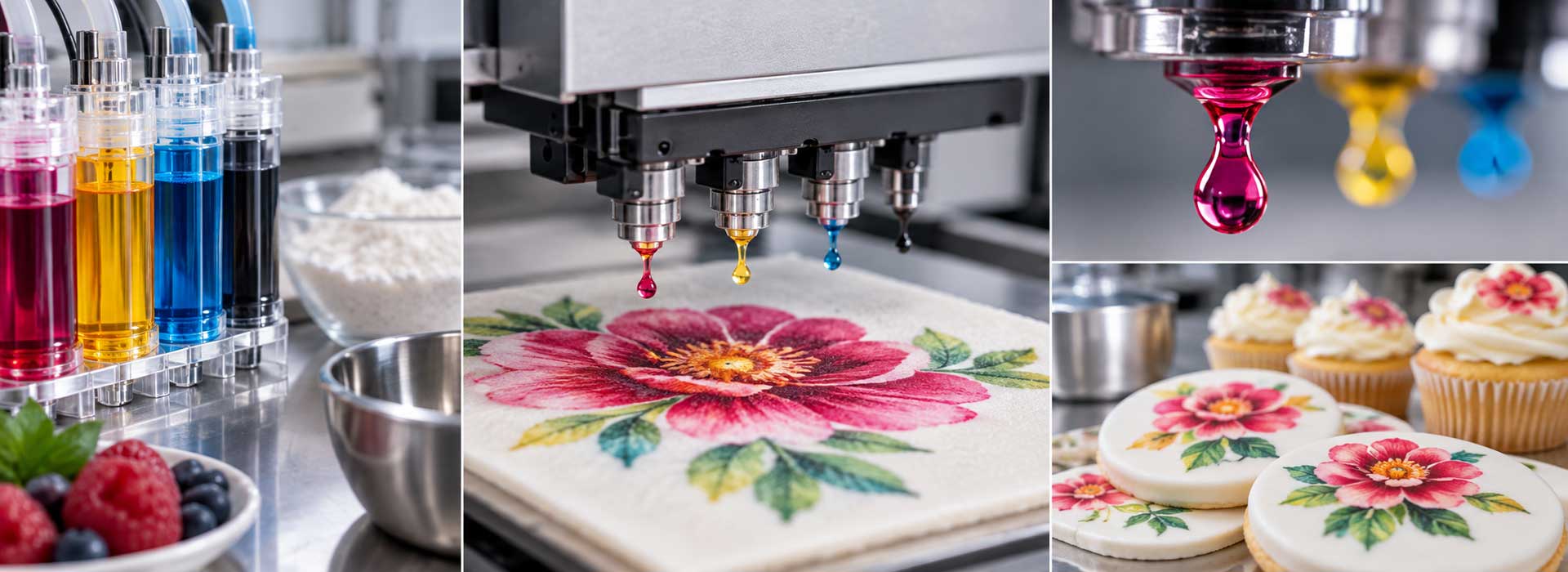
In practice, a colourant qualifies as “inkjet-grade” when a supplier can demonstrate consistent solubility or a controlled, sub-micron particle size at the intended use concentration, low levels of insoluble residue, and batch-to-batch reproducibility tight enough to avoid re-tuning the ink formulation every time a new lot arrives.
Food printing ink vs edible ink vs food packaging ink
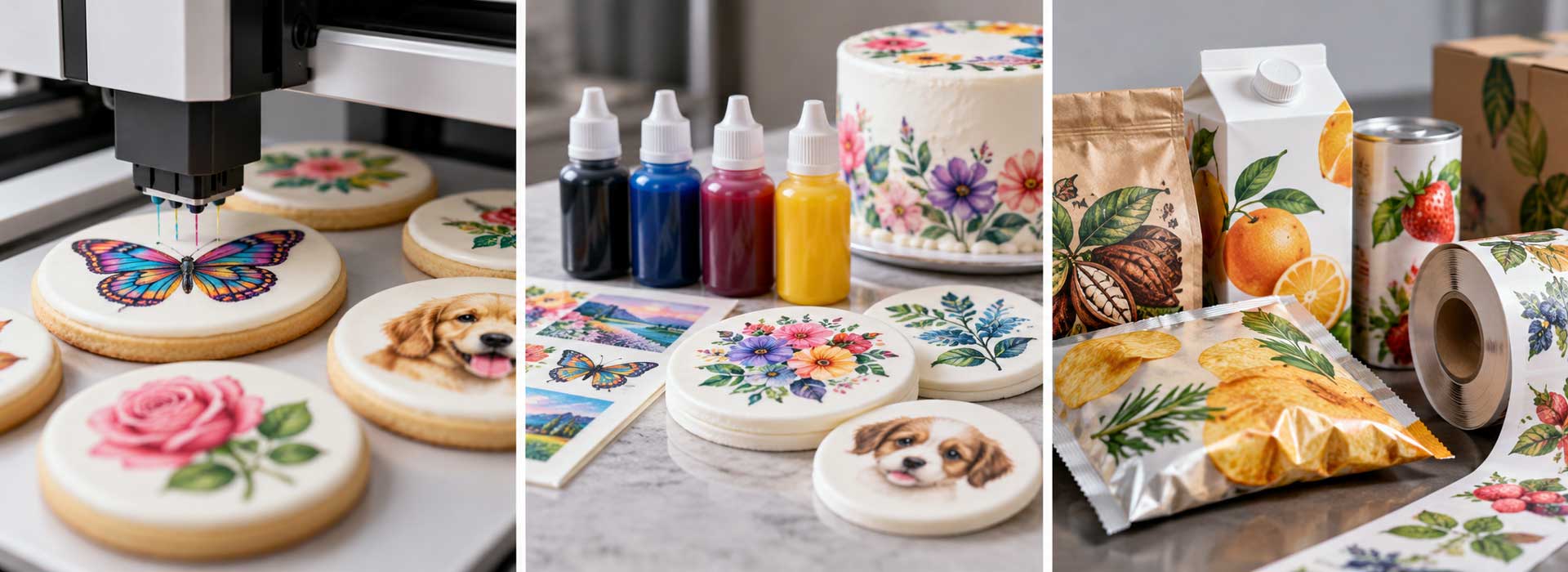
These three terms are often used loosely, but they describe different exposure scenarios and, consequently, different colourant requirements.
| Ink category | Where it is applied | Primary colourant concern |
|---|---|---|
| Edible ink | Directly onto food surfaces or edible substrates intended for immediate consumption (cakes, confectionery, baked goods) | Full food-contact and ingestion approval for every component |
| Food printing ink | Broader category covering ink used in or around food production, including some non-ingested marking applications | Food-contact status even where the ink is not itself consumed, and low migration potential |
| Food packaging ink | Printed onto packaging materials that contact or are printed near food packaging | Set-off and migration control from packaging into the food |
The colourant that is right for a food packaging ink is not automatically right for an edible ink, even where both are described in supplier material as “food safe.” Confirm which category your end product falls into before shortlisting colourants.
Why ink manufacturers need specialised food colourants
Standard industrial inks are formulated around pigments and dyes chosen for lightfastness, cost and compatibility with non-food substrates — none of which are the priorities in a food-contact system. Three factors push ink manufacturers toward a distinct colourant category:
Ingestion or direct food contact
Any colourant that ends up on or in food carries an ingestion risk that industrial ink colourants are never evaluated against.
Nozzle-scale physical demands
Undissolved particulate that would be invisible in a bulk food application can block a printhead orifice measured in microns.
Regulatory scrutiny by market
Food-contact colourants are subject to market-specific permitted-use lists and purity criteria that general industrial pigments never face.
Types of colourants used in food-grade inks
Most food-grade inkjet formulations draw from four broad colourant categories, each with a different fit depending on the ink’s carrier system and application method.
WATER-SOLUBLE
Water-soluble food dyes
Fully dissolve in an aqueous carrier, leaving no particulate to filter or settle — generally the preferred starting point for inkjet formulations, provided solubility holds at the working concentration and pH.
SYNTHETIC
Synthetic food colours
Offer strong, consistent colour strength and well-characterised purity, supporting the batch-to-batch reproducibility a production line depends on. Confirm permitted-use status for each destination market.
NATURAL
Natural colourants
Can meet clean-label requirements but typically bring more shade and strength variability, and some extracts carry more particulate that needs closer filtration screening.
LAKE / PIGMENT
Lake colours and pigments (where appropriate)
Insoluble by design, generally reserved for oil-based or specialised ink systems rather than aqueous inkjet formulations.
FORMULATOR’S NOTE
Water solubility is not a universal advantage — it is an advantage specifically because it removes particle-related failure modes from an inkjet system. In non-aqueous ink carriers, a soluble food dye is not automatically the right fit, and dispersion behaviour needs to be checked against that carrier directly.
Colourant properties that determine ink performance
Eight properties recur across almost every technical conversation with an ink formulator evaluating a new colourant. None of them can be assumed from a colourant’s regulatory status alone.
- Solubility — complete and stable dissolution at working concentration, carrier composition and storage temperature, not just at lab-bench dilution.
- Purity — low levels of by-products, unreacted intermediates or insoluble matter that could seed nozzle blockages.
- Colour strength — consistent tinting strength batch to batch, so colourant loading doesn’t need re-calibrating on every lot.
- Particle size — for any non-fully-soluble component, a tightly controlled distribution relative to the printhead’s minimum orifice.
- Filtration compatibility — passes cleanly through the production filter rating without rapid loading or aggregation.
- Stability — resists precipitation, colour drift or microbial growth across the ink’s shelf life.
- Batch-to-batch consistency — repeatable shade, strength and physical behaviour across production lots.
- Regulatory documentation — traceable CoAs and compliance status tied to the specific batch supplied.
A colourant that performs well in a beaker and fails at the nozzle has not been evaluated for the right application — bench solubility and jetting solubility are related but not identical tests.
— Formulator’s Rule
Printhead compatibility
Printhead nozzle geometry sets a hard physical limit on what a colourant is allowed to be, independent of its chemistry. Manufacturers typically work backward from the printhead’s minimum orifice dimension and rated fluid viscosity range to decide what particle size and viscosity contribution a colourant can bring to the formulation.
- Confirm the printhead manufacturer’s fluid specification for viscosity, surface tension and particulate size before shortlisting colourants.
- Treat particle size distribution, not average particle size, as the qualifying figure.
- Re-verify compatibility whenever the printhead model changes, since tolerances differ across manufacturers and generations.
Colourant concentration
Concentration decisions trade off against viscosity, solubility headroom and print density. Pushing colourant loading higher to achieve stronger print colour reduces the safety margin against precipitation during storage or temperature fluctuation, and can push viscosity outside the printhead’s rated range. Because colour strength varies between batches even within specification tolerance, set concentration with a working margin below the saturation or viscosity limit — not at the edge of it.
Clogging and filtration considerations
Clogging is the most common field complaint tied back to colourant selection, and it is rarely a regulatory issue — it is a physical-form issue.
| Problem | Likely cause | Recommended fix |
|---|---|---|
| Progressive nozzle blockage over a production run | Undissolved particulate or colourant agglomeration during storage | Pre-filter at production micron rating; verify supplier particle size data against actual lots |
| Rapid filter loading, shorter filter life than expected | Colourant purity below specification, or incompatibility with a co-formulated additive | Request a CoA per batch; run compatibility checks when introducing new additives |
| Intermittent misfires that worsen after storage | Slow re-crystallisation or aggregation of a marginally soluble colourant | Extend stability testing to the full intended shelf period, not just time zero |
COMMON MISTAKE
Qualifying a colourant on a freshly prepared ink sample and skipping storage-stability testing. Many clogging issues only appear after weeks of storage, once slow aggregation or precipitation has had time to occur — by which point the ink is already in the field.
pH and formulation compatibility
Colourant solubility and shade can both shift with pH, and an ink carrier’s pH is rarely neutral by accident — it is usually set to manage viscosity, microbial stability or drying behaviour. Before finalising a colourant, check its solubility and colour stability across the full pH range the formulation is expected to see in production, including any drift caused by evaporation or additive interaction over the ink’s shelf life. Some colourants that are stable and vividly coloured near neutral pH shift shade or precipitate outside a narrow window — this needs to be confirmed against the specific formulation rather than assumed.
Thermal vs piezo inkjet systems
Thermal inkjet
Uses a heating element to vaporise a thin layer of ink and force out a droplet. Colourants and carrier components are repeatedly exposed to brief, localised high temperatures, so thermal stability under repeated heat cycling is a priority. Heat-sensitive natural colourants may degrade or shift shade faster here than in piezo systems.
Piezo inkjet
Uses a piezoelectric actuator to mechanically deform a chamber and eject the droplet, without heating the fluid. Generally suits heat-sensitive colourants better, but piezo systems tend to be more sensitive to viscosity and particle size consistency for reliable droplet formation.
| Consideration | Thermal inkjet | Piezo inkjet |
|---|---|---|
| Heat exposure to colourant | Repeated brief high-temperature pulses | Minimal to none |
| Primary sensitivity | Colourant and carrier thermal stability | Viscosity and particle size consistency |
| Fit for heat-sensitive natural colourants | Requires closer thermal-stability screening | Generally more forgiving |
Direct-to-food printing vs printing on edible substrates
Direct-to-food printing
Ink is deposited straight onto the food surface — often uneven, sometimes moist or fatty, and variable between units. Adhesion, migration and full ingestion-safety status of every ink component are the central concerns.
Printing on edible substrates
Ink is applied to a pre-formed edible medium — an icing sheet or wafer — giving a flatter, more predictable surface. The substrate itself must independently carry food-approved status, and the ink-substrate combination needs its own adhesion check.
Regulatory considerations
Permitted colourants, maximum usage levels and purity criteria differ by colourant, by food category, and by destination market. A colourant approved for one application or market is not automatically approved for another, and status can change over time.
REGULATORY NOTE
Regulations vary by colourant, product category and destination market. Verify current requirements for the specific application and market before commercial use — this guide is general technical background, not a compliance determination for any particular formulation.
For export-oriented ink manufacturers in particular, confirm regulatory status separately for each destination market rather than assuming a domestic approval carries over.
Documentation manufacturers should request from suppliers
- Certificate of Analysis (CoA) specific to the batch being supplied, not a generic product-level document
- Technical specification sheet covering purity, particle size range and solubility parameters
- Regulatory status documentation relevant to the destination market and food category
- Safety data sheet (SDS) where applicable
- Batch traceability information supporting recall or investigation if a quality issue arises
How to evaluate a food colour supplier

Beyond price and lead time, the factors that predict whether a supplier relationship will hold up in production are consistency-related rather than transactional.
Batch consistency track record
Ask for CoAs from several recent batches, not one, to see how tightly the supplier holds its own specification over time.
Willingness to support qualification
A supplier prepared to provide working samples and technical data signals they expect to be evaluated technically, not just commercially.
Manufacturing and export experience
Experience supplying export markets suggests familiarity with the documentation and regulatory variation those markets require.
Responsiveness on documentation requests
How quickly a supplier produces CoAs and compliance documents is often a leading indicator of how they’ll handle issues later.
Questions to ask before buying
- What is the particle size distribution at the concentration we intend to use, not just at the standard test dilution?
- Can you provide CoAs from at least three recent production batches?
- What is the documented shelf life and storage condition for this colourant in solution form?
- What regulatory status applies specifically to our destination market and food category?
- Has this colourant been used in inkjet applications before, and under what printhead technology?
- What filtration rating has this colourant been validated against?
- What lead time and minimum order quantity apply to ongoing bulk supply, not just the initial sample?
Sample and testing process
A structured qualification sequence catches most colourant-related production issues before they reach the field.
- Request a working sample with documentation — obtain the colourant along with its CoA and specification sheet before any bench work begins.
- Dissolve and inspect — prepare a solution at the intended use level and inspect for undissolved residue, haze, or sediment.
- Filter at production micron rating — check for premature filter loading using the rating used in actual production.
- Run a jetting trial — load the trial ink into the target printhead and run a jetting and nozzle-check cycle.
- Check storage stability — hold a sealed sample at expected storage conditions and re-check performance after the intended shelf period.
- Confirm batch-to-batch consistency — repeat the evaluation on at least one additional production batch before committing to ongoing supply.
Need a working sample against your own printhead and formulation before you commit to a supplier?
Bulk procurement and global supply considerations
Consistent lot sizing
Confirm the supplier can hold specification across the lot sizes your production schedule actually requires, not only at pilot-batch scale.
Export documentation readiness
For cross-border procurement, confirm the supplier can consistently provide the compliance and shipping documentation your destination market requires.
Supply continuity
Ask about backup capacity and typical lead times during demand spikes, so a single-source dependency doesn’t become a production risk.
Frequently asked questions
Are food dyes and food-grade inkjet colourants the same thing?
Not automatically. A colourant may be approved for use in food, but that does not mean the same grade is fit for a printhead — an ink formulation needs a filtered, low-particulate, controlled-viscosity form of the colourant with documented purity, not just food-approval status.
What colourant properties matter most for inkjet systems compared with other food-colour applications?
Solubility, particle size and filtration compatibility matter more here than in most other food applications, because inkjet nozzles are far less tolerant of undissolved material or coarse particles than a bulk food matrix is.
Can synthetic and natural colourants be blended in the same ink?
It depends on the formulation — solubility profile, pH behaviour and particle size need to be compatible, and the resulting blend needs its own filtration and stability testing rather than assuming each component behaves the same combined as it does individually.
Why do inkjet inks clog even when the colourant is technically food-approved?
Approval status speaks to what the colourant is, not necessarily to its particle size distribution, dissolution behaviour, or the presence of trace insolubles. Clogging is usually a physical-form issue rather than a regulatory one.
What documentation should an ink manufacturer request from a food colour supplier?
At minimum, a current Certificate of Analysis for the specific batch, a technical specification sheet covering purity, particle size and solubility, and confirmation of regulatory status for the destination market.
Does thermal or piezo inkjet technology change which colourant is suitable?
Yes. Thermal inkjet heats the ink locally, so colourant and carrier stability under repeated heating matters. Piezo inkjet uses mechanical actuation instead of heat, which is generally gentler on heat-sensitive colourants but places more emphasis on viscosity and particle size consistency.
Is direct food printing different from printing on an edible substrate?
Yes. Direct food printing raises migration and adhesion concerns on a variable food surface. Printing on a pre-formed edible substrate gives more control over uniformity, but the substrate itself must also be food-approved.
Can Advik Colors supply food-grade colourants in bulk for ink production?
Advik Colors manufactures and exports synthetic colours for industrial applications and supports ink manufacturers with technical documentation, sample evaluation and bulk quantities. Exact grades, packaging and regulatory documentation should be confirmed against the specific ink system and destination market.
Need the right colourant for your ink formulation?
Advik Colors supplies synthetic colours for industrial manufacturers, including ink producers working in food-contact and edible-print applications, with technical documentation and formulation support.
Advik Colors manufactures and exports synthetic colours for industrial applications. Information on this page is provided for industry professionals and general technical guidance. Regulatory permissions and maximum usage levels vary by colourant, application and destination market — verify current requirements for your specific formulation and market before commercial production.