
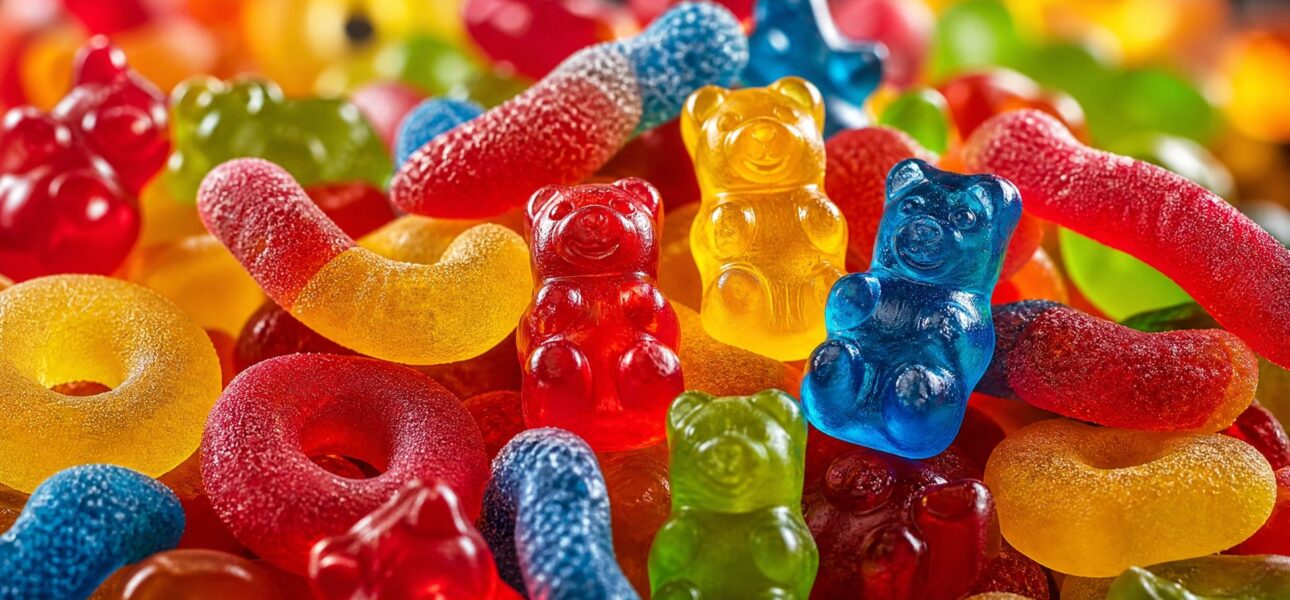
The best food colors for gummies are high-purity water-soluble synthetic dyes. Specifically: Carmoisine (E122) for deep red and pink, Ponceau 4R (E124) for strawberry red, Tartrazine (E102) for bright yellow, and Brilliant Blue FCF (E133) for vivid blue. These dissolve cleanly in gelatin or pectin solutions at gummy processing temperatures (70–90°C), resist hue shift in the acidic pH range of gummy candy (pH 3–4), and deliver jewel-like translucency with consistent shade across every production batch. Lake colors are not suitable for standard gummies — they are insoluble pigments designed for dry or fat-based systems, not water-continuous gelatin matrices. View the full Advik Colors synthetic range →
pH 3–4
Typical Gummy Acidity
90°C
Max Gummy Processing Temp
0.05%
Max Typical Dye Dosage
12+
Approved Colors for Gummies
Why Food Coloring in Gummies Is More Complex Than You Think
A gummy is a deceptively demanding color application. Unlike a cake batter or beverage, the gummy matrix subjects food colors to a precise combination of stressors that eliminate many color options at the outset:
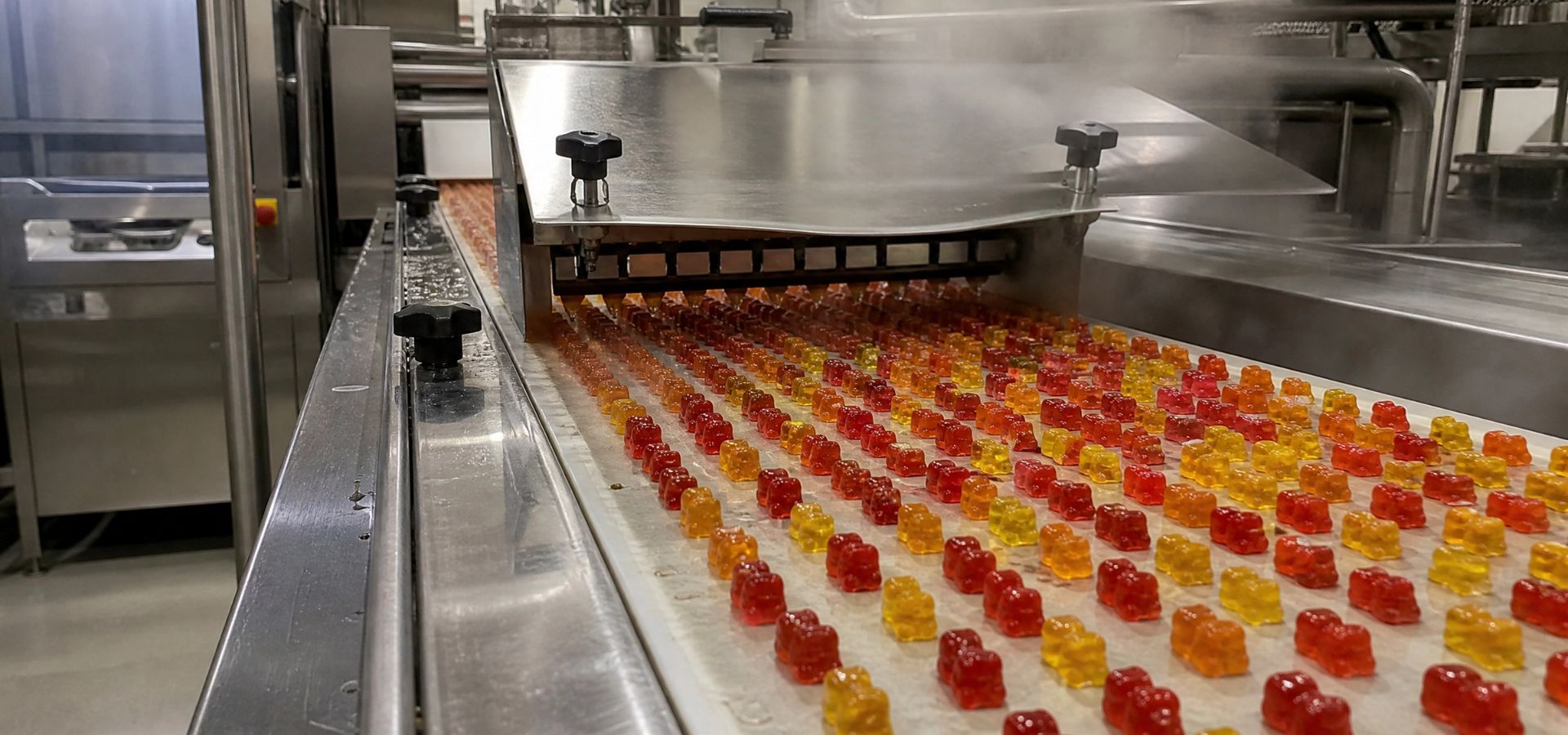
- Heat processing — The gummy slurry (gelatin, pectin, or starch-based) is heated to 75–90°C during cooking and dissolving. Colors must withstand this without degradation or hue shift.
- Persistent acidity — Citric acid, malic acid, or tartaric acid bring gummy pH down to 3–4. Many natural colors and some synthetic dyes shift hue, precipitate, or fade significantly below pH 5.
- Transparency requirement — Premium gummies are prized for their jewel-like, translucent appearance. Any insoluble particle, pigment haze, or cloud causes immediate quality rejection.
- Extended shelf life — Gummy products must maintain their shade through 12–18 months of shelf life, often exposed to ambient light and variable humidity in retail packaging.
- High sugar concentration — Elevated Brix (°Bx 65–78) in gummy mass can affect dye solubility and dispersion kinetics.
Synthetic vs Natural Food Colors for Gummies
This is the most common decision point for gummy manufacturers, and the answer depends heavily on your target market, regulatory jurisdiction, and production economics. Here is an evidence-based comparison:
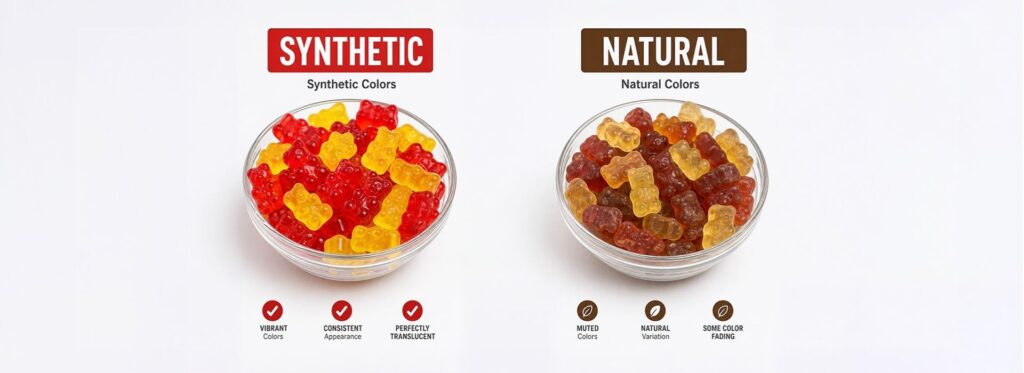
✅ Synthetic Colors
- Excellent heat stability at 75–90°C processing temps
- pH-stable across typical gummy acid range (pH 3–4)
- High tint strength — small dose, vibrant result
- Batch-to-batch shade consistency across production runs
- Full solubility in water — no haze or cloudiness
- Long shelf life retention without refrigeration
- Lower cost per unit color intensity
- Broad shade range from a single supplier source
🔥 Natural Colors
- “Clean label” positioning for premium market segments
- Consumer perception advantage in select markets
- Some (e.g. anthocyanins) are pH-sensitive — shift red to blue above pH 4
- Many degrade above 70°C — requires careful processing control
- Higher dosage rates — 5–20× more needed for equivalent shade
- Harvest-dependent batch variation requires QC adjustment
- Higher cost, often 3–8× more per kg of finished gummy
- May require refrigerated shipping and storage
For industrial-scale gummy production, synthetic food colors deliver superior performance across every technical parameter. Natural colors are viable for premium, small-batch, or specialty-market gummies where the “clean label” commercial premium offsets the higher formulation cost and added complexity. The right choice depends on your brand positioning and target market — not on production convenience alone.
Lake Colors vs Water-Soluble Colors for Gummies
This is a critical distinction that causes costly reformulation when misapplied. Understanding the structural difference between these two color types prevents quality failures in gummy production.
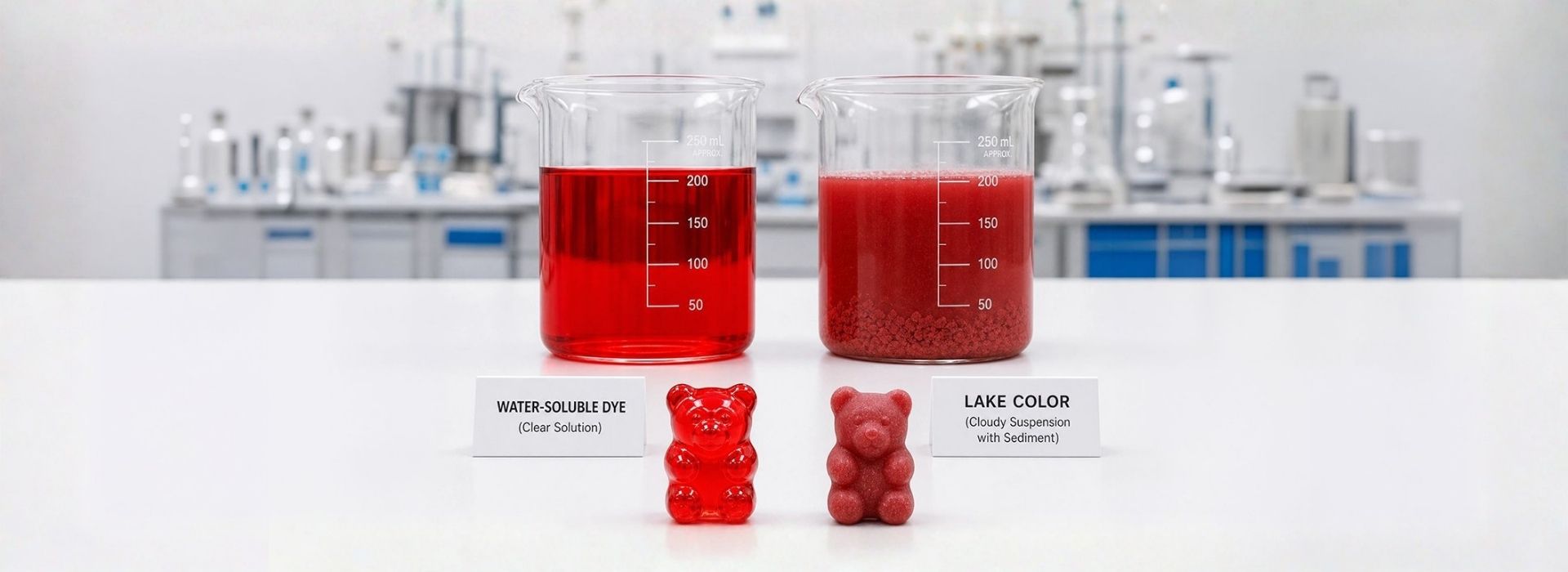
What Are Lake Colors?
Lake colors are water-insoluble aluminium salts of synthetic dyes. The dye is precipitated onto an aluminium hydroxide substrate, creating a stable pigment particle that does not dissolve in water or fat. Lakes are designed for applications where the vehicle contains no free water — dry mixes, fat-based coatings, hard-panned candies, tablet coatings, and lipstick bases.
What Are Water-Soluble Dyes?
Water-soluble food colors (also called “straight dyes”) fully dissolve in water to produce a clear, intensely colored solution. In a gummy, the water-soluble dye becomes molecularly dispersed throughout the gelatin matrix, creating the characteristic translucent, jewel-like appearance consumers expect.
| Property | Water-Soluble Dye ✅ Gummies | Lake Color ❌ Gummies |
|---|---|---|
| Solubility in Gelatin Mass | ✅ Complete molecular dissolution | ❌ Disperses rather than dissolves |
| Visual Result in Gummy | ✅ Clear, jewel-like translucency | ❌ More opaque appearance with lower transparency |
| Shade Uniformity | ✅ Uniform throughout the mass | ❌ Streaked or spotted distribution |
| Dosage Efficiency | ✅ 0.005–0.05% w/w typical | 👍 Higher dose needed, poor efficiency |
| Correct Application | Gummies, jellies, beverages, gelatin desserts | Hard candy shells, tablet coatings, dry mixes, fat panning |
⚡ Rule of Thumb — Water Determines Solubility Type
If your gummy system is water-continuous (gelatin, pectin, agar, starch-based), always use water-soluble synthetic dyes. Lakes belong in fat-continuous or dry systems. Mixing them up is the single most common color quality failure in confectionery manufacturing.
Heat Stability of Food Colors in Gummy Processing
The gummy cooking process involves heating the mass to 75–90°C to dissolve gelatin and sugars. Colors are typically added after the mass cools slightly (to 60–70°C) to minimize exposure time — but even this range is sufficient to degrade unstable dyes.
| Color (E-No.) | Hue | Stability at 70°C | Stability at 90°C | pH Stability (3–4) | Recommended |
|---|---|---|---|---|---|
| Tartrazine (E102) | Yellow | ✅ Excellent | ✅ Excellent | ✅ Stable | ⭐⭐⭐ Top Pick |
| Sunset Yellow (E110) | Orange-Yellow | ✅ Excellent | ✅ Good | ✅ Stable | ⭐⭐⭐ Top Pick |
| Allura Red (E129) | Red | ✅ Excellent | ✅ Excellent | ✅ Stable | ⭐⭐⭐ Top Pick |
| Carmoisine (E122) | Deep Red/Pink | ✅ Good | ✅ Good | ✅ Stable | ⭐⭐⭐ Recommended |
| Ponceau 4R (E124) | Strawberry Red | ✅ Excellent | ✅ Good | ✅ Stable | ⭐⭐⭐ Recommended |
| Brilliant Blue (E133) | Royal Blue | ✅ Good | 👍 Moderate | ✅ Stable | ⭐⭐ Add at cooling stage |
| Indigo Carmine (E132) | Deep Blue | 👍 Moderate | ❌ Poor | 👍 Slight shift | ⭐ Not ideal for gummies |
| Erythrosine (E127) | Cherry Pink | ✅ Good | 👍 Moderate | ✅ Stable | ⭐⭐ Use at lower temp |
| Green S (E142) | Green | ✅ Good | 👍 Moderate | 👍 Slight shift | ⭐⭐ Blend with Tartrazine |
Top Recommended Food Colors for Gummies
The following four synthetic food colors from Advik Colors are the primary recommendations for gummy manufacturers based on technical performance, regulatory status, and commercial availability:
Carmoisine
E122 · C.I. 14720
A reliable deep red to raspberry-pink shade for gummies, offering excellent clarity and heat stability in gelatin and pectin systems. Delivers a clean raspberry-to-cherry shade with excellent clarity in gelatin. Fully soluble at gummy processing temperatures. Popular for strawberry, cherry, watermelon, and mixed berry gummy variants. Pairs well with Ponceau 4R for brighter strawberry blends.
Deep Red · Raspberry Pink
Ponceau 4R
E124 · C.I. 16255
Bright, punchy strawberry-red with exceptional clarity in water-based systems. A bright, slightly cool-toned red that appears more vivid in finished gummies. Strong tint strength means low dosage is needed. Recommended for strawberry, cherry, and fruit punch flavors where a vibrant, eye-catching red is required.
Strawberry Red · Cherry
Tartrazine
E102 · C.I. 19140
The industry-standard yellow for gummies and confectionery. Outstanding heat and pH stability — holds its lemon-to-golden hue reliably at gummy pH 3–4. High tint strength enables very low dosage. deal for lemon, pineapple, mango, and yellow fruit gummies. Blended with Sunset Yellow FCF for deeper orange shades; with Brilliant Blue for leaf green.
Lemon Yellow · Golden
Brilliant Blue FCF
E133 · C.I. 42090
One of the brightest and most stable blue shades for gummies. Produces a vivid royal blue in gummies when used alone; blended with Tartrazine it creates a versatile leaf green. For blue raspberry, blueberry, and blue mixed fruit gummies. For maximum shade intensity, add during the cooling phase (typically 65–70°C), as prolonged high-temperature exposure may slightly reduce brilliance.
Royal Blue · Blue Raspberry
Shade Consistency: Achieving the Same Color Every Batch
Shade drift between production runs is one of the most common quality complaints in gummy manufacturing. Achieving batch-to-batch color consistency depends on controlling six variables simultaneously:
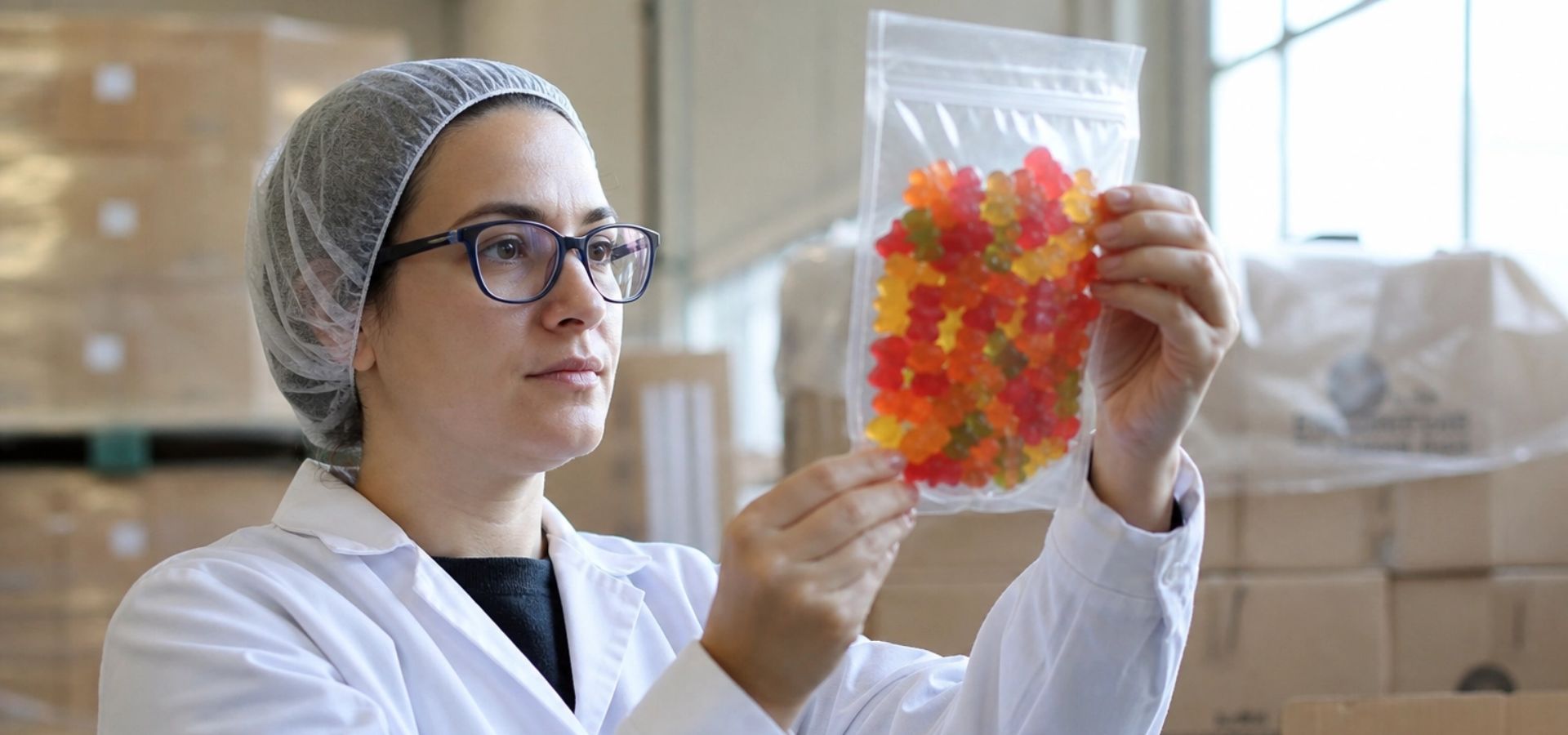
1. Dye Purity & Lot Certification
Always source food colors with a Certificate of Analysis (CoA) specifying the percentage dye content per lot. A dye rated at 90% purity has 10% impurities that vary from batch to batch — causing dose-performance drift. High-purity synthetic dyes (≥85% declared dye content, verified per lot) are the foundation of consistent gummy color.
2. Weigh, Don’t Estimate
Gummy color dosages are typically between 0.005% and 0.05% w/w — meaning errors as small as 0.5g per 10kg batch create visible shade variation. Use a calibrated analytical balance for color weighing, not a scoop or volumetric measure. Pre-dissolve in a fixed volume of warm water before addition to the mass.
3. Control Your Gummy pH
pH is the silent driver of shade shift. A gummy formulated at pH 3.2 will look measurably different from the same formulation at pH 3.8, even with an identical color dose. Standardize your acid addition (citric, malic, lactic) and test pH with a calibrated meter — not strips — before color addition at every production run.
4. Temperature at Color Addition
Add food color when the gummy mass temperature is between 65°C and 75°C. Too hot (>85°C) risks heat degradation, especially for Brilliant Blue and Erythrosine. Too cool (<55°C) risks poor dispersion as the gelatin begins to set. Standardize your addition temperature and hold to ±3°C.
5. Mixing Protocol
Pre-dissolve dye powder in a measured volume of warm water (approximately 10–20× the weight of the dye). Add this solution uniformly to the gummy mass while maintaining consistent agitation. Uneven mixing creates concentration gradients that become visible as color striping in the finished piece.
6. Store Colors Correctly
Synthetic dye powders absorb moisture, which affects weighing accuracy and dispersibility. Store in sealed, airtight containers in a cool, dark, dry location. Seal the container immediately after use. Lumped or caked powder indicates moisture ingress — discard and replace from a fresh lot.
Application Recommendations by Gummy Type
| Gummy Flavor / Type | Recommended Color(s) | E-Number(s) | Notes |
|---|---|---|---|
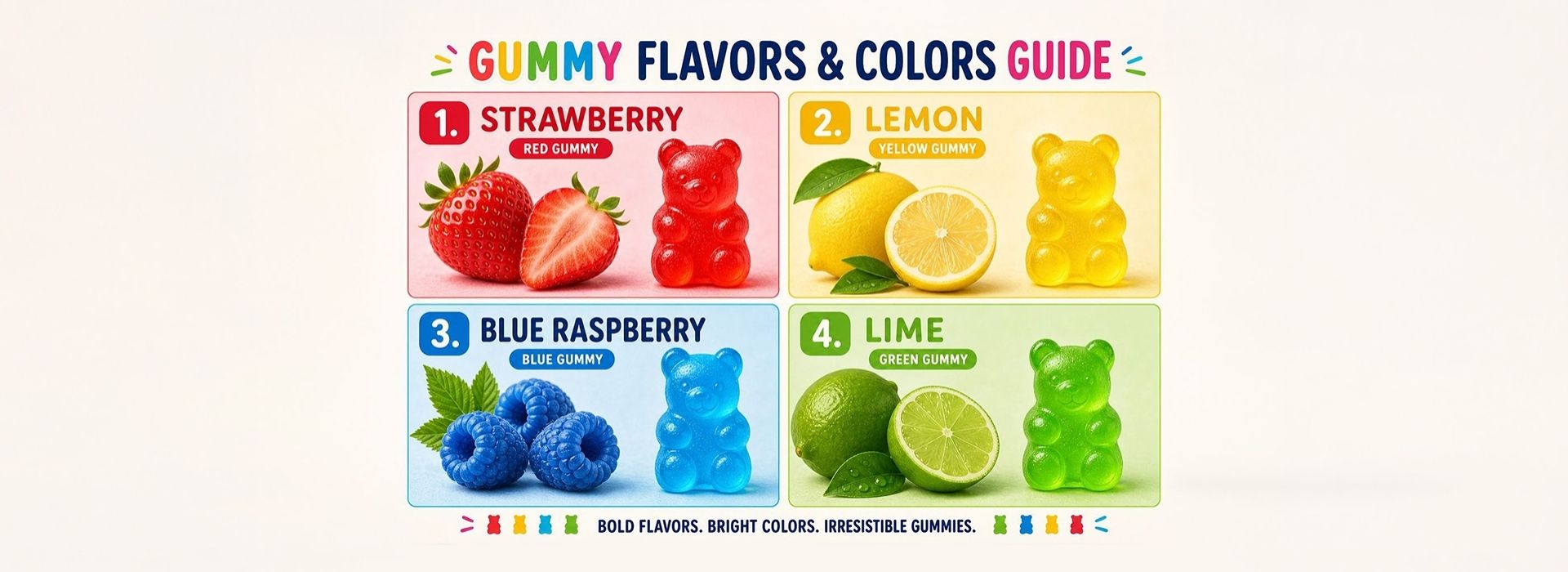
| Strawberry | Ponceau 4R + Carmoisine | E124 + E122 | 70:30 blend for bright strawberry-red with body |
| Cherry | Carmoisine + Allura Red | E122 + E129 | 50:50 blend for authentic cherry red or more E129 than E122 for brightness |
| Lemon | Tartrazine | E102 | Alone at low dose for crisp lemon yellow |
| Orange / Mango | Tartrazine + Sunset Yellow FCF | E102 + E110 | Mango: 90% E110 + 10% E129 Orange: 85% E110 + 15% E129 |
| Blue Raspberry | Brilliant Blue FCF | E133 | Add during cooling phase (typically below 70°C) to minimize shade loss |
| Grape Purple / Blackcurrant | Brilliant Blue + Carmoisine | E133 + E122 | 30:70 blend produces deep purple-violet |
| Watermelon | Allura Red + Tartrazine | E129 + E102 | 80:20 blend for warm pink-red |
| Apple / Lime Green | Tartrazine + Brilliant Blue | E102 + E133 | 85:15 blend for fresh leaf green |
| Peach / Apricot | Sunset Yellow FCF + Carmoisine | E110 + E122 | 75:25 blend for warm peach tone |
| Multifruit Mixed Pack | Individual colors per piece | Various | Batch-color by flavor for retail multipack |
| Cola | Caramel Colour Type IV + optional Brown HT | E150d + E155 | Authentic cola brown, avoid overdosing |
Full Synthetic Food Color Range for Confectionery & Gummies
Advik Colors supplies the following complete range of certified synthetic food colors for gummy and confectionery manufacturers, available in powder, liquid, and granular formats with full regulatory documentation:
| Color Name | E-Number | C.I. Number | Hue | Gummy Suitability |
|---|---|---|---|---|
| Tartrazine | E102 | 19140 | Yellow | ✅ Excellent |
| Quinoline Yellow WS | E104 | 47005 | Greenish Yellow or Lime Yellow | 👍 Good (blending) |
| Sunset Yellow FCF | E110 | 15985 | Orange-Yellow | ✅ Excellent |
| Amaranth | E123 | 16185 | Reddish-purple / wine red | 👍 Good |
| Ponceau 4R | E124 | 16255 | Strawberry Red | ✅ Excellent |
| Erythrosine | E127 | 45430 | Cherry Pink | 👍 Moderate |
| Allura Red AC | E129 | 16035 | Red | ✅ Excellent |
| Patent Blue V | E131 | 42051 | Bright Blue | 👍 Good |
| Indigo Carmine | E132 | 73015 | Deep Blue | ❌ Moderate – can fade under heat, acidic pH, and light exposure |
| Brilliant Blue FCF | E133 | 42090 | Royal Blue | ✅ Excellent (Preferably add during cooling phase (around 60–70°C) to preserve shade intensity) |
| Green S | E142 | 44090 | Green | 👍 Good (blend preferred) |
| Carmoisine | E122 | 14720 | Deep Red/Pink | ✅ Excellent |
| Brown HT | E155 | 20285 | Chocolate Brown | 👍 Niche use (cola gummies) |
Regulatory Compliance for Gummy Food Colors
All synthetic food colors supplied by Advik Colors meet major international food additive regulations applicable to gummy candy and confectionery products:
- FSSAI (India) — Compliant with Schedule II permitted colors for confectionery under the Food Safety and Standards (Food Products Standards and Food Additives) Regulations
- EU Regulation (EC) No 1333/2008 — Full compliance with European Parliament additives framework; MPLs (maximum permitted levels) for confectionery and gummy candies
- Codex Alimentarius GSFA — Compliance with FAO/WHO Global Standard for Food Additives, confectionery category 05.0
- Lot-specific CoA — Certificate of Analysis with declared dye content, heavy metal limits, and purity specifications per shipment
- MSDS / SDS — Material Safety Data Sheets provided for all colors for workplace compliance
⚑ EU Label Compliance Note for Gummy Exporters
Gummies containing Sunset Yellow FCF (E110), Quinoline Yellow (E104), Carmoisine (E122), Allura Red (E129), Tartrazine (E102), or Ponceau 4R (E124) and sold in the European Union require a mandatory on-pack warning statement: “may have an adverse effect on activity and attention in children.” This is a finished-product labelling requirement under EU Regulation (EC) No 1333/2008 Annex V. Advik Colors provides complete regulatory documentation to support global labelling compliance for each shipment.
Frequently Asked Questions — Food Colors for Gummies
What food colors work best in gummies?
The best food colors for gummies are water-soluble synthetic dyes: Carmoisine (E122) for red/pink, Ponceau 4R (E124) for strawberry red, Tartrazine (E102) for yellow, and Brilliant Blue FCF (E133) for blue. These dyes dissolve completely in the gelatin mass, deliver jewel-like translucency, withstand gummy processing temperatures, and remain stable in the acidic pH (3–4) typical of gummy candy formulations.
Should I use lake colors or water-soluble colors in gummies?
Always use water-soluble dyes for standard gummies. Lake colors are insoluble aluminium pigment salts designed for dry or fat-based systems — they do not dissolve in the water-continuous gelatin matrix. Using lake colors in gummies produces a dull, opaque, unevenly distributed result and fails to achieve the clarity that defines a quality gummy. Lakes belong in tablet coatings, hard candy shells, and dry powder applications.
Are synthetic food colors better than natural for gummies?
For industrial gummy production, synthetic food colors significantly outperform natural colors in heat stability, pH resistance, batch-to-batch shade consistency, tint strength per unit cost, and shelf-life retention. Natural colors require 5–20× higher dosage for equivalent shade, are often pH-sensitive (shifting hue in acidic gummies), and add cost and supply chain complexity. Natural colors suit premium, small-batch, or “clean label” positioned products where the market premium offsets the higher formulation cost.
How do I achieve vibrant, jewel-like color in gummies?
To get vivid, jewel-like color: use high-purity water-soluble synthetic dyes, pre-dissolve the dye in warm water before adding to the gelatin mass, add color at 65–75°C (not above 85°C), maintain consistent batch pH (3.2–3.6 is typical), use a calibrated balance for precise dosing (0.01–0.05% w/w), and mix thoroughly with consistent agitation. The clarity and transparency of gummy gelatin naturally amplifies the luminosity of properly dispersed synthetic dyes.
What is the correct dosage of food color for gummies?
Typical synthetic dye dosage in gummies is 0.005% to 0.05% w/w of the total gummy mass weight. Begin at the lower end and adjust incrementally. Always pre-dissolve powder in warm water (10–20× the dye weight in water) before adding to the mass. Check your regulatory jurisdiction for any maximum permitted levels for specific dyes in the confectionery category.
Where can I buy food-grade synthetic colors for gummy production in bulk?
Advik Colors manufactures and exports high-purity synthetic food colors for gummy manufacturers globally. Available in powder, liquid, and granular formats with complete lot-specific CoA, MSDS, and regulatory compliance documentation. Request a sample and B2B pricing here →
Find the Right Color for Your Gummies
Get samples, technical specifications, and B2B pricing for Carmoisine, Ponceau 4R, Tartrazine, Brilliant Blue, and the full synthetic color range.