

Solubility, purity, colour strength, stability and print performance — a working reference for formulators qualifying food-grade dyes for an inkjet system, not a general food-colour overview.
A food-grade dye is not an inkjet ingredient until it has been qualified against the specific ink: solubility at use concentration, purity and particle behaviour, and stability under the pH, heat, light and storage conditions the ink will actually see determine whether it prints reliably. Regulatory approval for food use is a separate, necessary but insufficient condition.
An ink manufacturer does not simply take a food colour off the shelf and put it into a printer. The dye has to work inside a complete ink system — carrier, additives, viscosity target, filtration stage and printhead — and it is that system, not the dye’s food-approval status alone, that determines whether the finished ink jets reliably and holds its colour. This reference works through the properties that actually decide fitness for inkjet use: solubility, purity, colour strength, and stability under pH, heat, light and storage conditions, followed by filtration, printhead compatibility and the documentation a formulator should be requesting at each stage.
What are food grade dyes for inkjet ink?
A food grade dye intended for inkjet use is a water-soluble synthetic or lake-form colourant, permitted for use in food, that has been evaluated — or is being evaluated — for behaviour inside a specific ink formulation rather than inside a food matrix. The distinction matters because the two contexts test different things. A food matrix tolerates a wider range of particle sizes, viscosities and mixing conditions than a printhead does; an inkjet nozzle, by contrast, is unforgiving of anything the dye’s food-grade specification does not directly address, such as trace insolubles or dissolution rate in the specific carrier system used.
In practice, a formulator selecting a food grade dye for inkjet use is really selecting a starting material for a formulation project, not a finished ink component. The dye still has to be dissolved or dispersed into a carrier, balanced against viscosity and surface tension targets, filtered to the production micron rating, and tested for stability across the ink’s intended shelf life and printing conditions before it can be considered qualified.
Water-soluble dyes vs pigments and what colours are available
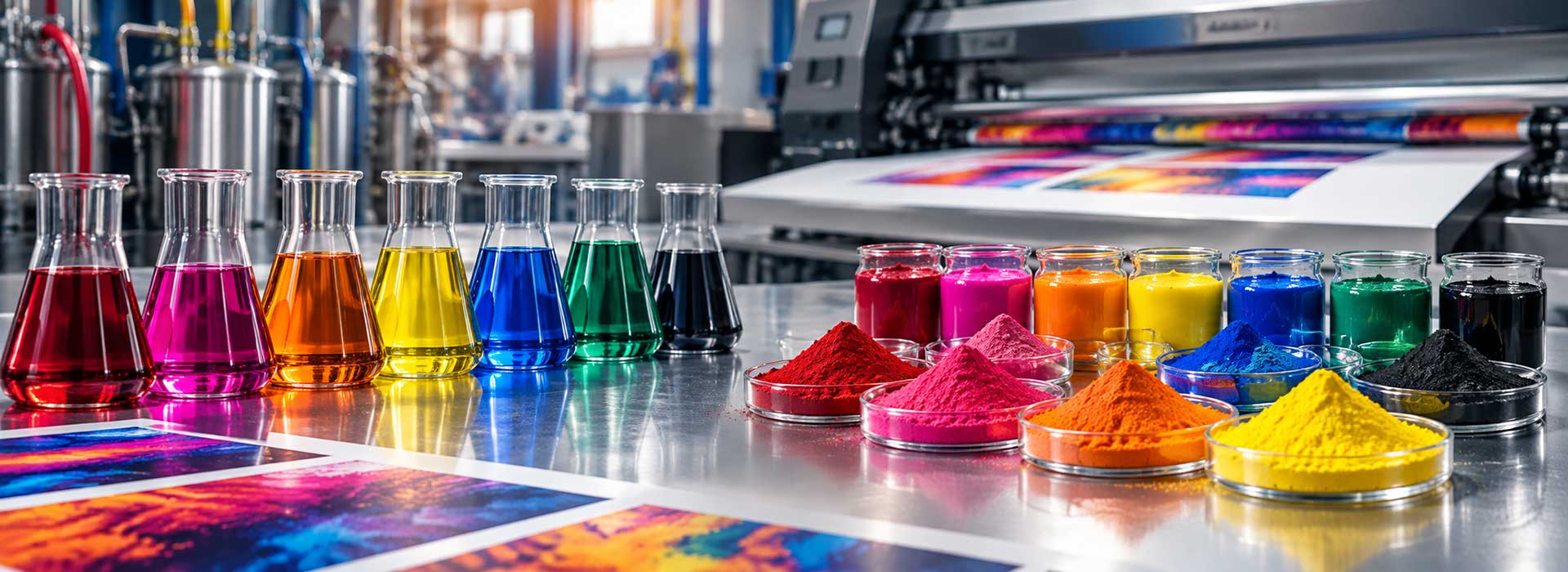
Food colourants used in ink development generally fall into two physical categories: water-soluble dyes, which dissolve fully in a suitable carrier, and lake colours (pigments), which are insoluble and remain dispersed as fine particles. The two behave differently at every stage of ink formulation.
| Property | Water-soluble dye | Lake / pigment |
|---|---|---|
| Solubility | Dissolves in a suitable solvent | Disperses rather than dissolves |
| Particle concerns | Lower — no particulate once fully dissolved | Higher — particle size and distribution are central |
| Filtration | Important, mainly to catch undissolved residue | Critical — filtration is a primary qualification step |
| Printhead risk | Formulation dependent | Often more demanding, particularly for narrow-orifice heads |
| Typical use | Dye-based aqueous ink systems | Pigment/dispersed ink systems |
Advik Colors manufactures both forms across a range of synthetic colour index entities. The water-soluble straight colours below are the category most commonly considered as a starting point for aqueous inkjet formulations, precisely because full dissolution removes particle-related risk at the outset — though each still requires its own solubility, purity and stability qualification against the specific ink before it can be treated as fit for jetting. Lake forms of the same colour index entities are also available and follow the pigment/dispersed route described above.
| Colour | E number | C.I. number | |
|---|---|---|---|
| Erythrosine | E127 | 45430 | |
| Amaranth | E123 | 16185 | |
| Brown HT | E155 | 20285 | |
| Brilliant Blue FCF | E133 | 42090 | |
| Patent Blue V | E131 | 42051 | |
| Indigo Carmine | E132 | 73015 | |
| Tartrazine | E102 | 19140 | |
| Quinoline Yellow WS | E104 | 47005 | |
| Sunset Yellow FCF | E110 | 15985 | |
| Allura Red | E129 | 16035 | |
| Ponceau 4R | E124 | 16255 | |
| Carmoisine | E122 | 14720 | |
| Green S | E142 | 44090 | |
| Fast Green FCF | E143 | 42053 | |
| Black PN | E151 | 28440 |
Representative shades shown for orientation only — actual dissolved-solution hue depends on concentration, carrier and pH. See Advik Colors’ synthetic food colours range for full specifications, blends and lake forms.
Why purity matters
Purity in a food dye specification usually refers to assay content, but for an ink formulator it stands in for several distinct risks that all show up at the printhead rather than in the food application the dye was originally specified against.
- Insoluble matter — even trace insoluble residue can seed nozzle blockage over the course of a production run.
- Unwanted impurities — by-products or unreacted intermediates can affect solubility, shade or filter life.
- Heavy metals — relevant to both food-contact compliance and, in some cases, colloidal behaviour in solution.
- Residual salts — can shift solution ionic strength, affecting solubility and long-term stability.
- Batch variation — purity that drifts between lots forces repeated re-qualification and inconsistent print density.
- Filtration behaviour — purity and particulate load together determine how quickly a production filter loads.
- Printhead reliability — the cumulative effect of the factors above, observed only once the ink is actually jetted.
- Documentation trail — purity claims are only useful if backed by a batch-specific Certificate of Analysis.
It would be inaccurate to claim that any particular colourant “never clogs printheads” — clogging is the outcome of colourant purity, particle behaviour, formulation and filtration acting together, not a property of the dye in isolation. What can be said with more confidence is that colourant selection and the ink’s filtration strategy need to be qualified as a pair, not evaluated separately.
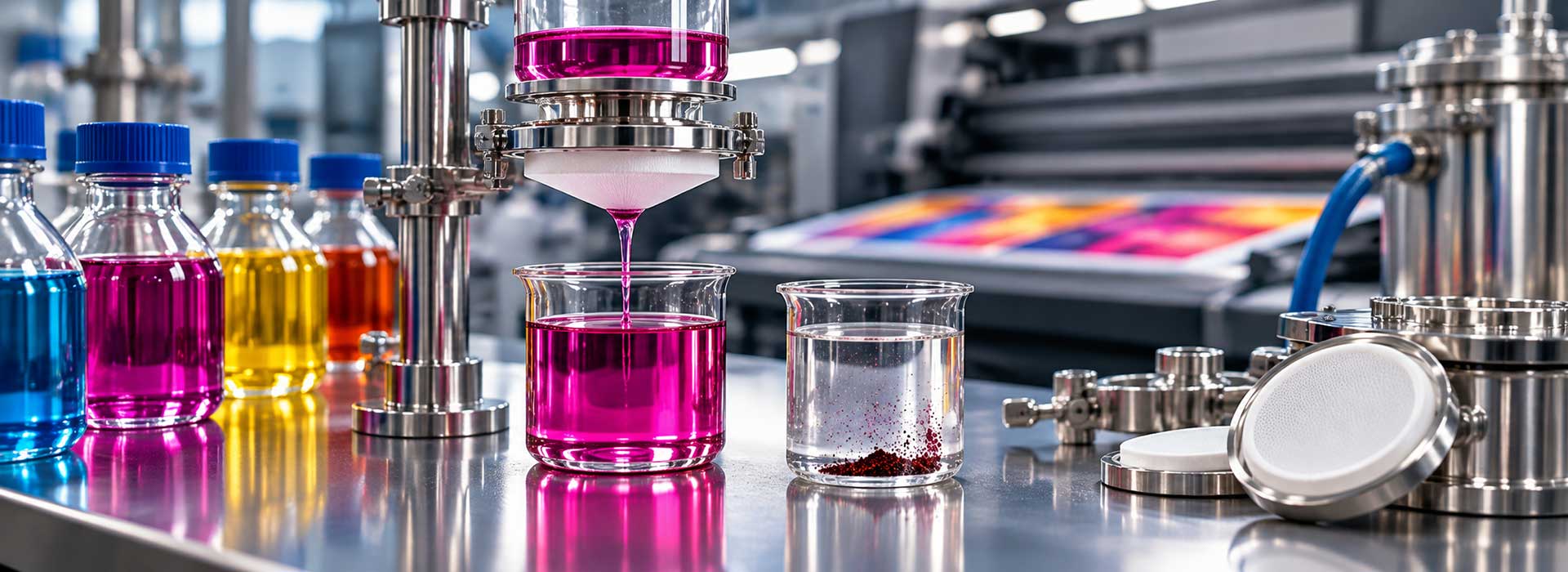
A dye’s purity specification tells you what it is; it does not tell you what it will do once it is dissolved, filtered and pumped through a printhead a thousand times.
Formulator’s Rule
This is not a new concern in the industry. Patent literature on food-grade inkjet formulations has addressed it directly: US Patent 5,800,601, covering food grade jet inks, describes lake concentrates milled to a controlled sub-micron particle size — under roughly half a micron — specifically to achieve dispersibility suited to jetting, and later patent filings in the same space (for example, US 7,247,199, on food grade inkjet inks for edible substrates) describe similar milling of food-grade lake pigments down to a controlled mean particle size before use in an ink. The consistent theme across this body of work is that particle size and dispersibility, not colourant approval status, are what the formulation has to solve for.
Colour strength
Higher colour strength gives a formulator more room to hit a target optical density at a lower colourant loading, which in turn leaves more headroom against viscosity and solubility limits. This is a genuine advantage — but it is not an unconditional one. The optimum colour strength and loading for a given ink depend on the complete formulation and the printing system it will run on: a strength that works well in one carrier and printhead combination may need to be re-balanced entirely in another.
Because tinting strength varies between production batches even within a supplier’s stated specification tolerance, it is worth treating strength as a variable to monitor per batch rather than a fixed constant to formulate against once and forget.
Solubility
Solubility is the single property most likely to determine whether a water-soluble food dye succeeds or fails in an inkjet system, and it is also one of the most search-relevant technical questions ink formulators bring to a colourant supplier — food dye solubility, water-soluble food dyes for ink, food colour solubility and dye solubility for inkjet formulation all describe the same underlying qualification question from slightly different angles.
Solubility needs to be confirmed at three levels, not just one:
- At the working concentration — bench solubility at dilute test concentrations does not guarantee solubility at the actual use level in the ink.
- In the actual carrier system — co-solvents, humectants and other additives can shift a dye’s effective solubility compared with pure water.
- Across the expected temperature and storage range — a dye fully soluble at room temperature can approach its solubility limit at a lower storage temperature, risking slow precipitation.
TECHNICAL NOTE
Solubility should be evaluated with a working margin, not at the saturation point. Formulating right up to the solubility limit removes the buffer needed to absorb normal batch-to-batch variation in dye strength and purity.
pH stability
Many food dyes shift shade, or lose solubility altogether, outside a specific pH window. Because an ink carrier’s pH is usually set deliberately — to manage viscosity, microbial stability or drying behaviour — the dye’s pH stability has to be checked against the ink’s actual pH, including any drift that occurs over the shelf life of the ink as additives interact or as the formulation is exposed to air. A dye that is stable and vividly coloured near neutral pH can precipitate or shift hue markedly outside a narrow window — this is formulation-specific and should be confirmed on the bench rather than assumed from a general product description.
Light stability
Light stability determines whether a printed image holds its colour under retail lighting, packaging exposure, or ambient conditions over the product’s shelf life. Synthetic food dyes vary in their resistance to photodegradation, and the degree of exposure the finished printed product will see in practice — direct sunlight versus indoor retail lighting, for example — should inform how much weight is placed on this property during colourant selection.
Heat stability
Heat exposure occurs at two separate points in an inkjet system: briefly and repeatedly inside a thermal printhead during jetting, and potentially for longer periods if the printed product itself undergoes downstream heat processing (baking, for example). A dye that tolerates one exposure profile does not automatically tolerate the other, so heat stability should be evaluated against both the printhead technology in use and the thermal history of the finished printed product.
Storage stability
Storage stability is where many colourant-related ink failures actually originate, because it is the property most often under-tested. A dye solution that is stable at time zero can slowly precipitate, shift shade, or support microbial growth over weeks of storage — none of which shows up in a same-day bench evaluation. Storage stability should be checked at the ink’s intended storage temperature and for the full length of its intended shelf life before a colourant is qualified for ongoing production use.
Filtration and particle control
Filtration is where colourant purity, solubility and particle behaviour all converge into a single practical outcome: does the ink pass cleanly through the production filter without loading it prematurely or leaving material that reaches the printhead. This matters more for an ink manufacturer than for most other food colour buyers, because the concern here is not colour appearance but printhead reliability over an entire production run.
| Problem | Likely cause | Recommended fix |
|---|---|---|
| Filter loads faster than expected, shortening filter life | Colourant purity below specification, or trace insoluble matter not caught at bench scale | Request batch-specific CoA; filter trial batches at the actual production micron rating before scale-up |
| Nozzle blockage appears only after weeks of storage | Slow precipitation or aggregation of a marginally soluble dye over shelf life | Extend storage-stability testing to the full intended shelf period, not just time zero |
COMMON MISTAKE
Treating filtration as a downstream production step rather than part of colourant qualification. Filtration performance should be tested during dye selection, using the same filter rating the production line will actually use.
Printhead compatibility
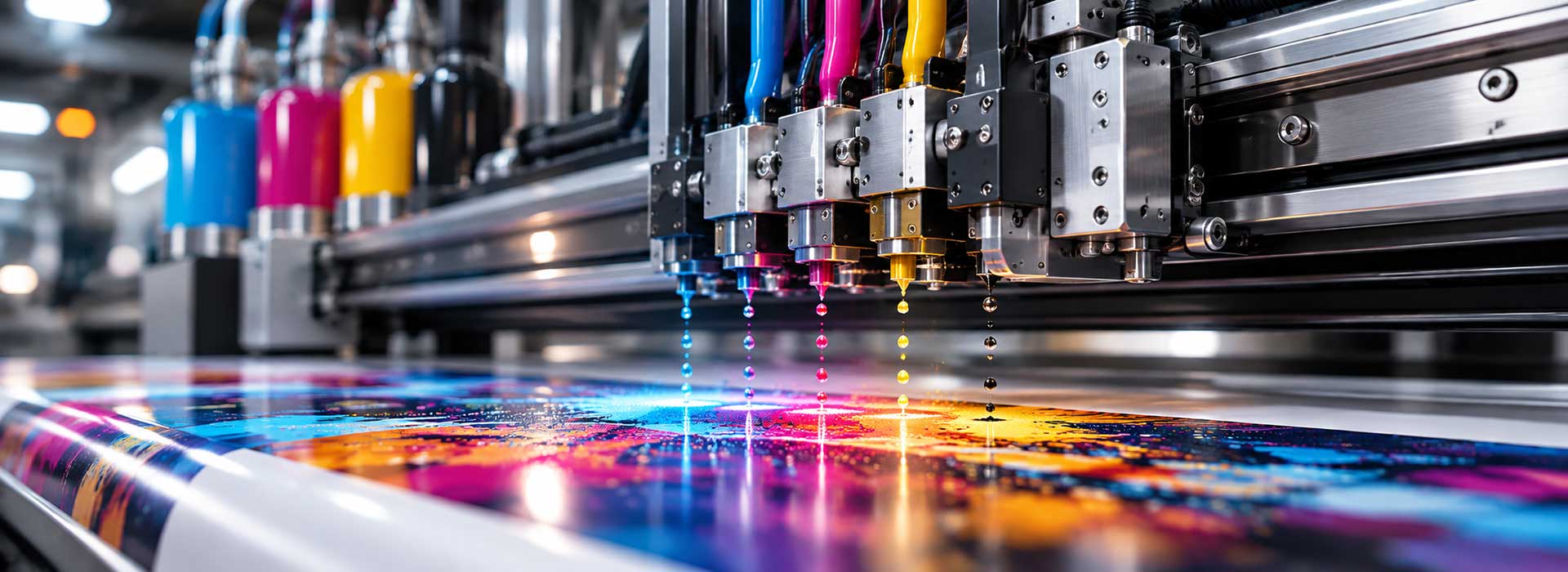
Not every food colour works in every printhead, and it is a mistake to assume that a dye qualified for one printing system will behave the same way in another. Printhead technology and the ink system built around it are usually engineered together.
THERMAL INKJET
Heat-cycled jetting
Local heating vaporises a thin ink layer to eject each droplet, so the dye and carrier are repeatedly exposed to brief high temperatures — thermal stability under cycling matters more here than in piezo systems.
PIEZOELECTRIC INKJET
Mechanically actuated jetting
A piezoelectric element deforms to eject the droplet without heating the fluid, generally easier on heat-sensitive dyes but more sensitive to viscosity and particle-size consistency for reliable droplet formation.
INDUSTRIAL INKJET
Continuous, high-throughput lines
Runs for extended periods at production scale, which raises the bar for storage stability, filtration life and batch-to-batch consistency compared with short print runs.
DESKTOP EDIBLE PRINTERS
Lower-volume, consumer-facing units
Typically use cartridge-based systems with their own viscosity and particle tolerances, and are usually qualified against a specific ink product rather than an open colourant choice.
The wider edible-ink market illustrates this point directly. Sun Chemical, for example, offers separate edible inkjet ink lines engineered for different viscosity ranges and printhead types — a low-viscosity line, a high-viscosity line, and a mid-viscosity line developed specifically for piezo printheads such as certain Ricoh digital printhead models. The existence of distinct product lines for distinct viscosity and printhead combinations is itself the evidence that colourant and carrier choices are printhead-specific decisions, not general-purpose ones.
Regulatory documentation
A complete documentation package is what turns a colourant evaluation into a defensible sourcing decision, and it matters more in inkjet applications than in most food colour purchases because the finished ink, not just the dye, ultimately needs to be defensible to a customer or regulator.
- Certificate of Analysis (CoA) specific to the batch supplied
- Safety Data Sheet (SDS/MSDS)
- Technical Data Sheet (TDS) covering solubility, strength and physical form
- Specification sheet with purity/assay parameters
- Regulatory status documentation for the destination market and food category
- Batch traceability supporting recall or investigation if needed
- Heavy-metal specification data
- Microbiological requirements, where the application calls for them
- Halal / Kosher certification, where relevant to the end market
- Country-specific regulatory assessment for each export destination
REGULATORY NOTE
A food-grade colourant being acceptable for food use does not automatically mean that a finished ink formulation is compliant for every food-printing application or every country. Current edible-ink manufacturers are explicit on this point: the finished application and the destination country’s legislation must be evaluated in their own right, not inferred from the colourant’s approval status alone. Regulations vary by colourant, product category and destination market — verify current requirements before commercial use.
Need batch-specific CoAs and specification sheets to start qualifying a water-soluble dye for your ink system?
Frequently asked questions
Is any food-approved dye automatically suitable for inkjet ink?
No. Food approval confirms the dye is permitted for consumption; it says nothing about the dye’s solubility behaviour at ink concentration, its filterability, or its compatibility with a specific carrier and printhead. Each candidate dye needs formulation-level qualification before use in an ink.
What dosage or loading level should be used for a food dye in inkjet ink?
This depends entirely on the specific dye’s colour strength, the carrier system, the target optical density and the printhead’s viscosity tolerance, so there is no single figure that applies across formulations. Loading should be set through bench trials with a working margin below the dye’s solubility limit.
Can water-soluble dyes and lake pigments be used in the same ink?
They are generally treated as separate formulation routes because a dissolved dye and a dispersed pigment behave differently under filtration, storage and jetting. Combining them in one ink is possible in principle but requires its own compatibility and stability testing rather than assuming both behave as they do individually.
Why does a dye that looks stable on the bench still cause problems in production?
Bench evaluation is often done at low volumes, short timeframes and without the shear and filtration a production line applies. Batch-to-batch variation, extended storage, and repeated pumping and filtration can reveal solubility or stability issues that a short bench test does not.
What documentation should be requested for a food dye intended for inkjet use?
At minimum, a batch-specific Certificate of Analysis, a Safety Data Sheet, a technical data sheet with solubility and particle information where relevant, and confirmation of regulatory status for the destination market. Halal or Kosher documentation should be requested separately where the end application requires it.
Does a food-approved dye guarantee that the finished ink is compliant?
No. A dye’s food approval covers the dye itself; the finished ink formulation, its intended food-contact application and the destination country’s legislation all need separate evaluation before the ink can be considered compliant for a given use.
Can Advik Colors supply water-soluble food dyes for inkjet ink development?
Advik Colors manufactures and exports a range of synthetic food dyes, including water-soluble straight colours, blends and lake forms, and supports ink formulators with technical documentation and sample quantities for qualification work.
Qualifying a dye for your next ink batch?
Advik Colors supplies water-soluble synthetic food dyes and lake colours for industrial manufacturers, including ink formulators working in food-contact and edible-print applications, with batch-specific documentation to support qualification.
Advik Colors manufactures and exports synthetic colours for industrial applications. Information on this page is provided for industry professionals and general technical guidance. Regulatory permissions and maximum usage levels vary by colourant, application and destination market — verify current requirements for your specific formulation and market before commercial production.