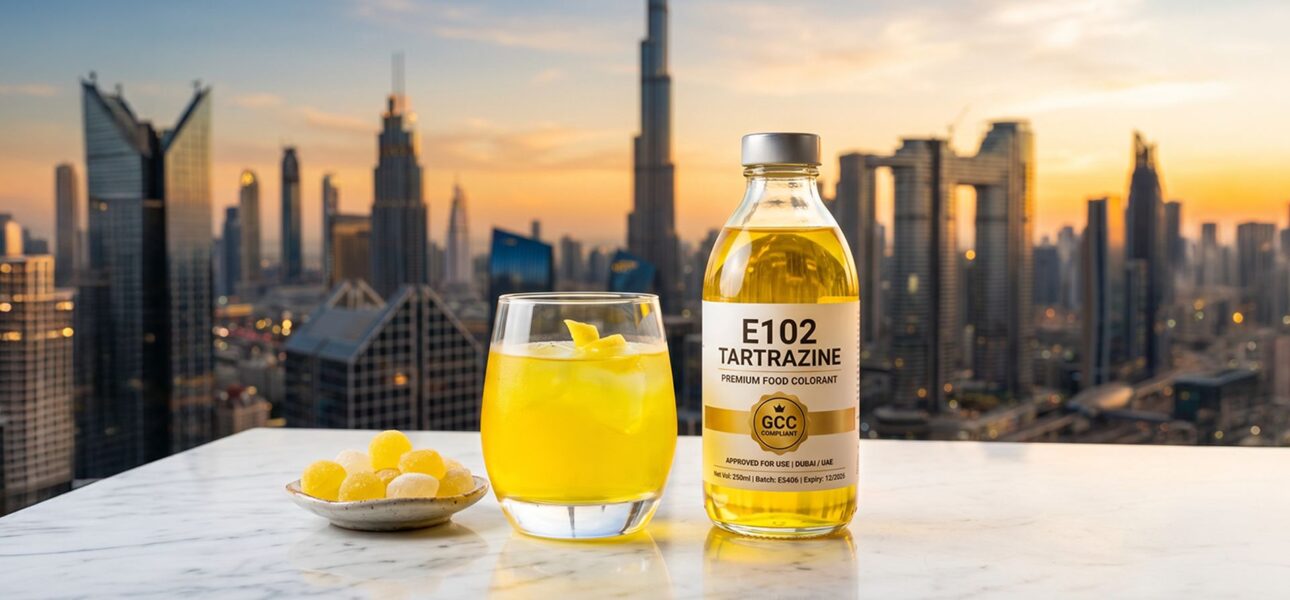
No — Tartrazine (E102) is not banned in the UAE. It is legally permitted under guidelines set by the Emirates Authority for Standardization and Metrology (ESMA). However, it is strictly regulated: all products must declare “Tartrazine” or “E102” on labels, and items marketed to children require a specific adverse-effect warning. Skipping these rules can lead to shipment holds, fines, or product recalls.
If you’re importing food or working with food colours in the UAE — especially in Dubai — you’ve probably noticed regulations tightening. There’s a lot of confusion online about whether tartrazine is restricted, banned, or freely allowed. The short answer: it’s allowed, but with a strict rulebook. This guide walks you through everything — the UAE regulations, import documentation, labelling obligations, and clean-label alternatives — so you can stay compliant and competitive in one of the Gulf’s most lucrative food markets.
What Is Tartrazine (E102)?
Definition
Tartrazine (also called E102 or FD&C Yellow No. 5) is a synthetic azo dye derived from petroleum. It produces a vivid lemon-yellow colour used in food, pharmaceuticals, and cosmetics. It is one of the most widely used synthetic food dyes globally.
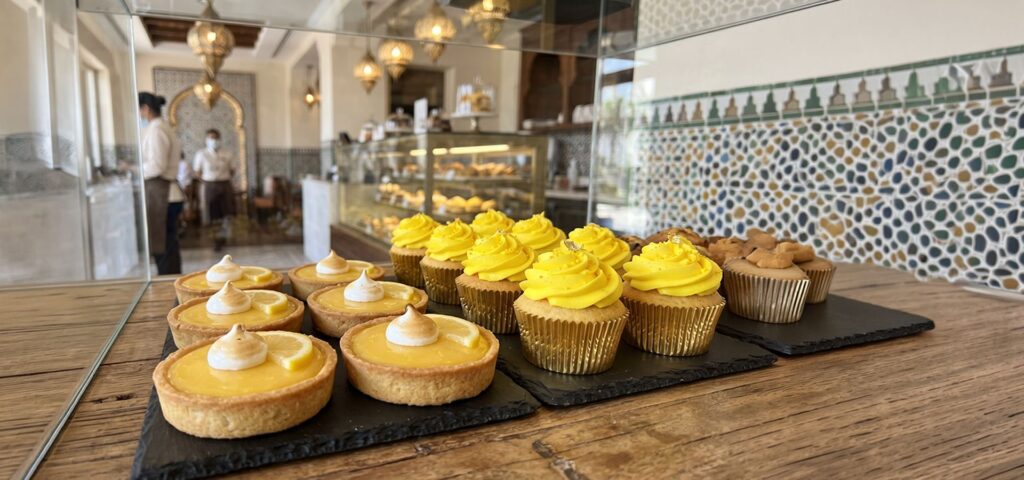
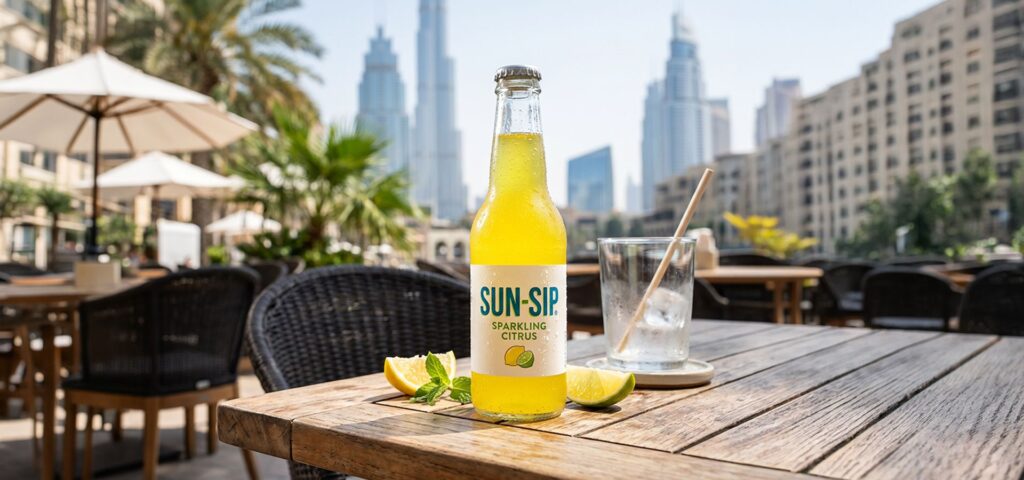
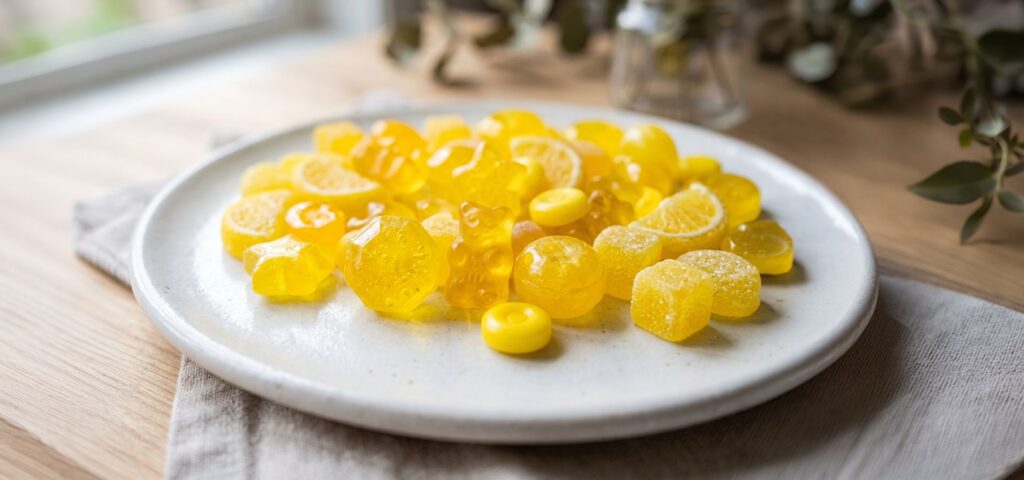
You’ll find it in soft drinks, sweets, custard powders, flavoured rice mixes, instant noodles, chewing gum, and even toothpaste and pharmaceutical tablets. Its appeal to manufacturers is straightforward: it’s inexpensive, highly stable under heat and light, and delivers a consistent, bright colour across batches.
Why Is It Under Scrutiny?
A growing body of research links E102 to allergic reactions in sensitive individuals — including skin rashes, asthma-like symptoms, and hives. More significantly, studies have associated tartrazine (combined with other synthetic dyes) with increased hyperactivity in children, prompting regulators worldwide to impose stricter controls.
⚠️ Health Note
Research, including a landmark UK Food Standards Agency study, found a statistically significant link between certain synthetic dyes (including E102) and hyperactivity in children. This evidence directly informed UAE child-product labelling requirements.
Is Tartrazine Allowed in the UAE? The Exact Regulation
Yes — tartrazine is permitted in the UAE under guidelines governed by ESMA (Emirates Authority for Standardization and Metrology) and enforced by Dubai Municipality. It is not on any UAE prohibited additives list. But “permitted” doesn’t mean unrestricted.
✅ UAE Legal Status: Permitted with Conditions
Tartrazine (E102) may be used in food products sold in the UAE, provided manufacturers follow usage limits, mandatory labelling declarations, and child-product warning requirements.
The UAE’s food standards align closely with international frameworks — particularly those of the Codex Alimentarius and the Gulf Standardization Organization (GSO). Permitted levels and usage categories mirror those recommended by EFSA and Codex, though local enforcement by Dubai Municipality and UAE customs can be stringent.
UAE Labelling Requirements for Tartrazine
Getting your label right is non-negotiable. Here’s exactly what UAE food labelling laws require for any product containing E102:
01 Declare “Tartrazine” or “E102” in the ingredients list — not hidden as a generic “colour” or “food dye.”
02 If the product is marketed to children, include the warning: “May have an adverse effect on activity and attention in children.”
03 Labels must appear in both Arabic and English as required by UAE consumer protection standards.
04 The additive’s functional class (e.g., “colour”) must appear alongside its name or E-number in the ingredient declaration.
🚨 Common Mistake
Listing only “colour (E102)” without spelling out “Tartrazine” or “colour (Tartrazine)” is insufficient under Dubai’s labelling standards. Both the E-number and/or common name must be unambiguously declared. Ambiguous labelling is one of the top reasons shipments are held at UAE ports.
Import Documentation: What Dubai Customs Requires
If you’re shipping food products containing tartrazine into the UAE, Dubai Municipality and customs authorities typically require the following before clearance:
📋 Full Ingredient Breakdown — a complete declaration of all additives, including their E-number, source, and concentration.
🔬 Certificate of Analysis (COA) — a batch-specific lab report confirming the type and quantity of colour additives used.
🛡️ Proof of Safety Clearance — certification from a recognised authority such as the FDA (US), EFSA (EU), or FSSAI (India) confirming the additive is food-grade.
🏷️ Compliant Label Proof — artwork or label copy confirming that E102 is properly declared and any required warnings are present.
Failing to provide complete documentation has real consequences: shipments held at Jebel Ali Port, goods returned to origin at the importer’s cost, or financial penalties. Given the volume of food imports through Dubai, inspections are thorough and regulators are not lenient with documentation gaps.
Natural & Synthetic Alternatives to Tartrazine for the UAE Market
Whether you’re future-proofing your formulations, responding to retailer pressure for clean labels, or simply looking to reduce regulatory complexity, the UAE market offers several strong alternatives to E102.
Natural Yellow Colour Alternatives (UAE-Approved)
Curcumin (E100)
Extracted from turmeric. Delivers a warm golden-yellow. Widely used in sauces, snacks, and beverages. Broadly accepted across UAE, EU, and FDA frameworks.
Beta-Carotene (E160a)
Sourced from carrots and sweet potatoes. Offers a yellow-to-orange hue. Popular in dairy, margarine, and beverage applications. Excellent heat stability.
Saffron Extract
Premium natural yellow from Crocus sativus. Higher cost but a strong premium brand signal. Ideal for health-focused and high-end product lines in the Gulf.
Annatto (E160b)
Derived from achiote seeds. Gives a yellow-to-orange tone. Common in cheese, spreads, and baked goods. A cost-effective natural option for bulk manufacturers.
Sunset Yellow FCF (E110)
Synthetic, UAE-permitted. Offers a similar hue to tartrazine. Also requires proper E-number labelling. Suitable where synthetic formulations are still preferred.
Custom Lake Blends
Oil-dispersible and water-soluble blended colours engineered for specific applications — ideal for high-heat, high-light, or long-shelf-life products.
Tartrazine vs. Alternatives: Side-by-Side Comparison
| Colour / E-Number | Type | UAE Status | Child Warning? | Stability | Cost Range |
|---|---|---|---|---|---|
| Tartrazine (E102) | Synthetic | 👍 Permitted (regulated) | Yes — mandatory | Excellent | Low |
| Curcumin (E100) | Natural | ✅ Approved | No | Moderate | Low–Med |
| Beta-Carotene (E160a) | Natural | ✅ Approved | No | Good | Medium |
| Annatto (E160b) | Natural | ✅ Approved | No | Good | Low–Med |
| Saffron Extract | Natural | ✅ Approved | No | Moderate | High |
| Sunset Yellow (E110) | Synthetic | 👍 Permitted (regulated) | Yes — mandatory | Excellent | Low |
Market Trends: UAE’s Shift Toward Clean Label Colours
The UAE food and beverage market is undergoing a clear structural shift. Urban consumers — particularly in Dubai and Abu Dhabi — are reading ingredient labels more carefully than ever before and actively avoiding artificial dyes. This isn’t a passing trend: it reflects a broader GCC-wide clean label movement that is reshaping purchasing behaviour, retailer expectations, and supplier requirements.
Major Dubai-based retailers and food service chains now actively prefer suppliers offering natural or E-number-free alternatives. For importers, the calculus is shifting: staying compliant is necessary, but going natural is increasingly becoming a competitive advantage.
💡 Strategic Insight for Importers
Brands that proactively switch from synthetic dyes like tartrazine to approved natural alternatives are gaining shelf priority with premium UAE retailers — often without needing to compete on price alone.
Frequently Asked Questions
Can you use Tartrazine (E102) in food products in the UAE?
Yes. Tartrazine (E102) is permitted for use in food products in the UAE under ESMA guidelines. However, manufacturers must clearly declare its presence on product labels, and child-targeted products require a specific adverse-effect warning. Compliance is mandatory — not optional.
What is E102 food colour and is it allowed in the UAE?
E102, also known as Tartrazine, is a synthetic lemon-yellow azo dye widely used in the food and beverage industry. In the UAE, E102 is legally approved under regulated limits. Importers and manufacturers must declare it on labels in compliance with Gulf Standardization Organization (GSO) and ESMA food safety standards.
What labelling is required for Tartrazine products in Dubai?
Dubai’s food labelling laws require that products containing Tartrazine explicitly state “Tartrazine” or “E102” in the ingredient list — generic terms like “colour” or “artificial colour” are insufficient. For products marketed to children, you must add: “May have an adverse effect on activity and attention in children.” Labels must be in both Arabic and English.
What documents do I need to import Tartrazine-containing products into Dubai?
Dubai Municipality and UAE customs typically require: a complete ingredient breakdown declaring all additives, a Certificate of Analysis (COA) for the relevant product batch, proof of safety clearance from a recognised authority (FDA, EFSA, or FSSAI), and compliant label artwork showing correct E102 declaration and any required warnings.
What are the best natural alternatives to Tartrazine in the UAE market?
UAE-approved natural yellow alternatives include Curcumin (E100) from turmeric, Beta-Carotene (E160a) from carrots and sweet potatoes, Saffron Extract for premium applications, and Annatto (E160b) from achiote seeds. These require no child-safety warning, align with clean-label positioning, and are broadly accepted by major UAE retailers.
Is Tartrazine a natural or synthetic food colour?
Tartrazine is a fully synthetic (artificial) food dye manufactured from petroleum-derived compounds. Unlike natural colorants such as turmeric (curcumin) or beta-carotene, it offers superior heat stability and colour uniformity — which is why it remains common in industrial food processing despite growing consumer preference for natural alternatives.
Stay Compliant. Stay Competitive.
Whether you need certified E102 products, natural alternatives like curcumin or beta-carotene, or full regulatory documentation support for the UAE market — Advik Colors has you covered.