
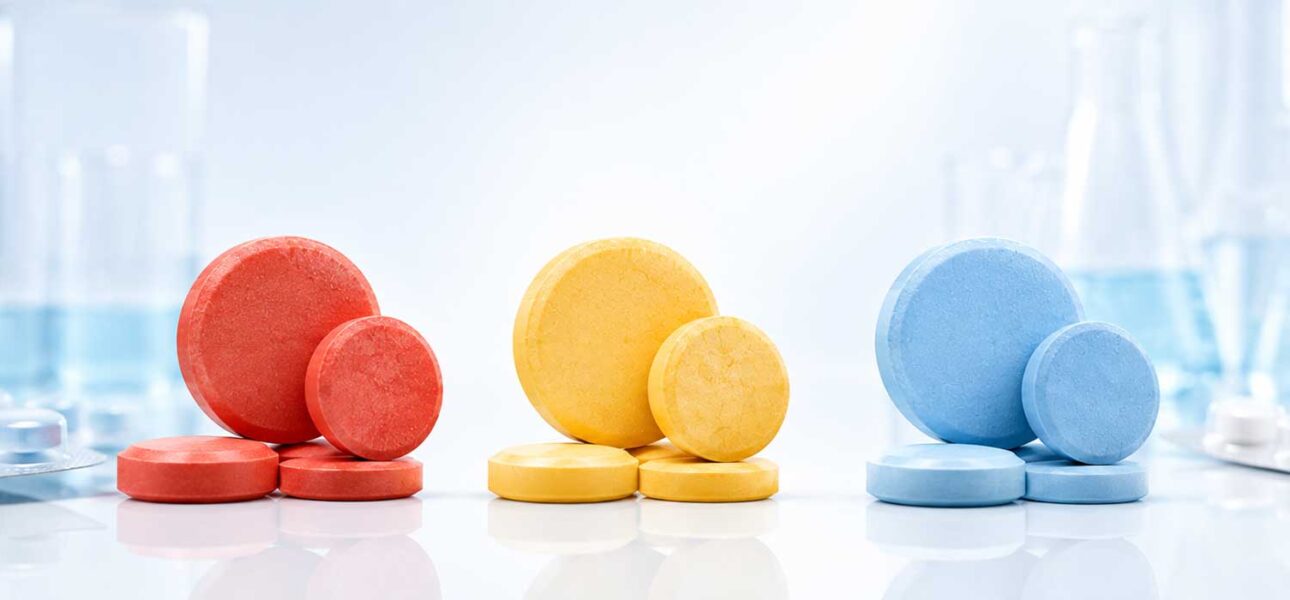
Pharmaceutical tablet colors play a critical role in product identification, regulatory compliance, and formulation performance. This technical guide compares the major red, yellow, and blue colorants by C.I. number, solubility class, stability, and regulatory status so you can select the right shade for your application.
When choosing pharmaceutical tablet colors, the most widely specified options include FD&C Red 40 (Allura Red, C.I. 16035), FD&C Yellow 5 (Tartrazine, C.I. 19140), and FD&C Blue 1 (Brilliant Blue, C.I. 42090) — all dual-approved for food, drug, and cosmetic use in the US, heat- and light-stable, and available as both water-soluble dyes and organic lakes. The right pick still depends on your dosage form, target market, and whether you need an opaque coating or a translucent liquid tint — the full comparison is below.
| Shade | C.I. No. | Category | Best For | US Status |
|---|---|---|---|---|
| FD&C Red 40 | 16035 | Water-soluble / Lake | Coatings, syrups — default red | Food, Drug, Cosmetic |
| FD&C Red 3 | 45430 | Water-soluble / Lake | Bright pink-red, light-sensitive | Food, Drug, Cosmetic |
| D&C Red 33 | 17200 | Water-soluble | Deep red, drug & cosmetic only | Drug, Cosmetic |
| FD&C Yellow 5 | 19140 | Water-soluble / Lake | Default yellow, needs label declaration | Food, Drug, Cosmetic |
| FD&C Yellow 6 | 15985 | Water-soluble / Lake | Warmer yellow-orange alternative | Food, Drug, Cosmetic |
| D&C Yellow 10 | 47005 | Water-soluble / Lake | EU-standard yellow (Quinoline Yellow) | Drug, Cosmetic |
| FD&C Blue 1 | 42090 | Water-soluble / Lake | Most stable pharma blue | Food, Drug, Cosmetic |
| FD&C Blue 2 | 73015 | Water-soluble / Lake | Deeper blue, lower light stability | Food, Drug, Cosmetic |
| Patent Blue V | 42051 | Water-soluble / Lake | EU-preferred blue | Drug, Cosmetic |
Know Your Shade? Request a Sample Now.
Every colorant above ships with a Certificate of Analysis and full C.I. traceability. Tell us your dosage form and target market — we’ll confirm the right grade.
How to Choose Between Red, Yellow & Blue for Your Tablet
When selecting pharmaceutical tablet colors, three variables narrow the field faster than color preference alone: dosage-strength differentiation, colorant form, and regulatory status.
Match the Shade to Dosage-Strength Signaling
If your product line uses color to differentiate dosage strengths — a common informal convention — pick shades with enough visual separation between them that patients and pharmacists can tell strengths apart at a glance. A pale yellow and a pale orange sitting next to each other on a shelf invite exactly the confusion you’re trying to prevent. See why color consistency matters for patient trust for the full reasoning.
Match the Solubility Class to Your Formulation
The same shade name exists in more than one chemical form. A red tablet coating and a red oral syrup are not using the same physical product, even if both are labeled “FD&C Red 40” — one is a lake pigment, the other a water-soluble dye. Specifying the wrong form is the single most common sourcing mistake at this stage.
Check Regulatory Status Before You Commit to a Shade
“FD&C” and “D&C” are not interchangeable designations. FD&C colors are approved for food, drug, and cosmetic use in the US; D&C colors are approved for drug and cosmetic use only — not food. If your product could ever be classified or co-marketed as a food or dietary supplement in a food-regulated category, this distinction determines which shades are even eligible.
Best Red Shades for Pharmaceutical Tablets
Among red pharmaceutical tablet colors, FD&C Red 40 offers one of the strongest combinations of stability, cost efficiency, and regulatory reach.
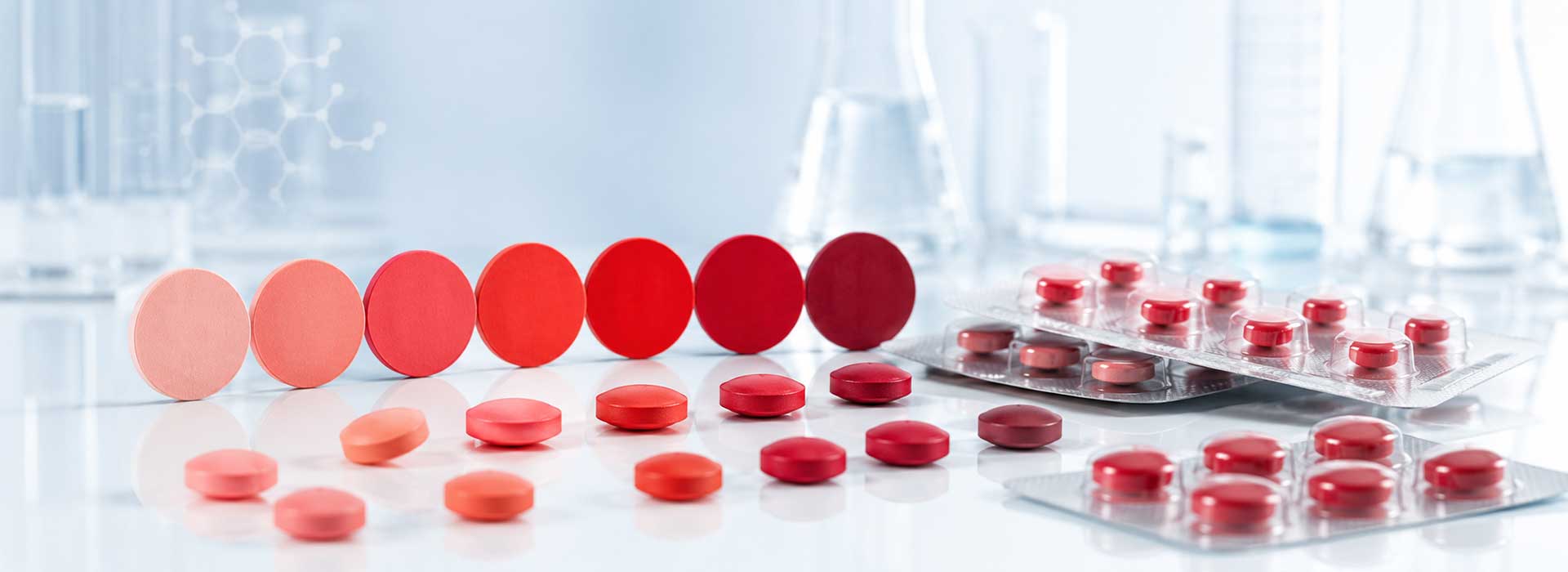
FD&C Red 40 (Allura Red) — The Industry Standard
Color Index: 16035 · Water-soluble & Lake
The default red for tablet coatings and oral liquids alike. Excellent heat and light stability, dual food/drug/cosmetic approval in the US, and available in both dye and lake form — which is why it’s the shade most manufacturers reach for first before evaluating alternatives.
FD&C Red 3 (Erythrosine) — Bright, Light-Sensitive
Color Index: 45430 · Water-soluble & Lake
A brighter, more pink-leaning red than Allura Red, useful where a cooler red tone is needed. It’s more light-sensitive, so it suits opaque coatings or light-protected packaging better than translucent, long-shelf-life products.
D&C Red 33 / D&C Red 27 / D&C Red 28 — Deeper, Coating-Grade Reds
Color Index: 17200 / 45410 / 45410 · Water-soluble, Lake & Solvent-soluble
Drug-and-cosmetic-only reds (not food-approved) that offer deeper, more saturated shades for coatings and capsules where an FD&C designation isn’t required. Available across water-soluble, lake, and solvent-soluble forms depending on the exact grade.
Carmoisine & Amaranth — For EU and Non-US Markets
Color Index: 14720 / 16185 · Water-soluble & Lake
Neither is FDA-approved for use in the US, but both are widely accepted across the EU and other markets. If you manufacture for export, confirm which red is approved in the destination market before locking a shade across your whole product line.
Best Yellow Shades for Pharmaceutical Tablets
For yellow pharmaceutical tablet colors, regulatory requirements can influence the decision just as much as shade preference. Yellow carries the most regulatory nuance of the three hues — the choice between FD&C Yellow 5, FD&C Yellow 6, and D&C Yellow 10 is rarely just a matter of shade preference.
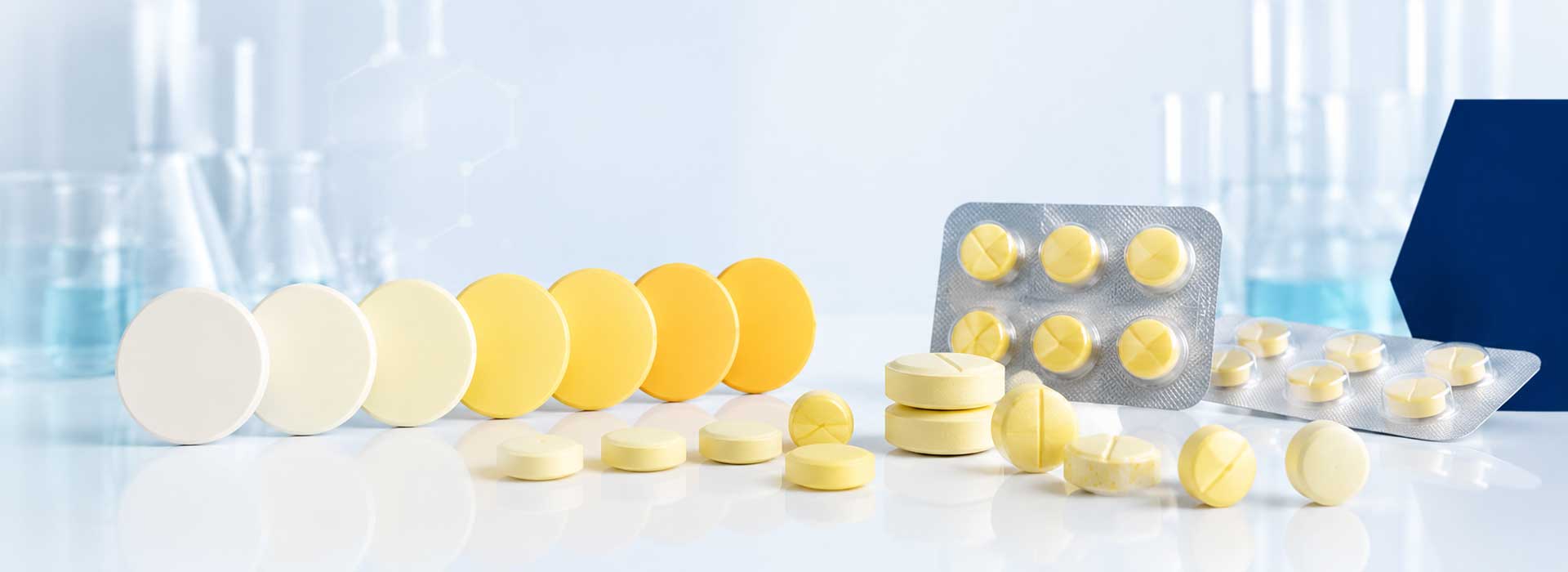
FD&C Yellow 5 (Tartrazine) — Most Widely Used, With a Labeling Catch
Color Index: 19140 · Water-soluble & Lake
The most common pharma yellow, but the one exception to “just pick the FD&C shade”: US labeling rules require FD&C Yellow 5 to be declared by name on the product label, separately from a general “artificial color” listing, due to sensitivity in a small subset of the population. This doesn’t restrict its use — it’s a documentation step to plan for, not a blocker.
FD&C Yellow 6 (Sunset Yellow) — Allergen-Label-Free Alternative
Color Index: 15985 · Water-soluble & Lake
A warmer, more orange-leaning yellow without the Yellow 5 labeling requirement. Frequently substituted in where a manufacturer wants to avoid the separate declaration without sacrificing FD&C-level regulatory reach.
D&C Yellow 10 (Quinoline Yellow) — Why It’s EU-Standard But Not FDA Oral-Approved
Color Index: 47005 · Water-soluble & Lake
Quinoline Yellow is the standard yellow across EU pharmaceutical formulations (E104), and in the US it’s approved for drug and cosmetic use — but as a “D&C” color, it is not approved for food. This is a genuinely easy mistake to make when specifying a single yellow across a multi-market product line: confirm the exact designation matches your product’s regulatory category in each market before you standardize on it.
Best Blue Shades for Pharmaceutical Tablets
Blue pharmaceutical tablet colors offer fewer commercially practical choices than red or yellow, making stability and target market the main selection criteria.
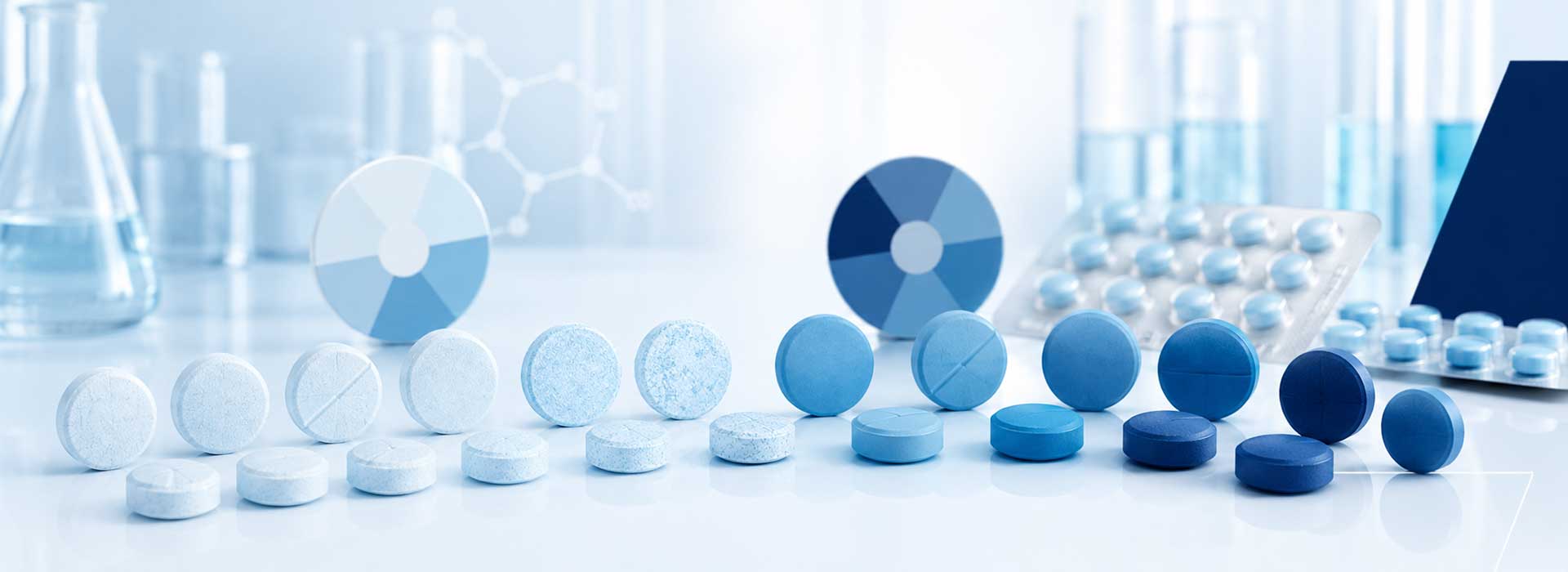
FD&C Blue 1 (Brilliant Blue) — The Most Stable Pharma Blue
Color Index: 42090 · Water-soluble & Lake
The default choice for most tablet coatings — the most light-stable blue available, dual food/drug/cosmetic approved, and available as both a dye and a lake for opaque coating work.
FD&C Blue 2 (Indigotine) — Deeper Blue, Lower Light Stability
Color Index: 73015 · Water-soluble & Lake
Produces a deeper, more purple-leaning blue than Blue 1, but fades faster under light exposure. Better suited to opaque coatings or shorter-shelf-life products than to translucent or long-shelf-life ones.
Patent Blue V — The EU-Preferred Blue
Color Index: 42051 · Water-soluble & Lake
Not FDA-approved for use in the US, but a standard choice across EU pharmaceutical formulations. Relevant if your target market is Europe rather than, or in addition to, the US.
9
Shades compared across red, yellow, blue
3
Colorant forms — water-soluble, lake, solvent
FD&C
vs D&C — the designation that decides eligibility
1
C.I. number per shade, always traceable
Water-Soluble vs. Lake vs. Solvent-Soluble: Which Form Do You Need?
The performance of pharmaceutical tablet colors depends not only on the shade but also on the physical form of the colorant. Once you’ve picked a hue, the form matters as much as the shade name. Match it to your dosage form’s continuous phase:
Syrups & Solutions
Water-Soluble
Dissolves fully for a uniform, transparent tint. The only correct choice for any aqueous liquid dosage form.
Tablets & Capsules
Organic Lake
Insoluble pigment dispersed for opaque, batch-stable color. Built for coatings, capsules, and dry blends.
Film Coats & Inks
Solvent-Soluble
For non-aqueous systems — certain film coatings and tablet-branding inks where neither water nor a lake dispersion fits.
For the full reasoning behind why the wrong form causes migration, bleeding, or uneven distribution, see how pharma colorants actually work.
Regulatory Checklist Before You Order
Before approving pharmaceutical tablet colors for commercial production, verify the C.I. number, target-market approval, batch documentation, and any labeling obligations.
- Color Index (C.I.) traceability — confirm the exact C.I. number on the Certificate of Analysis matches the shade you specified.
- Market-specific approval — FD&C vs. D&C in the US; separate approval lists for EU, IP, BP, and USP markets. Never assume a shade approved in one market clears another.
- Certificate of Analysis, every batch — request a COA tied to the same tested specification for every shipment, not just the first sample.
- Labeling obligations — check whether your chosen shade (like FD&C Yellow 5) carries a mandatory label declaration in your target market.
How to Request Samples & Specify Your Shade
When sourcing pharmaceutical tablet colors, give your supplier four pieces of information: dosage form, target market, required shade, and required colorant form.
- Identify your dosage form — tablet coating, capsule, syrup, or film coat — this determines whether you need a lake, a water-soluble dye, or a solvent-soluble color.
- Confirm your target market — US, EU, or another region — this narrows the shade list to what’s actually approved for your product category there.
- Request a sample and COA — ask for a Certificate of Analysis alongside any physical sample so your QA team can verify C.I. number, purity, and heavy-metal limits before approval.
- Lock the specification — document the final shade, C.I. number, form, and supplier lot on your formulation record so every future batch is ordered against the same spec.
Frequently Asked Questions
What are the most commonly used pharmaceutical tablet colors?
FD&C Red 40 (C.I. 16035), FD&C Yellow 5 (C.I. 19140), and FD&C Blue 1 (C.I. 42090) are the most widely used shades globally — heat- and light-stable, dual-approved for food, drug, and cosmetic use in the US, and available in both water-soluble and lake form.
Does FD&C Yellow 5 require a warning label?
In the US, products containing FD&C Yellow 5 must declare it by name on the label, separate from a general “artificial color” listing, because a small subset of the population is sensitive to it. This is a declaration requirement, not a restriction on use.
Can I use D&C Yellow 10 in the US?
Yes, for drug and cosmetic applications — that’s exactly what “D&C” means. D&C colorants are approved for drug and cosmetic use in the US but not for food. Confirm the designation matches your product category before specifying it.
What’s the difference between FD&C Blue 1 and FD&C Blue 2?
FD&C Blue 1 is more light-stable and is the default for most tablet coatings. FD&C Blue 2 produces a deeper, more purple-leaning blue but fades faster under light, so it suits opaque coatings or shorter-shelf-life products better than translucent or long-shelf-life ones.
How do I choose between water-soluble, lake, and solvent-soluble colorant forms?
Match the form to your dosage form’s continuous phase: water-soluble for syrups and solutions, organic lakes for tablet coatings and capsules, and solvent-soluble colors for film coatings and other non-aqueous applications.
How do I choose pharmaceutical tablet colors for different dosage strengths?
Use clearly separated shades that patients and pharmacists can distinguish quickly, then confirm that each selected colorant is suitable for the dosage form and approved in the target market.
Ready to Source
Get Your Shade, Backed by a COA.
Advik Colors supplies pharmaceutical tablet colors in water-soluble, lake, and solvent-soluble forms, with C.I. traceability and batch documentation for your QA requirements.