
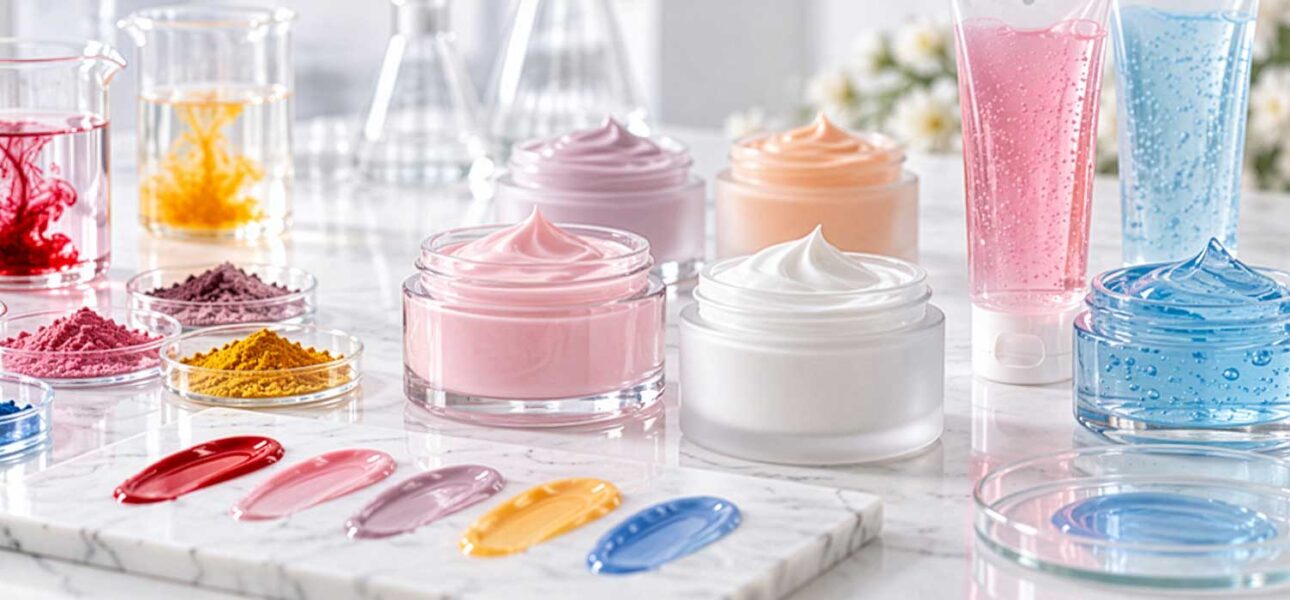
Every cosmetic-grade lake pigment used as colors for skincare creams and gels, plus the water-soluble dyes that tint clear gels — C.I. numbers, dispersion behavior, stability factors, and sourcing guidance. Twelve pigments. One reference.
| System | Base Type | Solubility | Status |
|---|---|---|---|
| Lake Pigments | Opaque creams, emulsions | Insoluble, dispersed | ✓ Cosmetic-Grade |
| Water-Soluble Dyes | Clear / translucent gels | Fully soluble | ✓ Cosmetic-Grade |
| Oil-Soluble Dyes | Oil phase of emulsions | Soluble in oil | ✓ Cosmetic-Grade |
Choosing colors for skincare creams and gels comes down to one structural question before shade ever enters the picture: is the base an opaque emulsion or a clear gel? Creams need a pigment that disperses without dissolving; gels need a dye that dissolves without dispersing. Get that wrong and no amount of shade-matching fixes it.
This guide is a complete reference to colors for skincare creams and gels — the cosmetic-grade lake pigments Advik Colors supplies for creams, and the water-soluble dyes for gels, each with C.I. numbers, dispersion and stability behavior, and sourcing guidance drawn from supplying both categories to cosmetic manufacturers.
What Makes a Pigment Cosmetic-Grade
Cosmetic-grade colors for skincare creams and gels are synthetic organic pigments and dyes reviewed under FDA color additive regulations for drug and cosmetic use, covering dermal sensitization and safety at the concentrations used in leave-on and rinse-off products. The aluminum lake form precipitates a water-soluble parent dye onto an insoluble alumina substrate, producing oil-dispersible, migration-resistant particles engineered for emulsion-based cream and lotion bases — the opposite of what a water-soluble dye does in a clear gel.
Jump to a Pigment
- 🟥 D&C Red 6 Na Salt — C.I. 15850
- 🟥 D&C Red 21 Al Lake — C.I. 45380:3
- 🟥 D&C Red 22 Al Lake — C.I. 45430:1
- 🟥 D&C Red 27 Al Lake — C.I. 45410:2
- 🟪 D&C Red 33 Al Lake — C.I. 17200:1
- 🟧 D&C Red 36 — C.I. 12085
- 🟥 FD&C Red 40 Al Lake — C.I. 16035:1
- 🟨 FD&C Yellow 5 Al Lake — C.I. 19140:1
- 🟧 FD&C Yellow 6 Al Lake — C.I. 15985:1
- 🟨 D&C Yellow 10 Al Lake — C.I. 47005:1
- 🟦 FD&C Blue 1 Al Lake — C.I. 42090:2
✓ Cosmetic-Grade Widely Used
🟥 D&C Red 6 Na Salt
C.I. 15850 · Azo · Sodium Salt
Colour Character
A warm red with strong tinting strength — the shade most tinted-cream formulators reach for first when a warm, blush-toned red is needed, from tinted moisturizers to color-correcting creams.
Behavior in Cream Bases
Disperses evenly in an emulsion when properly milled, with good resistance to color migration. As a general rule for this pigment class, warm azo lakes hold their shade well under typical cream storage conditions.
Dispersion ●●●●●○ · pH Stability ●●●●●○ · Light Stability ●●●●●○
Best for: Warm-toned tinted creams, BB/CC bases, and blush-toned corrective creams where a reliable, well-characterized warm red is the priority.
✓ Cosmetic-Grade Light-Test Recommended
🟥 D&C Red 21 Al Lake
C.I. 45380:3 · Xanthene · Aluminum Lake
Colour Character
A bright mid-red with a fluorescent optical quality — appears more vivid than non-fluorescent reds at the same loading, useful for gel-cream hybrids that want visible brightness at a low dose.
Behavior in Cream Bases
Delivers strong color payoff at low loading. Xanthene-class lakes like this one are generally more light-sensitive than azo lakes, so light-fastness testing in your actual packaging is worth doing before launch.
Dispersion ●●●●●○ · pH Stability ●●●●○○ · Light Stability ●●●○○○
Best for: Low-loading brightness in tinted gels and gel-creams; a small addition alongside a primary lake shifts perceived vibrancy without changing the base hue much.
✓ Cosmetic-Grade
🟥 D&C Red 22 Al Lake
C.I. 45430:1 · Xanthene · Aluminum Lake
Colour Character
A cool pink-red — the workhorse shade for pink-toned creams and gel blushes, sitting between a true red and a mauve without leaning too warm or too cool.
Behavior in Cream Bases
Good dispersibility in typical emulsion bases. Moderate light stability, so pair with opaque or tinted packaging where possible rather than a fully clear jar.
Dispersion ●●●●●○ · pH Stability ●●●●○○ · Light Stability ●●●○○○
Best for: Cool-pink tinted creams and gel blushes; often paired with D&C Red 33 Al Lake to soften toward a dustier mauve-pink.
✓ Cosmetic-Grade High Stability
🟥 D&C Red 27 Al Lake
C.I. 45410:2 · Xanthene · Aluminum Lake
Colour Character
A deep, cool red with high chroma — the go-to pigment for berry-toned correcting creams and richer tinted formulas that need depth without turning brown or muddy.
Behavior in Cream Bases
Strong aluminum-lake bonding gives good migration resistance at higher loadings, which matters more in deeper, more pigmented formulas where a weaker lake bond would show separation over time.
Dispersion ●●●●●○ · pH Stability ●●●●○○ · Light Stability ●●●○○○
Best for: Berry-toned correcting creams and deeper tinted formulas; note it shares its C.I. designation with D&C Red 28 Al Lake but is a distinct, cooler-red preparation.
✓ Cosmetic-Grade
🟪 D&C Red 33 Al Lake
C.I. 17200:1 · Azo · Aluminum Lake
Colour Character
A muted mauve-pink that works better as a shade modifier than a standalone color — used in small amounts to shift a base cream toward a dustier, more neutral pink.
Behavior in Cream Bases
Good dispersibility. Since it’s typically used at low addition rates rather than as the primary pigment, minor stability variance matters less than it would for a dominant shade.
Dispersion ●●●●●○ · pH Stability ●●●●○○ · Light Stability ●●●○○○
Best for: Shade adjustment toward dusty rose or nude-mauve tones — added at a low percentage alongside a primary lake rather than used alone.
✓ Cosmetic-Grade
🟧 D&C Red 36
C.I. 12085 · Insoluble Azo
Colour Character
A warm orange-red that provides the orange warmth a straight red lake can’t deliver alone — useful for bronzing creams and warm-undertone tinted formulas.
Behavior in Cream Bases
Good dispersibility from its insoluble azo structure. As with other orange-leaning pigments generally, confirm light stability against your specific packaging before a large production run.
Dispersion ●●●●○○ · pH Stability ●●●●○○ · Light Stability ●●●○○○
Best for: Bronzing and warm-undertone tinted creams; often blended with a yellow lake for a fuller warm-coral direction.
✓ Cosmetic-Grade Widely Used
🟥 FD&C Red 40 Al Lake
C.I. 16035:1 · Azo · Aluminum Lake
Colour Character
A bright, true red with broad regulatory reach as both an FD&C and D&C-eligible shade — the default red most formulators test first before evaluating narrower alternatives.
Behavior in Cream Bases
Reliable dispersion and generally good heat and light stability, which is a large part of why it’s the most broadly specified red lake across cosmetic categories.
Dispersion ●●●●●○ · pH Stability ●●●●●○ · Light Stability ●●●●●○
Best for: The default red for most tinted cream and emulsion formulas; a safe first choice before evaluating the more specialized reds above.
✓ Cosmetic-Grade Widely Used
🟨 FD&C Yellow 5 Al Lake
C.I. 19140:1 · Azo Pyrazolone · Aluminum Lake
Colour Character
A clean warm yellow, the default yellow lake for warming a base cream’s undertone or building bronzer and warm-corrective shades.
Behavior in Cream Bases
Disperses reliably and holds its tone well in typical emulsion conditions, which is why it’s the most commonly reached-for yellow across cosmetic categories broadly.
Dispersion ●●●●○○ · pH Stability ●●●●○○ · Light Stability ●●●●○○
Best for: Warm undertone building in bronzing and self-tan-adjacent creams; a base component in most warm-coral custom blends.
✓ Cosmetic-Grade
🟧 FD&C Yellow 6 Al Lake
C.I. 15985:1 · Azo · Aluminum Lake
Colour Character
A warmer, more orange-leaning yellow than FD&C Yellow 5 — the shade to reach for when a cream needs a deeper amber-gold warmth rather than a clean lemon tone.
Behavior in Cream Bases
Similar dispersion and stability profile to FD&C Yellow 5, with the practical advantage of not carrying the specific labeling considerations that apply to Yellow 5 in some regulatory frameworks.
Dispersion ●●●●○○ · pH Stability ●●●●○○ · Light Stability ●●●●○○
Best for: Deeper amber-gold warmth in bronzing creams; frequently substituted for Yellow 5 where a formulator wants to avoid a separate label declaration.
✓ Cosmetic-Grade
🟨 D&C Yellow 10 Al Lake
C.I. 47005:1 · Quinoline · Aluminum Lake
Colour Character
A greenish-yellow, distinct from the warmer FD&C yellows — useful for color-correcting creams that need to neutralize purple or red undertones rather than add warmth.
Behavior in Cream Bases
Reasonable dispersion in standard emulsion systems. As with other Al Lake pigments in this class, confirm pH stability against your specific base since correcting creams often skew toward the more acidic end of the range.
Dispersion ●●●●○○ · pH Stability ●●●○○○ · Light Stability ●●●●○○
Best for: Color-correcting creams needing a greenish-yellow neutralizing tone; a standard yellow across EU cosmetic formulations generally.
✓ Cosmetic-Grade High Stability
🟦 FD&C Blue 1 Al Lake
C.I. 42090:2 · Triarylmethane · Aluminum Lake
Colour Character
A bright, clean blue — rarely used at full strength in skincare, but essential in small amounts for color-correcting creams that neutralize redness, and for violet/plum shade development.
Behavior in Cream Bases
Generally one of the more light-stable lakes in common use, which suits it well to redness-correcting creams that are frequently sold in clear or lightly tinted packaging.
Dispersion ●●●●○○ · pH Stability ●●●●○○ · Light Stability ●●●●●○
Best for: Redness-neutralizing color-correcting creams at low loading; violet/plum shade development paired with a red lake.
Lake Pigments for Skincare Creams — Master Comparison Table
All twelve lake pigments used most often as colors for skincare creams and gels, compared side by side.
| Shade | C.I. No. | Hue | Dispersion | pH Stab. | Light Stab. | Best Application |
|---|---|---|---|---|---|---|
| 🟥 Red 6 Na Salt | 15850 | Warm Red | ●●●●●○ | ●●●●●○ | ●●●●●○ | Warm tinted creams |
| 🟥 Red 21 Al Lake | 45380:3 | Mid-Red (Fluor.) | ●●●●●○ | ●●●●○○ | ●●●○○○ | Low-load brightness |
| 🟥 Red 22 Al Lake | 45430:1 | Cool Pink | ●●●●●○ | ●●●●○○ | ●●●○○○ | Pink creams, gel blush |
| 🟥 Red 27 Al Lake | 45410:2 | Deep Cool Red | ●●●●●○ | ●●●●○○ | ●●●○○○ | Berry correcting creams |
| 🟪 Red 33 Al Lake | 17200:1 | Mauve Pink | ●●●●●○ | ●●●●○○ | ●●●○○○ | Nude/mauve modifier |
| 🟧 Red 36 | 12085 | Orange-Red | ●●●●○○ | ●●●●○○ | ●●●○○○ | Bronzing creams |
| 🟥 Red 40 Al Lake | 16035:1 | True Red | ●●●●●○ | ●●●●●○ | ●●●●●○ | Default cream red |
| 🟨 Yellow 5 Al Lake | 19140:1 | Warm Yellow | ●●●●○○ | ●●●●○○ | ●●●●○○ | Warm undertone building |
| 🟧 Yellow 6 Al Lake | 15985:1 | Orange-Yellow | ●●●●○○ | ●●●●○○ | ●●●●○○ | Amber-gold bronzing |
| 🟨 Yellow 10 Al Lake | 47005:1 | Green-Yellow | ●●●●○○ | ●●●○○○ | ●●●●○○ | Color-correcting |
| 🟦 Blue 1 Al Lake | 42090:2 | Blue | ●●●●○○ | ●●●●○○ | ●●●●●○ | Redness-correcting |
Water-Soluble Dyes — Colors for Skincare Gels
Everything above is a lake pigment, built for an opaque emulsion. Clear or translucent gels need the opposite: a colorant that dissolves fully rather than dispersing as a particle, which is why the water-soluble side of colors for skincare creams and gels looks nothing like the lake pigment list above. Advik Colors supplies these on the personal and home care colors range — a representative sample of the shades used for gel tinting:
| Shade | C.I. No. | Color Family |
|---|---|---|
| FD&C Yellow 5 | 19140 | Yellow |
| FD&C Red 40 | 16035 | Red |
| D&C Red 22 | 45380 | Red |
| FD&C Blue 1 | 42090 | Blue |
| D&C Green 5 | 61570 | Green |
The full water-soluble and oil-soluble range runs well beyond these five — see the complete list on the personal and home care colors page.
Request samples of any colors for skincare creams and gels covered here, with full CoA data. View our complete cosmetic color range →
Application Conditions That Affect Your Choice
Picking a shade is the easy part. Whether colors for skincare creams and gels stay true on the shelf depends on how well they’re matched to these conditions.
Formulation
Emulsion vs. Gel Base
An opaque cream calls for a dispersed lake; a clear gel calls for a dissolved dye. This decides the system before shade enters the picture.
Formulation
pH Range
Skincare formulas often sit around pH 4.5–6.5. Some colorants shift or precipitate outside their tested range.
Formulation
Emulsifier Compatibility
Emulsifier systems interact differently with a given lake or dye — test in your actual base, not a generic reference formula.
Formulation
Preservative & Active Interactions
Preservatives and actives like vitamin C or retinoids can degrade color faster than expected — prioritize documented resistance.
Storage
Temperature & Shelf Life
Heat accelerates color degradation. Validate stability at real storage and transport temperatures, not just room temperature.
Packaging
Light Exposure
Clear jars and tubes expose the formula to continuous UV and visible light — the single biggest driver of fading.
Regulatory Framework — Cosmetic Color Approvals
Every lake pigment profiled in this guide is reviewed for drug and cosmetic use in the US under the FDA’s list of color additives permitted for cosmetic use. Each shade also carries a standardized Colour Index (C.I.) number — the international reference maintained by the Society of Dyers and Colourists — which is what your regulatory documentation should always cite alongside the D&C/FD&C name.
Regional Approval — What to Verify
Approval status for colors for skincare creams and gels varies by region and by specific colorant. US approval under FDA color additive regulations does not automatically confer EU approval, and vice versa. Confirm current status with your supplier for each destination market before locking a formula.
Sourcing — The 5-Variable CoA Standard
The C.I. number identifies which pigment or dye you’re ordering. It doesn’t tell you how it will perform in your formula. These five variables — all of which should appear on every batch CoA — determine whether your sourced colors for skincare creams and gels deliver the strength, stability, and consistency commercial production requires.
The 5-Variable CoA Standard
- Pigment/dye content % — determines color strength per gram and loading requirement.
- Particle size distribution (for lakes) — determines dispersion quality and speckling risk.
- Stability data for your base type — heat, pH, and preservative compatibility specific to emulsions or gels.
- Moisture content — affects batch weight calculations.
- Heavy-metal compliance — lead, arsenic, cadmium, mercury at cosmetic-grade limits.
A supplier who cannot provide all five on one document per batch is a risk, not a specification.
Working with a colors for skincare creams and gels manufacturer that documents the same content and particle-size specification at sample and commercial volume matters — the most common sourcing failure is a quality gap between sample and commercial supply that only surfaces after a production commitment.
Frequently Asked Questions
What colors are used in skincare creams and gels?
The most common colors for skincare creams and gels split by base type: creams typically use lake pigments — insoluble, dispersed colorants such as D&C Red 27 Al Lake or FD&C Yellow 5 Al Lake — because they hold up in an opaque emulsion base. Skincare gels, which are usually clear or translucent, typically use water-soluble dyes like FD&C Red 40 or D&C Red 22 instead.
Are synthetic colors in skincare products safe?
Synthetic colorants used in skincare creams and gels are subject to cosmetic-specific regulatory review in most markets, and reputable suppliers provide safety data sheets and documentation for each shade. Approval status varies by region and by colorant, so confirm current status with your supplier for your target market.
Why does color fade or migrate in a cream or gel over time?
Fading is usually caused by light exposure in clear jars or tubes, pH drift in the formulation, or interaction with active ingredients and preservative systems. Lake pigments can also show visible speckling if they aren’t milled and dispersed finely enough during manufacturing.
Can lake pigments and water-soluble dyes be combined in one formulation?
Yes. Some cream-gel hybrid formulas use a water-soluble dye to tint the aqueous phase alongside a lake pigment for opacity or a decorative shimmer effect, provided both are tested together for compatibility and stable dispersion over the product’s shelf life.
What CoA data should I request when sourcing colors for skincare creams and gels?
Ask for five things on every batch: pigment or dye content percentage, particle size distribution (for lakes), stability data specific to your base type, moisture content, and heavy-metal compliance limits. A supplier who cannot provide all five on one document per batch is a risk, not a specification.
For Cosmetic Formulators & Brand Owners
Request Colors for Skincare Creams and Gels — With Full CoA Data
Lake pigments and water-soluble dyes, sourced from the same specification at sample and commercial volume, with regulatory documentation on every batch.