
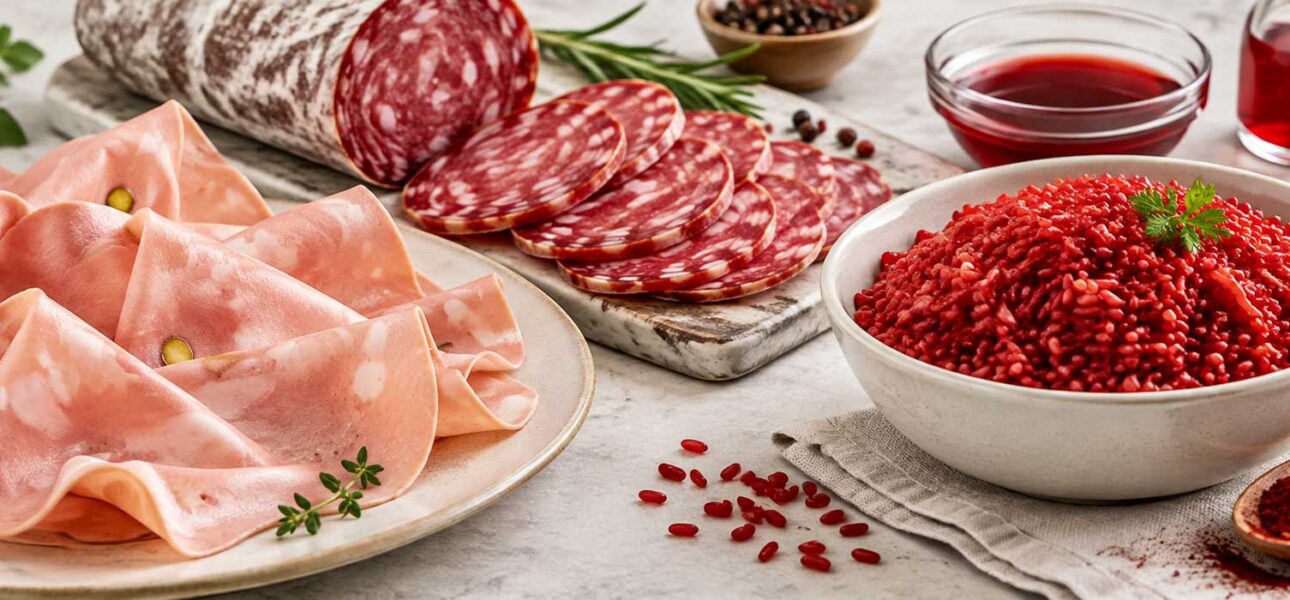
Mortadella, salami, and red rice don’t share a category on paper, but they share the same commercial headache: the color a customer expects doesn’t happen on its own, and whatever gets it there has to survive a process that actively works against it.
Mortadella loses shade to heat. Salami loses it to weeks of fermentation, smoking, and drying. Red rice loses it to uneven surface contact or, if you’re working with red yeast rice, to a completely different fermentation process that gets confused with simple dyeing more often than it should. This guide covers what color to use for mortadella, salami, and red rice — what holds up in each one, what doesn’t, and what the halal, kosher, and export paperwork actually requires.
| Product | What mainly holds the color | Biggest risk point |
|---|---|---|
| Mortadella | Nitrite-myoglobin cure reaction, topped up with a small added colorant | Internal cook temperature |
| Salami | Same cure reaction, carried through a much longer process | Fermentation pH drop, smoking, and weeks of drying |
| Dyed red rice | Water-soluble dye applied to the grain surface or cooking water | Incomplete dissolution or uneven grain contact |
| Red yeast rice | Natural pigment produced by Monascus fermentation itself | Fermentation conditions, not a dye at all |
The short answer
For mortadella, the color mostly comes from the sodium nitrite cure reaction with myoglobin, topped up with a synthetic red like Ponceau 4R or Allura Red AC, or with beet red where a natural-source claim matters. For salami, that same cure-driven color has to additionally survive fermentation, smoking, and a long dry cycle, which is why synthetic dyes and lakes are the more predictable choice over natural pigments for anything beyond the base cure color. For red rice, the answer splits in two: dyed rice takes a water-soluble food dye applied to the grain surface or cooking water, while red yeast rice is a different product entirely, colored by the Monascus fermentation itself rather than by an added dye. None of these should use carmine or cochineal if the product needs a halal or kosher claim. Both are insect-derived and excluded from either certification.
Why these three belong in one guide
Mortadella, salami, and red rice sit in three different aisles, but the underlying question a processor is asking is identical: what color survives this specific process without drifting, fading, or failing an audit. The processes are different enough that the same colorant rarely works across all three at the same dosage, but the diagnostic approach is the same in every case.
| Product | The problem | Why |
|---|---|---|
| Mortadella | The heat problem | A single cook cycle at high internal temperature is the main risk. The failure shows up immediately, at the cook, not later on shelf. |
| Salami | The time problem | Fermentation, smoking, and weeks of drying give color far longer to drift, fade, or react with pH change than a cooked product ever sees. |
| Red rice | The contact problem | Dyed rice fails on uneven surface contact, not colorant stability. Red yeast rice fails when it’s treated as a dye application rather than a fermentation product. |
| All three | The certification problem | Halal, kosher, and multi-market export status get decided by the colorant choice as much as by the shade — it’s the detail most often caught late. |
Color for mortadella
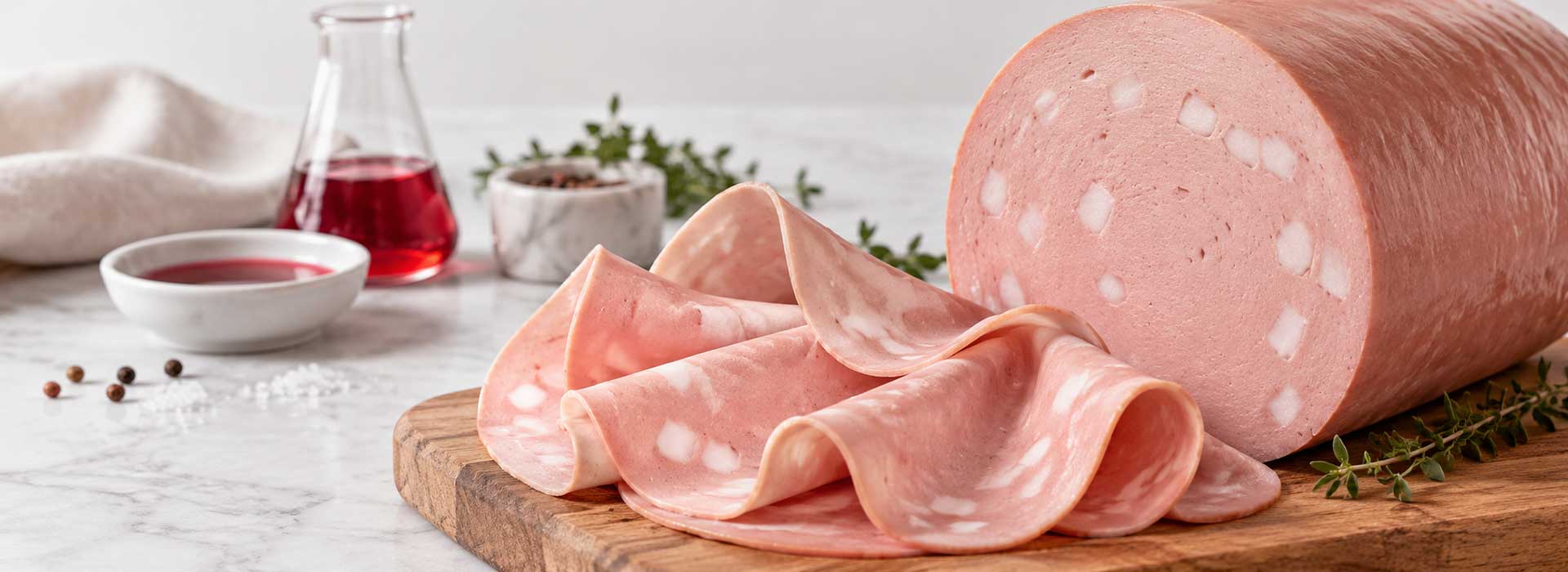
Mortadella’s characteristic pale pink comes primarily from the nitrite-myoglobin cure reaction, not from an added colorant. Most formulations add a small amount of color on top of that cure reaction to standardize the shade across batches and correct for natural variation in the meat itself. The choice of what to add depends on the cook temperature, the certification the brand needs, and whether the emulsion carries much fat.
| Colorant | Process stage | Heat behavior | Halal / kosher |
|---|---|---|---|
| Synthetic red dye or lake (Ponceau 4R, Allura Red AC) | Added during emulsion blending, before stuffing and cooking | Holds shade through typical cook temperatures without visible fade | Not excluded by default; check the specific certifying body’s list |
| Beet red (betanin) | Added during blending; use level typically runs higher than a synthetic dye | More heat-sensitive; confirm stability at your cook temperature first | Plant-derived; generally compatible |
| Cochineal carmine | Added during blending; strong tinting strength at low use levels | Good heat stability, historically common in cured meat | Insect-derived; excluded from both regardless of dosage |
If mortadella comes out grey or brown after cooking: check the cure reaction itself first, not the added color. Grey-brown mortadella almost always means the nitrite cure didn’t fully develop, or the colorant broke down at the cook’s actual internal temperature rather than the temperature on its spec sheet.
Color for salami
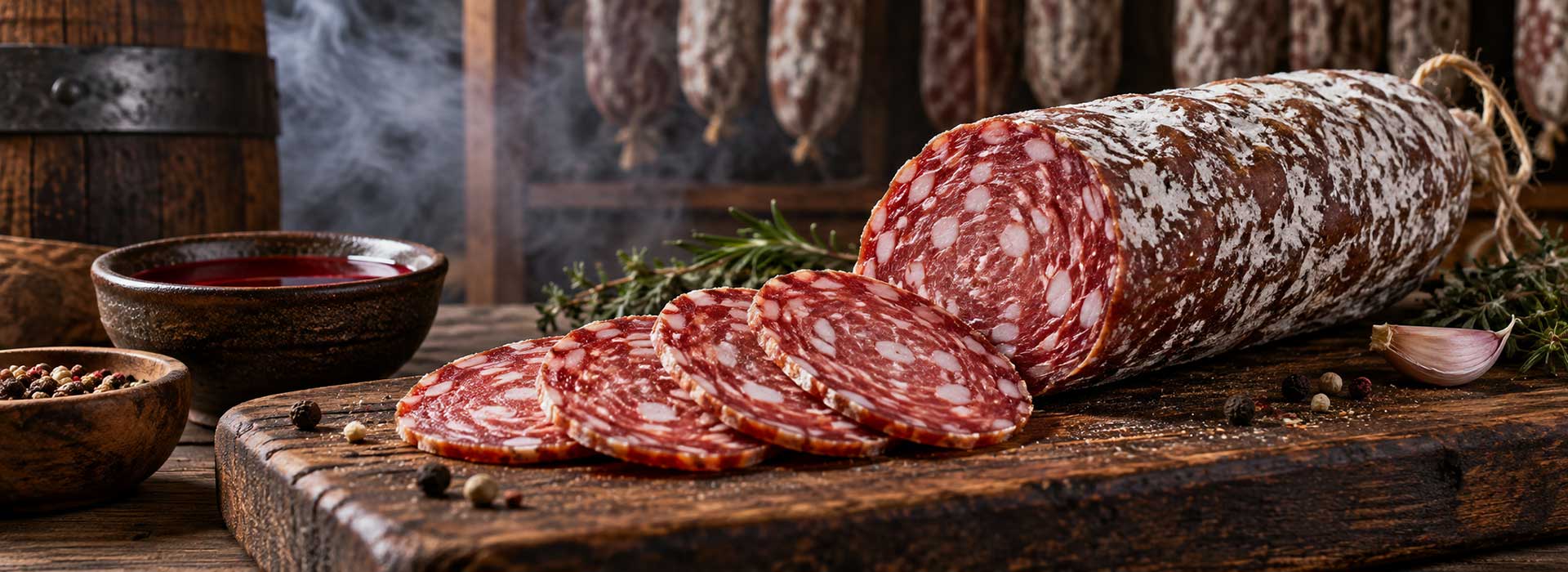
Salami asks more of a colorant than mortadella does, because the product sits through fermentation, a pH drop, often smoking, and then weeks of controlled drying before it ever reaches a shelf. Whatever holds the color has to survive all of that, not just a single cook.
| Factor | Synthetic dyes & lakes | Natural pigments |
|---|---|---|
| Fermentation (pH drop) | More predictable through the acid drop than most natural pigments | Usable, but needs trial-batch confirmation across the full cycle |
| Smoking & drying | Hold shade through extended drying without significant fade | More prone to shade drift over a multi-week dry cycle |
| Fat-rich matrix | Lake form disperses well in salami’s fat content | Higher use levels typically needed for the same intensity |
| Batch consistency | Doesn’t depend on raw material season | Useful where a naturals claim outweighs the stability risk |
As with mortadella, most of the visible red in a properly cured salami comes from the nitrite reaction. An added colorant reinforces and standardizes that shade; it doesn’t substitute for a cure that hasn’t developed properly. Confirm cure time and nitrite dosage before troubleshooting the colorant itself.
Color for red rice
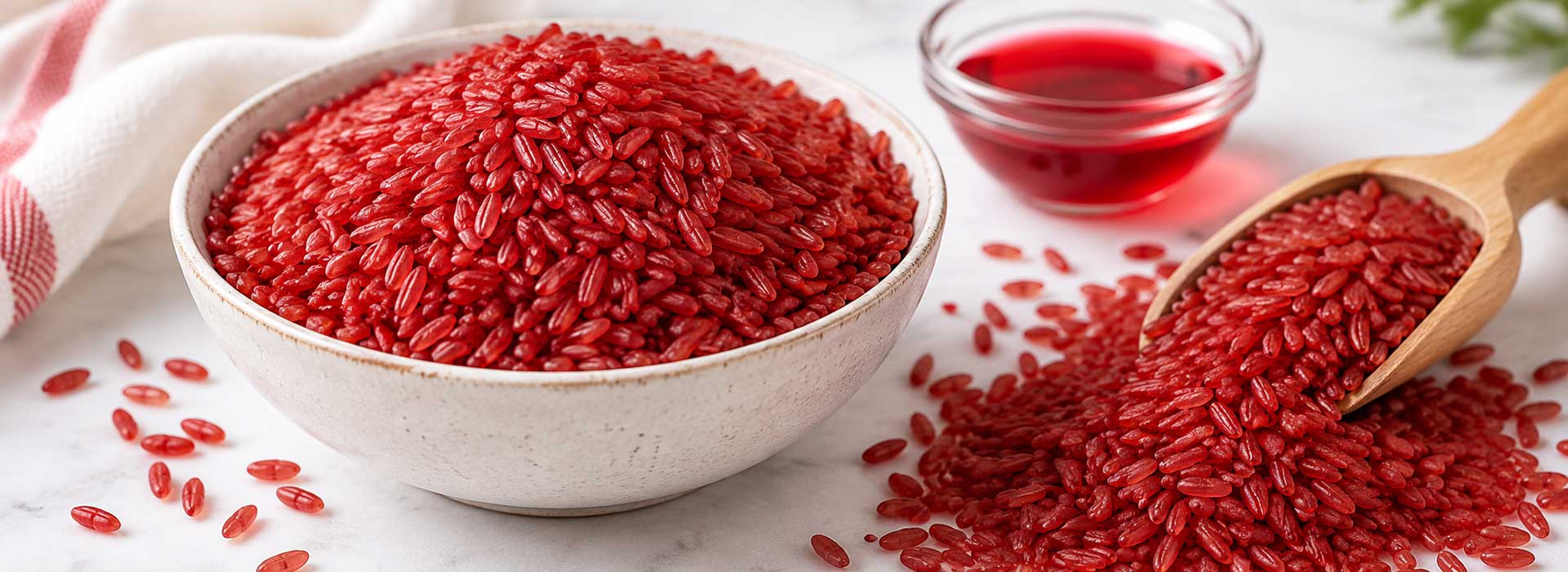
“Red rice” covers two genuinely different products, and mixing them up is the most common mistake we see at the inquiry stage.
Dyed or colored red rice is plain rice with a food-grade colorant applied to the grain surface or introduced through the cooking or soaking water, typically for a retail or festive product. Red yeast rice is rice fermented with the mold Monascus purpureus, which produces its own natural red pigment as part of the fermentation itself. It isn’t dyed in the conventional sense. The color is a byproduct of the fermentation process, and it shows up as an ingredient in some Asian cured meats and rice dishes as much as a colorant in its own right.
| Aspect | Dyed rice | Red yeast rice |
|---|---|---|
| Process stage | Colorant fully dissolved in water first, then applied by soaking, misting, or tumbling before drying | Color develops during fermentation itself; not applied afterward |
| Typical colorants | Water-soluble synthetic dyes for bright shades; beet red or annatto for a naturals claim | Not applicable; the pigment is a fermentation product, not an additive |
| Common failure | Patchy or uneven color, almost always incomplete dissolution or uneven grain contact | Inconsistent fermentation conditions — a process question, not a dosage error |
Halal & kosher status
This is the detail that most often surfaces after a formulation is already locked in, and it’s expensive to fix late. Cochineal and carmine are extracted from the dried bodies of the cochineal insect. That origin excludes both from halal and kosher certification regardless of purity, processing method, or how the finished product is labeled. If a mortadella or salami line needs either certification, the red has to come from a synthetic dye or lake, a plant-derived pigment such as beet red or paprika extract, or another non-animal source.
The safest sequence is to confirm the certification requirement first, then shortlist colorants that clear it, rather than picking a shade and discovering the conflict during a certification audit.
Color to Use for Mortadella, Salami, Red Rice – Regulatory reference by region
A colorant’s approval status and permitted dosage are set separately in each market, even for the same molecule. Confirm the current limit for your specific product category and destination market before finalizing a formulation.
| Colorant | Common use | Typical regulatory basis |
|---|---|---|
| Ponceau 4R (INS 124) | Mortadella, salami red tones | FSSAI approved; EU-permitted with warning label requirements; restricted in some non-EU markets |
| Allura Red AC (INS 129) | Mortadella, dyed red rice | FSSAI approved; EU-permitted with Southampton Six warning label; Codex GSFA listed |
| Carmoisine (INS 122) | Mortadella, salami | FSSAI approved; EU-permitted with warning label requirements |
| Beet red / betanin (INS 162) | All three categories, naturals claim | Broadly permitted across FSSAI, EU, and Codex; check category-specific limits |
| Cochineal / carmine (INS 120) | Historically mortadella, salami | Permitted as a colorant in most markets, but excludes halal/kosher and carries allergen labeling requirements in several jurisdictions |
In the US, cured meat products fall under USDA/FSIS oversight rather than FDA alone, and colorant approval for meat applications should be checked against FSIS ingredient guidance specifically, not just the general FDA color additive list. In the EU, meat colorant limits sit under Regulation (EC) No 1333/2008 by food category. In India, FSSAI sets both the permitted colorant list and category-specific maximum limits. Always cross-check current limits against the Codex Alimentarius GSFA database before finalizing a formulation for export.
Documentation to request from your colorant supplier
- Batch-wise Certificate of Analysis (CoA)
- Halal and kosher certification, where the source ingredient is non-animal
- Compliance declaration for the specific INS number and food category, per destination market
- Heavy metal and purity testing data
Common failures & what actually causes them
Most complaints about color in these three products trace back to one of a handful of root causes, and the fix depends on correctly identifying which one it is.
- Mortadella turns grey or brown after cooking. Check nitrite dosage and cure time before touching the added colorant — this is almost always an incomplete cure reaction, not a failed dye.
- Salami fades unevenly over the dry cycle. Usually a natural pigment that wasn’t confirmed against the full fermentation-to-drying timeline. Re-trial with a synthetic dye or lake and compare.
- Red rice color is patchy or streaked. Almost always incomplete dissolution before application, or uneven grain contact during coating. Fix the application method before changing the colorant.
- A certified halal or kosher batch fails audit on color. Check whether carmine or cochineal is anywhere in the formulation, including in a pre-blended seasoning or base mix sourced from a third party.
Questions to ask your colorant supplier
A shade card doesn’t tell you whether a colorant will survive your specific process. Before committing to a supplier for mortadella, salami, or red rice color, ask for a Certificate of Analysis confirming CI number and purity, stability data across your actual cook, fermentation, or drying conditions, halal and kosher certification status where relevant, and a compliance statement for every market the product ships to. Advik Colors keeps this documentation on file across our personal and home care and food colorant ranges, which is worth checking regardless of who you end up sourcing from.
Frequently asked questions
What color additive is used in mortadella?
Most mortadella relies on curing color from sodium nitrite reacting with meat myoglobin, sometimes reinforced with cochineal carmine, beet red, or a synthetic red such as Ponceau 4R or Allura Red AC where local rules allow it. The choice depends on whether the brand needs a halal or kosher claim, since carmine is animal-derived and excluded from both.
Why does my mortadella turn grey or brown after cooking?
Grey-brown mortadella almost always means the nitrite cure reaction didn’t fully develop, or the added colorant broke down under the cook’s internal temperature. Confirm nitrite dosage and cure time first, then check whether the colorant you added is rated for the cook temperature you’re actually running, not just the temperature on its spec sheet.
Is carmine or cochineal extract halal or kosher for salami and mortadella?
No. Carmine and cochineal extract are insect-derived, which excludes them from both halal and kosher certification regardless of processing method. For a certified product, use a synthetic red dye or lake, beet red, or a plant-based alternative instead, and confirm the certifying body’s ingredient list before running production.
What color survives salami fermentation and drying?
Salami color has to survive a pH drop during fermentation, then weeks of drying and often smoking. Nitrite-driven cure color is the base layer; where an added colorant is used on top, synthetic dyes and lakes generally hold shade through that process more reliably than natural pigments, which tend to shift or fade over an extended dry cycle.
What is red yeast rice and is it the same as dyed red rice?
No, they’re different things. Red yeast rice is rice fermented with Monascus purpureus mold, which is itself the source of a natural red pigment used in some Asian cured meats and rice dishes. Dyed or colored red rice is plain rice with a food color applied to the grain surface or through the cooking water, typically for a retail or festive product. The two need completely different regulatory and technical approaches.
Why does red rice color come out patchy or uneven?
Patchy rice color is usually a coating or absorption problem, not a colorant defect. It happens when the dye isn’t fully dissolved before contact, when grains are added to the color bath unevenly, or when starch on the grain surface blocks even uptake. Pre-dissolving the colorant fully and tumbling or misting grains for even contact solves most cases.
Does nitrite curing fade the added color in processed meat?
Nitrite itself doesn’t fade a properly chosen added colorant. Most of the pink-red tone in cured meat already comes from the nitrite-myoglobin reaction, not the added dye, so the colorant’s job is to standardize and reinforce that shade across batches, not replace the cure reaction. Dosage should be set relative to the cure, not independent of it.
Can one colorant be used for mortadella, salami, and red rice across the US, EU, and Asian markets?
Sometimes for the same colorant, rarely at the same dosage. A dye’s regulatory status, permitted food category, and maximum limit are set separately in each market, so a level compliant in one country can exceed the limit in another even when the colorant itself is approved everywhere. Confirm the food category code and limit per destination market before finalizing a multi-market SKU.
Need the Right Red for Your Line?
Talk to Advik Colors About Mortadella, Salami & Red Rice
Send us your process — cook temperature, cure time, fermentation window, or application method — and Advik Colors will recommend a starting shade and dosage, with halal, kosher, and export documentation on file.