
Technical Formulation Guide · Hair Care Color Stability
QUICK Answer
Fragrance components destabilise colorants through five distinct mechanisms: pH shift, oxidative degradation, chelation interference, surfactant-fragrance-dye complex formation, and UV photosensitisation. A ΔE > 1.0 at 28 days accelerated storage is the signal that your color system needs to be rebuilt — not patched.
5×
Distinct fragrance–colorant interference pathways
ΔE 1.0
Industry acceptance limit at 28d accelerated storage
0.5–2%
Typical fragrance range that triggers instability review
T28
Days at 40°C/75% RH — the primary stability gate
The Fragrance Goes In. The Color Comes Out.
You’ve nailed your base. The shampoo is beautifully pigmented — a cool, translucent violet or a warm amber that looks precisely right in the bottle. Stability at 40°C passes at week two. Then the fragrance goes in. By week four, what was violet is now a muted grey-pink. What was amber now reads rust.
This is not bad luck. It is predictable chemistry — and that means it is preventable chemistry. After years of formulating color-forward hair care products and supplying cosmetic pigments to manufacturers across India and internationally, we at Advik Colors have seen this failure mode enough times to map it precisely. The five mechanisms described in this guide are the root causes behind nearly every fragrance-induced color failure we’ve encountered in our customers’ stability studies.
Hair care color stability is harder to achieve than most formulators expect when fragrance is added, and the reasons are more varied than a single pH or oxidation story. This guide breaks each mechanism apart, shows you what to look for in testing, and tells you what to do about it before your product launches.
Advik Colors Technical View
We’ve observed that the majority of color failures in hair care are not discovered during formulation — they surface during consumer complaints six months post-launch. The industry’s standard 8-week stability protocol is often treated as the finish line, when it should be a minimum floor. Fragrance-sourced colorant degradation frequently accelerates non-linearly after the eight-week window. If your ΔE is creeping toward 0.8 at week eight, it will almost certainly breach 1.0 in real-shelf time. Test longer. Launch with margin.
— Advik Colors, Formulation Technology, Surat
Mechanism 01 – pH Shift from Fragrance Acids
Mechanism 01 — Chemical
Many fragrance ingredients are organic acids — citral, benzyl benzoate, geraniol, and various terpenoid aldehydes shift the local pH of the formulation measurably. A drop of even 0.3–0.5 pH units can push a pH-sensitive colorant like D&C Yellow 11 or Direct Red 80 out of its chromophore stability window, triggering protonation or deprotonation of the azo bond and producing a permanent shade shift that spectrophotometry registers as a ΔL* or Δb* excursion.
The problem is compounded in shampoos and conditioners buffered at pH 4.5–5.5 — a range deliberately close to the instability boundary of many direct dyes.
Risk Levels
🔴 Azo Dyes — Very High (88%)
🟠 Lake Colors — Medium (55%)
🟡 Iron Oxides — Low-Medium (35%)
// Detection Protocol — pH Shift
Measure formulation pH at T0 and T28
Flag: ΔpH > 0.3 between fragrance variants
Buffer test: compare ΔE at pH 4.5 vs 5.5
Fix:  buffering with citric acid + sodium citrate
Mechanism 02 – Oxidative Degradation via Terpene Peroxides
Mechanism 02 — Oxidative
Terpenes — limonene, linalool, citronellol, and alpha-terpineol — are unstable under atmospheric oxygen. They auto-oxidise to form hydroperoxides, which then act as powerful oxidants inside your formulation. These peroxides attack the chromophore of azo direct dyes, breaking the N=N bond and bleaching the dye entirely.
Citrus-forward fragrances are the highest-risk category. We’ve seen formulations using a 1.5% citrus fragrance lose 60–70% of their initial color absorbance at 28 days accelerated simply from terpene peroxide accumulation. This is not a marginal risk — it is a launch-killing risk.
Risk Levels
🔴 Azo Dyes — Critical (95%)
🔴 Xanthene Lakes — High (72%)
🟢 Iron Oxides — Very Low (18%)
// Detection Protocol — Oxidation
Track absorbance at λmax of dye at T0/T7/T14/T28
Flag: >10% absorbance drop at T7
Chelate test: add 0.1% sodium ascorbate, retest
Fix:  BHT / BHA at 0.02–0.1%, or vitamin E TPGS
Mechanism 03 – Chelation of Metal-Coordination Pigments
Mechanism 03 — Structural
Iron oxide pigments and D&C lake colors are metal-coordinated structures. Their chromophore depends on the integrity of the Fe–O lattice (iron oxides) or the Al–dye coordination bond (lakes). Chelating agents — EDTA, citric acid, sodium phytate — that enter the formulation via fragrance compounds or appear as carry-through from fragrance manufacturing strip these metal centres.
The resulting shade drift is typically a warming or yellowing of cool-toned products, and a dulling of saturated hues. Unlike oxidative bleaching, chelation-induced drift is gradual and often missed until week four or six — well past the typical preliminary stability read.
Risk Levels
🔴 Iron Oxides — High (78%)
🔴 Lake Colors — High (65%)
🟢 Direct Dyes — Low (22%)
// Detection Protocol — Chelation
Request GC-MS + EDTA assay on fragrance sample
Flag: citric acid > 0.05% in fragrance compound
Compare ΔE with & without chelant in base
Fix:  counter-chelant at controlled ratio (MgSO4)
Mechanism 04 – Surfactant–Fragrance – Dye Complex Formation
Mechanism 04 — Colloidal
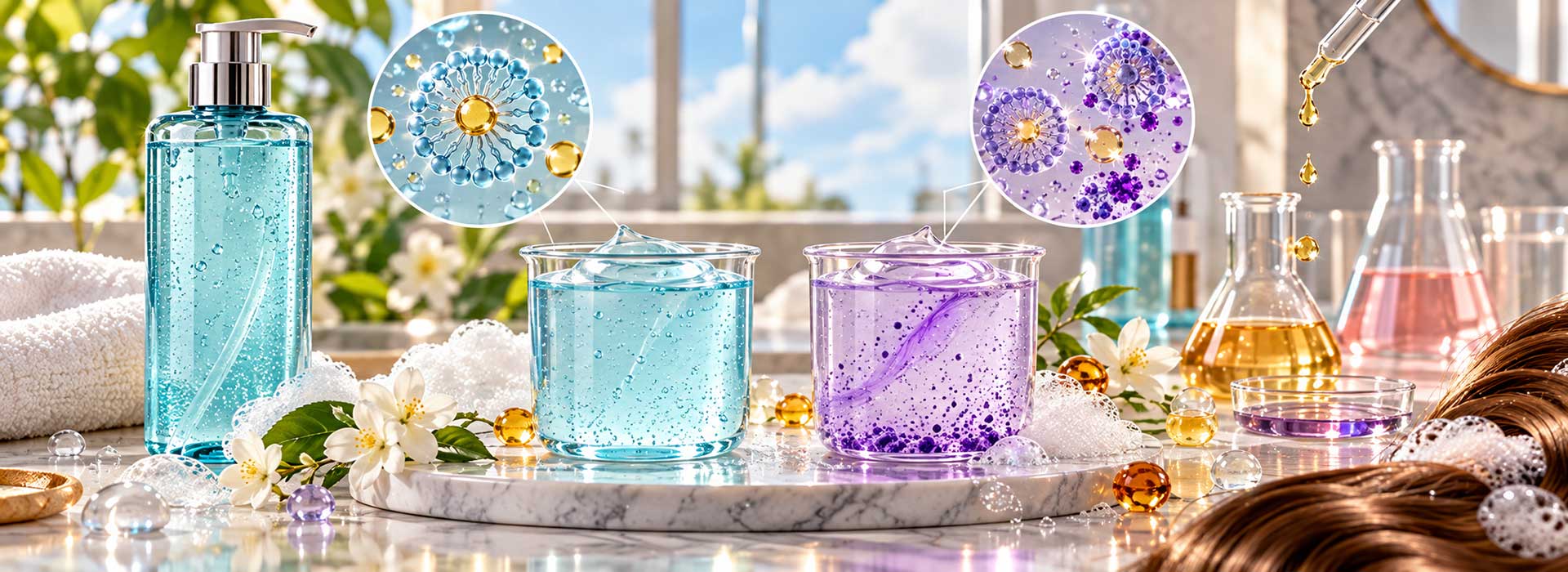
Hair care color bases are inherently surfactant-rich environments. Surfactant micelles solubilise both fragrance molecules and direct dyes simultaneously, creating ternary complexes where hydrophobic fragrance components and dye molecules compete for the same micellar interior. This changes the effective concentration of the dye available to contribute to perceived color and shifts the aggregate λmax — producing the curious phenomenon of a product that looks fine in a spectrophotometer and wrong to the human eye.
Additionally, some cationic conditioner polymers electrostatically bind anionic dyes when fragrance alters the ionic balance — causing localised dye precipitation that creates visible speckling or uneven color distribution.
Risk Levels
🔴 Direct Dyes (Anionic) — High (70%)
🟠 Lakes (Dispersed) — Medium (45%)
🟡 Iron Oxides — Low-Medium (25%)
// Detection Protocol — Surfactant
Visual assess + spectrophotometer at T0 / T28
Flag: ΔE(visual) ≠ ΔE(spec) — complex formation likely
Test at 0.5x / 1x / 2x fragrance concentration
Fix:  adjust HLB of emulsifier; review ionic charge balance
Mechanism 05 — UV Photosensitisation by Fragrance Chromophores
Mechanism 05 — Photochemical

Certain fragrance ingredients absorb UV radiation and transfer the excitation energy to adjacent colorant molecules — a process called photosensitised oxidation. Nitromusks (musk ambrette, musk tibetene) and some coumarin derivatives are well-known photosensitisers. Bergapten (5-methoxypsoralen) from bergamot oil is another.
The result is accelerated photobleaching — visible in products displayed in clear packaging under fluorescent retail lighting. ICH Q1B UV stability testing (1.2 million lux-hours) is mandatory for any hair care product making a color claim. Our strong recommendation is to run this test with and without fragrance side-by-side; the delta between those two results tells you how much photosensitisation the fragrance contributes.
Risk Levels
🔴 Xanthene Lakes — Very High (82%)
🔴 Azo Dyes — High (68%)
🟢 Iron Oxides — Very Low (15%)
// Detection Protocol — UV / Photo
ICH Q1B: 1.2 million lux-hours (D65 / UV)
Flag: ΔE with fragrance > 1.5× ΔE without fragrance
Request IFRA cert: check for nitromusk / bergapten
Fix:  UV filter (phenylbenzimidazole sulfonic acid) or opaque pack
Colorant Stability Matrix — Fragrance Interference Risk
Reference Data
This reference table maps six major colorant classes used in hair care against the five fragrance interference mechanisms. Use it as a pre-formulation risk screen before committing to a full stability study.
| Colorant Class | Examples | pH | Oxidation | Chelation | Surfactant | UV |
|---|---|---|---|---|---|---|
| Azo Direct Dyes | D&C Yellow 11, Direct Red 80, HC Blue 2 | Very High | Critical | Low | High | High |
| Iron Oxide Pigments | CI 77491, 77492, 77499 | Medium | Very Low | High | Low | Very Low |
| Xanthene Lakes | D&C Red 27 Lake, D&C Red 21 Lake | Medium | High | High | Medium | Very High |
| Vat Dyes | D&C Red 30 (Helindone Pink) | Low | Medium | Low | Medium | Medium |
| Titanium Dioxide | CI 77891 (rutile grade) | Very Low | Very Low | Low | Low | Medium* |
| Chromium Oxide Greens | CI 77288, CI 77289 | Low | Very Low | Medium | Very Low | Very Low |
* TiO₂ rutile grade is photocatalytically inert. Anatase grade generates reactive oxygen species under UV — always specify rutile.
Formulator Note
Risk levels in this table represent general patterns observed with standard fragrance concentrations of 1–2%. Your specific fragrance compound, colorant grade, base pH, and water quality will shift these risk profiles. This table is a starting framework, not a replacement for batch-specific stability testing. Request the fragrance GC-MS profile and cross-reference against the colorant class before finalising your test plan.
The Testing Protocol That Catches Fragrance Failures
Stability Testing
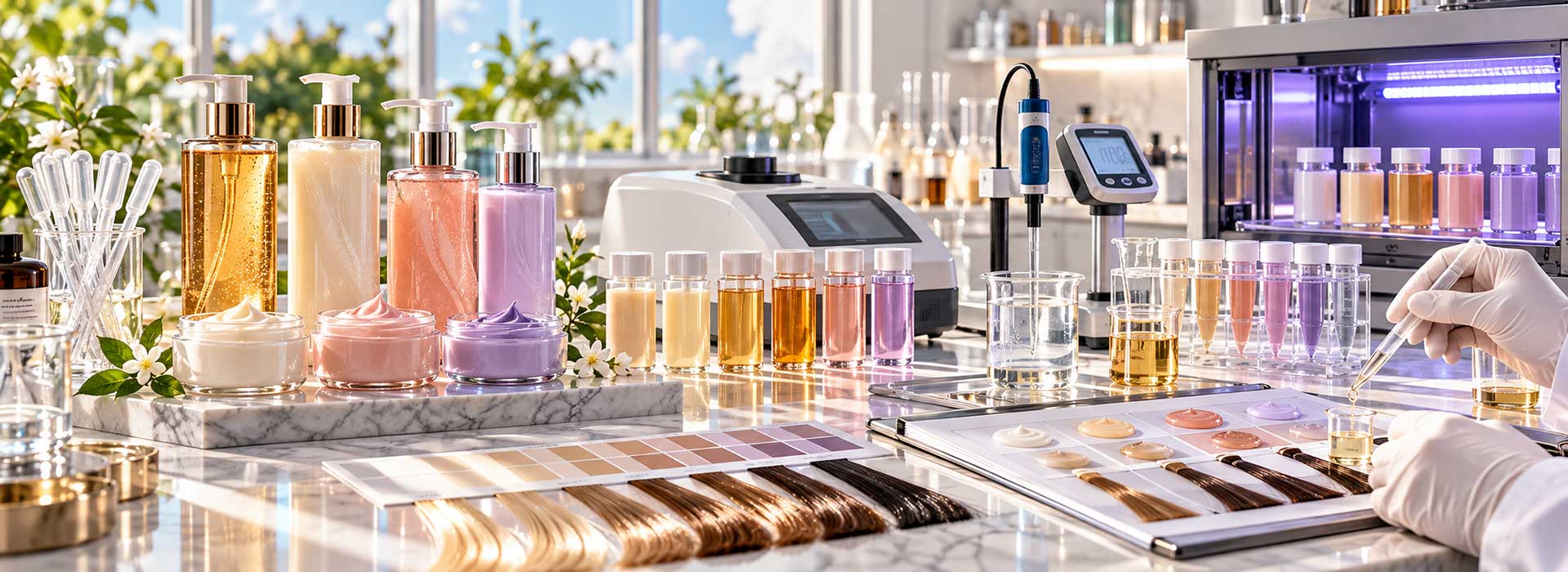
Most fragrance-induced color failures are discovered at consumer returns, not in the stability room — because the stability protocol was designed before fragrance was added to the scope. Here is the full protocol we recommend to hair care brands sourcing pigments from us.
The Underrated Fix Nobody Talks About
The single most underrated step in fragrance-colorant stability work is testing your fragrance on its own in your water phase — without any other ingredients. Run a ΔE read on the water + fragrance + colorant system at T0 and T7 at 40°C before adding any other actives or conditioners. If you see ΔE movement at this stage, the issue is direct chemical interaction, not formulation context. This diagnostic step saves weeks of troubleshooting and costs an afternoon of lab time.
— Advik Colors, Formulation Advisory Practice
// Stability Test Matrix — Fragrance × Colorant System
Fragrance Levels
0%, 1%, 2%, 3%
Storage Conditions
Ambient / 40°C / UV
Timepoints
T0 · T7 · T14 · T28 · T56
Measurements
ΔE · pH · Viscosity · Visual
Acceptance Criterion
ΔE ≤ 1.0 @ T28 stressed
Reformulation Trigger
ΔE > 0.8 @ T14 stressed
Why We Use ΔE 0.8 as an Early Warning, Not 1.0
The standard ΔE ≤ 1.0 at 28 days is an industry minimum, not a target. A product sitting at ΔE 0.9 at 28 days of accelerated testing typically reaches ΔE 1.5–2.0 in real-shelf conditions at 12 months, because acceleration factors don’t fully model retail temperature cycling, display lighting, and consumer bathroom environment humidity. We advise our customers to treat any T14 ΔE above 0.8 as a reformulation trigger — not as an observation to monitor.
Reformulation in response to early data costs a week. A consumer color complaint at month eight costs a reformulation plus a recall plus a reputation rebuild. The math favours acting early.
6-Point Fragrance-Colorant Compatibility Checklist
Pre-Formulation
Before you run a single stability sample, complete this checklist. It takes less than a day and eliminates the most common failure modes at design time rather than discovery time.
01Request and review the fragrance GC-MS data. Look for limonene, linalool, aldehydes, coumarins, nitromusks, and citric acid above 0.5%. Flag any compound that is a known oxidant precursor, photosensitiser, or chelant. If your fragrance supplier cannot provide this data, change suppliers.
02Verify your colorant class against the risk matrix. If you’re using azo direct dyes and a citrus-forward fragrance, you are entering the highest-risk intersection. Either switch the colorant class to a more oxidation-stable option (iron oxide, vat dye) or select a fragrance profile without high terpene content.
03Measure your base pH with and without fragrance. Add your target fragrance concentration to the base (no colorant). Measure pH at T0 and after 48 hours at 40°C. A ΔpH above 0.3 signals buffering insufficiency — fix this before introducing the colorant.
04Specify rutile-grade TiO₂ explicitly. Anatase TiO₂ is photocatalytically active and generates reactive oxygen species under UV — particularly dangerous when photosensitising fragrance components are present. Your pigment specification documents should state “rutile grade” explicitly. See our hair care color pigments guide for grade-specific formulation guidance.
05Choose packaging that matches your fragrance risk level. If your fragrance contains photosensitisers and your colorant is UV-vulnerable, opaque packaging is not a design choice — it is a stability requirement. Clear packaging with a UV photosensitising fragrance and a xanthene lake colorant is a combination that will fail on shelf.
06Document and keep the fragrance batch-locked. Fragrance compounds are themselves complex formulations with batch-to-batch variability. Lock the fragrance batch number to your stability data. When the fragrance batch changes, re-run the fragrance-colorant screen — even if the same fragrance code is ordered.
What Works in Practice
Formulators who complete this checklist before building their stability matrix consistently require fewer reformulation cycles. The most reliable combinations we have seen in hair care are: rutile-grade iron oxides paired with non-citrus, low-terpene fragrances in a pH 5.0–5.5 buffered base. This combination is also the most cost-stable — iron oxides are among the most price-predictable cosmetic colorants in the market.
The Combination That Consistently Fails
Azo direct dye (any shade) + citrus fragrance (≥1%) + unbuffered shampoo base at pH 4.5 + clear bottle. We see this combination fail in stability studies with remarkable consistency. By week four at 40°C, ΔE is often 2.5–4.0. If your current formulation matches this profile, treat it as urgent. The fix is achievable — but it requires changing at least two of the four variables, and it should happen before the next production run.
Why Pigment Grade and Source Documentation Matter
Choosing Pigment Partners
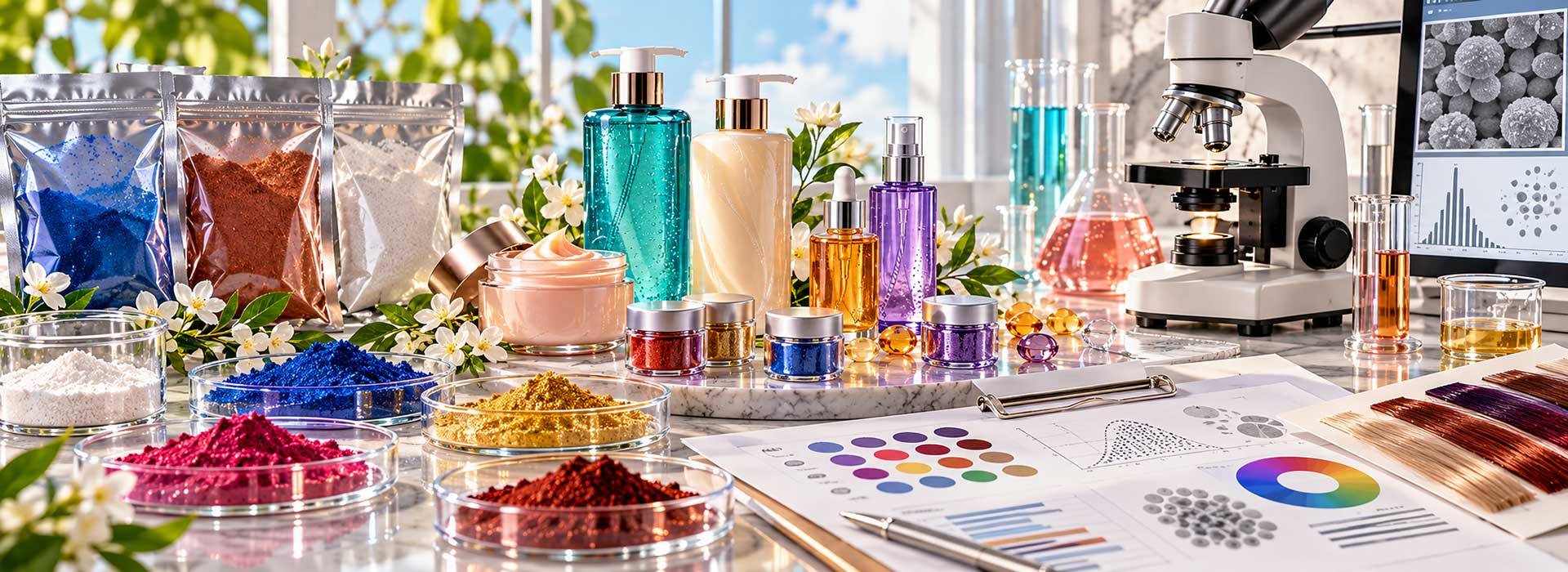
Not all cosmetic pigments behave identically in the presence of fragrance. Particle size, surface treatment, and manufacturing purity all affect how a pigment responds to the chemical stresses fragrance introduces. A coarser iron oxide particle with poor surface treatment will show chelation sensitivity that a well-processed, surface-treated version of the same CI number will not.
This is why we supply our hair care color pigment customers with full technical data sheets that specify particle size distribution, specific surface area, and water-soluble extractables — the latter being particularly relevant for chelation risk assessment. Without this data, a formulator cannot reliably predict stability outcomes from first principles alone.
We encourage every formulator working with colored hair care formulations to treat pigment documentation as a stability variable, not just a regulatory box-ticking exercise. The purity certificate and extractables data your pigment supplier provides either supports your stability case or flags a risk you need to manage. Explore our cosmetic pigment range for hair care with full technical documentation, or speak with our formulation technical team for a sample and data package.
From Our Experience at Advik Colors
The questions we get most often from hair care formulators aren’t about shade — they’re about stability. “Will this pigment hold color with the fragrance we’ve selected?” is the question that drives most of our technical conversations. It’s a good question, and the answer is always: it depends on the fragrance, the base, the pH, the packaging, and the testing protocol. Which is exactly why this guide exists.
Common Questions on Hair Care Color Stability
Formulator FAQs
Why do hair care products lose color after fragrance is added?
Fragrance components — particularly terpenes, aldehydes, and phenolic compounds — interact with colorants through five mechanisms: pH shift, oxidative degradation, chelation interference, surfactant-fragrance-dye complex formation, and UV photosensitisation. Even a 0.5–2% fragrance inclusion can destabilise a previously stable color system.
Which colorants are most vulnerable to fragrance-induced degradation?
Azo direct dyes (D&C Yellow 11, Direct Red 80) are most vulnerable due to azo bond sensitivity to oxidative and pH stress. Xanthene lake pigments (D&C Red 27 Lake) are susceptible to UV-catalysed fragrance interactions. Iron oxides are the most stable but can still shift under extreme pH excursion caused by fragrance acids.
What is a safe fragrance inclusion level for hair care color?
There is no universal safe level — it depends on the specific fragrance composition, the colorant class, and the base formulation. However, most formulators conduct accelerated stability at 1%, 2%, and 3% fragrance inclusion to establish the working threshold. A ΔE ≤ 1.0 at 28 days at 40°C/75% RH is the typical acceptance criterion.
Can chelating agents worsen hair care color stability?
Yes. EDTA and citric acid — common in both fragrance compounds and base formulations — chelate the metal coordination centres in iron oxide and lake pigments. This disrupts the pigment structure and causes shade drift. The risk is compounded when fragrance already contains chelating trace compounds.
How do I test hair care color stability against fragrance interference?
Run a structured stability matrix: prepare batches with 0%, 1%, 2%, and 3% fragrance; measure ΔE via spectrophotometer at T0, T7, T14, T28, and T56 days; store at ambient (25°C/60% RH), stressed (40°C/75% RH), and UV exposure (ICH Q1B: 1.2 million lux-hours). Flag any ΔE > 1.0 at 28 days stressed as a reformulation trigger.
What is ΔE and why does it matter for hair care color stability?
ΔE (Delta E) is a numerical measure of color difference computed from CIE L*a*b* colorimetric data. A ΔE of 1.0 represents the threshold of perceptibility to an average consumer — shades diverging beyond this are visibly different. For hair care products with a color claim, maintaining ΔE ≤ 1.0 at 28 days accelerated storage is the industry-standard minimum.
Does fragrance type affect the degree of colorant destabilisation?
Significantly. Citrus-forward fragrances high in limonene and aldehydes carry strong oxidative and pH-disrupting potential. Musk-dominant fragrances with synthetic nitromusks may photosensitise certain dyes. Floral fragrances containing eugenol and isoeugenol are mild chelators. Reviewing the fragrance IFRA certificate and GC-MS data before stability testing helps predict risk.
Technical Enquiry — Advik Colors
Working on a Colored Hair Care Formulation?
Our technical team works directly with formulators and R&D labs to match pigment grade, particle specification, and documentation requirements to your stability protocol. We supply cosmetic-grade iron oxides, lake colors, and vat dyes from Surat with full technical data sheets.
Regulatory references: FDA 21 CFR Part 73 · EU Cosmetics Regulation 1223/2009