
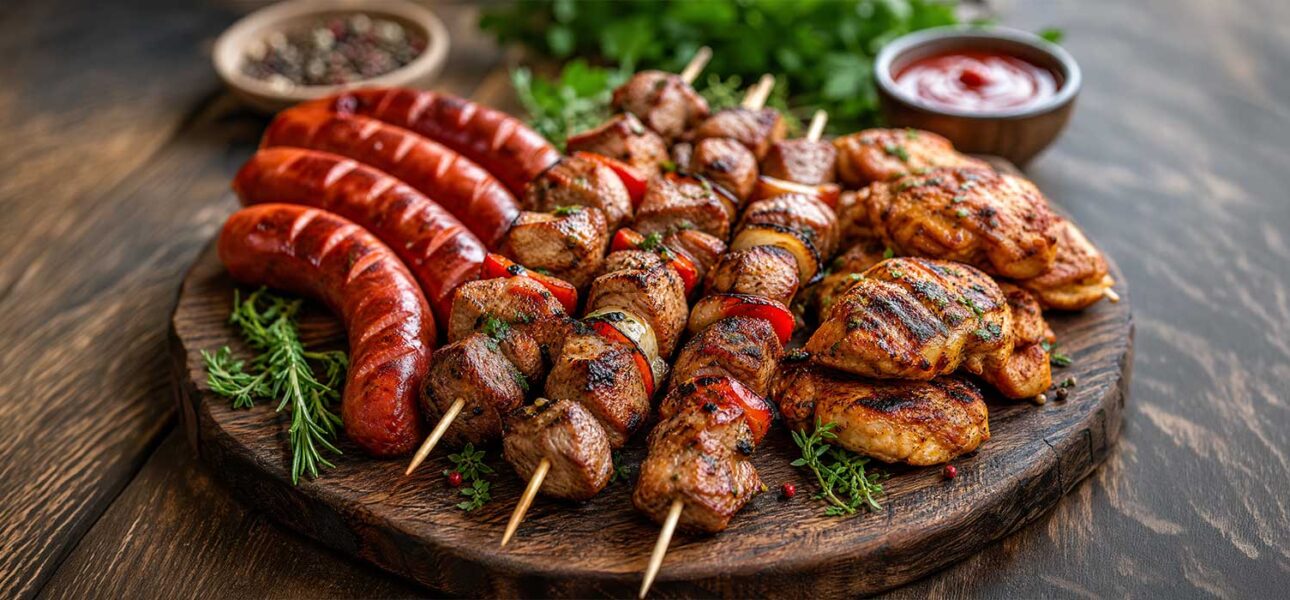
A processor’s reference for choosing, dosing, and staging synthetic food colour across sausages, marinated products, kebabs, and cooked meat lines — built from real production formulations, not lab theory.
If you process sausages, marinated chicken, kebabs, or salt-roasted meat products, you already know that raw and cooked meat color is unstable — it fades under heat, drifts under storage, and varies batch to batch depending on myoglobin content and cooking method. Synthetic food colour for meat and poultry products is the manufacturing standard used to correct this: a small, precisely dosed addition of dyes such as Allura Red AC, Carmoisine, Ponceau 4R, or Quinoline Yellow, added at a specific stage of processing to deliver a consistent, heat-stable, shelf-stable shade batch after batch.
Synthetic food colour for meat and poultry products refers to lab-manufactured, food-grade dye or lake colourants — as distinct from plant-derived natural pigments — used to standardise or restore the visual colour of raw, marinated, cooked, or canned meat and poultry items during processing. Synthetic colours are selected over natural alternatives in this category specifically because they hold up to retort heat, brine injection, long shelf life, and repeated freeze-thaw cycles without the shade drift that natural pigments are prone to.
This guide sets out exactly where in your process to add colour, how much to dose per product category, and what compliance documentation you should be asking your supplier for before you commit to a batch run.
01 Why Meat & Poultry Processors Choose Synthetic Colour
Natural pigments such as beetroot, paprika oleoresin, or annatto are heat-sensitive and break down under the sterilizing, retort, and long-storage conditions typical of processed meat manufacturing. For processors running high-volume lines, that instability is a production risk, not a cosmetic detail. This is why synthetic food colour for meat processing remains the default choice across sausage, kebab, and canned meat categories worldwide.
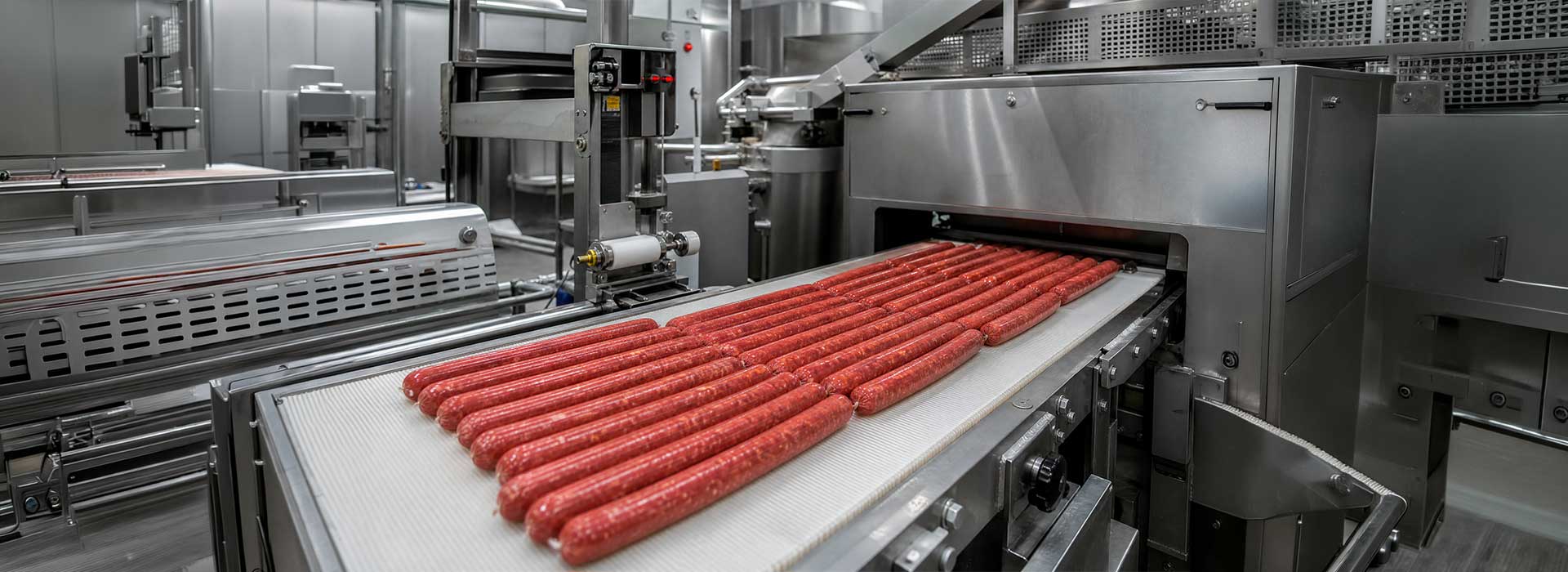
Heat Stability
Holds shade through retort & sterilizing
Synthetic dyes and lakes are chosen specifically because they don’t degrade under the pressure and temperature of canning and sterilization cycles.
Batch Consistency
Same shade, every production run
Natural pigment concentration varies by crop and season. Synthetic colour is manufactured to a fixed specification, so shade doesn’t drift between lots.
Shelf Life
Resists fading in storage & light
Processed meat products can sit in cold storage or on shelf for weeks. Synthetic colourants are formulated for stronger light and oxidation resistance.
Cost at Scale
Lower dosage, lower cost per kg
Synthetic colours typically need a fraction of the dosage of natural extracts to achieve the same visual intensity — a meaningful saving at export volume.
02 Synthetic Colour Solutions by Meat Product Category
Dosage and process timing are not interchangeable across product types — a sausage base, a marinated kebab, and a salt-roasted chicken product each call for a different colourant, dosage window, and stage of addition. The reference specifications below are drawn from production-tested formulations.
03 Lake vs. Water-Soluble Dye: Which One for Your Process?
Choosing between an aluminium lake and a water-soluble dye is a formulation decision, not a preference — it depends on whether your process stage is wet or dry, and how much fat is in the base.
As a working rule: if the colourant needs to travel with liquid — brine, marinade, or injection — use a water-soluble dye. If it needs to stay fixed in a fat or dry-powder matrix, specify the lake form instead.
04 C.I., E-Number, INS & CAS Reference Table
When specifying a colourant for export or cross-border compliance checks, use the exact identification numbers below rather than the trade name alone — regulatory databases and customs documentation reference these codes directly.
| Colourant | C.I. Number | E-Number (EU) | INS Number | CAS Number |
|---|---|---|---|---|
| Allura Red AC | 16035 | E129 | INS 129 | 25956-17-6 |
| Carmoisine (Azorubine) | 14720 | E122 | INS 122 | 3567-69-9 |
| Ponceau 4R | 16255 | E124 | INS 124 | 2611-82-7 |
| Quinoline Yellow WS | 47005 | E104 | INS 104 | 8004-92-0 |
C.I. and CAS numbers are provided for identification reference. Always confirm the current status of an E-number or INS listing against the destination market’s active regulation before finalising a formulation.
Maximum Permitted Limits for Processed Meat & Poultry (mg/kg)
| Colourant | FSSAI (India) | EU (Regulation 1333/2008) | US FDA | Codex GSFA |
|---|---|---|---|---|
| Allura Red AC (E129) | 100 mg/kg | Quantum satis / category-specific limits apply | Not FDA-listed for meat; check product category | Per GSFA food category 08.0 |
| Carmoisine (E122) | 100 mg/kg | Category-specific limits apply | Not FDA-approved for use in the US | Per GSFA food category 08.0 |
| Ponceau 4R (E124) | 100 mg/kg | Category-specific limits apply | Not FDA-approved for use in the US | Per GSFA food category 08.0 |
| Quinoline Yellow WS (E104) | 100 mg/kg | Category-specific limits apply | Not FDA-approved for use in the US | Per GSFA food category 08.0 |
05 How to Add Synthetic Food Colour in Meat Processing
Where you introduce the colourant in your process line matters as much as the dosage itself. Adding too early can mean colour loss during cooking; adding too late can mean poor dispersion. As a general rule for synthetic food colour for meat and poultry products:
01
During pickling or marinating
Best for products like kebabs and prepared meat series, where the colourant needs time to penetrate the meat alongside salt and seasoning before quick-freezing or cooking.
02
During blending
Standard stage for sausage bases — colour is mixed uniformly into the meat emulsion before filling, so it distributes evenly through the finished product.
03
30 minutes before pan-out
Used for salt-roasted, sauce-marinated, and marinated chicken lines — added post-sterilizing as a finishing step to correct any colour loss from the heat process.
04
During quick-freeze preparation
For kebab and skewer-style products, colour is locked in as part of the pickling-to-freezing sequence to ensure it survives frozen storage and later cooking.
06 FSSAI, EU & Codex Compliance for Synthetic Meat Colourants
Before finalising any synthetic food colour for meat processing, confirm that the specific dye and its dosage are permitted for your product category in the destination market. Regulatory limits differ by country and by food category — a dosage compliant for canned meat in one market may exceed the permitted level in another.
| Colourant | Common Shade | Typical Regulatory Basis |
|---|---|---|
| Allura Red AC (INS 129) | Bright red to orangish-red | FSSAI approved; EU-permitted with Southampton Six warning label; Codex GSFA listed |
| Carmoisine (INS 122) | Deep red | FSSAI approved; EU-permitted with warning label requirements |
| Ponceau 4R (INS 124) | Red | FSSAI approved; restricted in some non-EU markets |
| Quinoline Yellow WS (INS 104) | Greenish-yellow | FSSAI approved; EU-permitted with warning label requirements |
Because permitted use levels are reviewed periodically, always cross-check current limits against the Codex Alimentarius General Standard for Food Additives (GSFA) database before finalising a formulation for export, particularly if the same product line ships to more than one regulatory market.
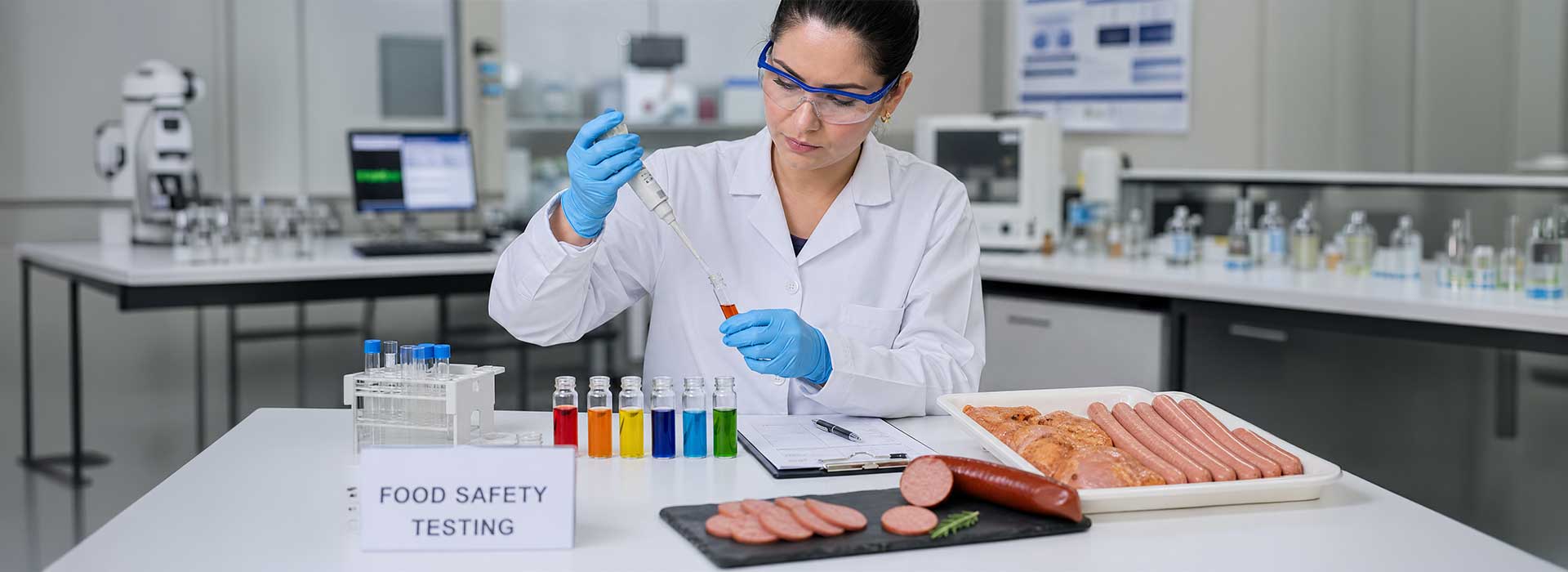
Documentation to request from your colour supplier
- Batch-wise Certificate of Analysis (CoA)
- FSSAI compliance declaration for the specific INS number and food category
- Halal and Kosher certification, where required for export markets
- Heavy metal and purity testing data
07 Choosing the Right Shade & Dosage for Your Product Line
The most common formulation error is treating dosage as a fixed number rather than a range tied to process stage. Under-dosing typically shows up as fading after sterilizing or storage; over-dosing risks exceeding the permitted level for that food category and market. A colour manufacturer working from real production data — not just a technical data sheet — should be able to recommend a starting dosage for your specific process, then help you fine-tune it across a trial batch before scale-up.
For processors running multiple product lines, a custom-blended synthetic colour solution, rather than a single standalone dye, often performs more consistently across varied cook times, pH levels, and packaging formats — which is where working directly with a manufacturer rather than a repacker makes a measurable difference.
08 Frequently Asked Questions
Is synthetic food colour for meat and poultry products safe?
Yes. Synthetic food colours such as Allura Red AC, Carmoisine, and Ponceau 4R are permitted for meat and poultry applications under FSSAI, EU, and Codex Alimentarius standards when used within prescribed dosage limits and declared correctly on the label.
What is the ideal dosage of synthetic colour for sausages?
As a reference range, sausage base formulations typically use 0.1% to 0.3% added during blending, while marinated and kebab-style products use 0.4% to 1.5% depending on the process stage.
Can synthetic meat colours survive retort and sterilization?
Yes — this is precisely why synthetic colour is preferred for meat and poultry processing. It withstands high heat, pressure, and extended storage without the fading that natural pigments are prone to.
Do synthetic food colour for meat need to be declared on the label?
Yes. Colour additives must be declared by their common or usual name in line with the food safety regulations of your destination market.
Can Advik Colors supply synthetic colour for export-grade meat processing?
Yes. Advik Colors manufactures synthetic food colours with batch-wise Certificates of Analysis, formulated to meet FSSAI, EU, and Codex Alimentarius requirements for meat and poultry processors.
Get FSSAI-Compliant Synthetic Food Colour for Meat Processing Line
Advik Colors manufactures and exports synthetic food colour for meat and poultry products, formulated to hold shade through retort, storage, and shelf life. Request a dosage recommendation or a sample batch for your specific product line.