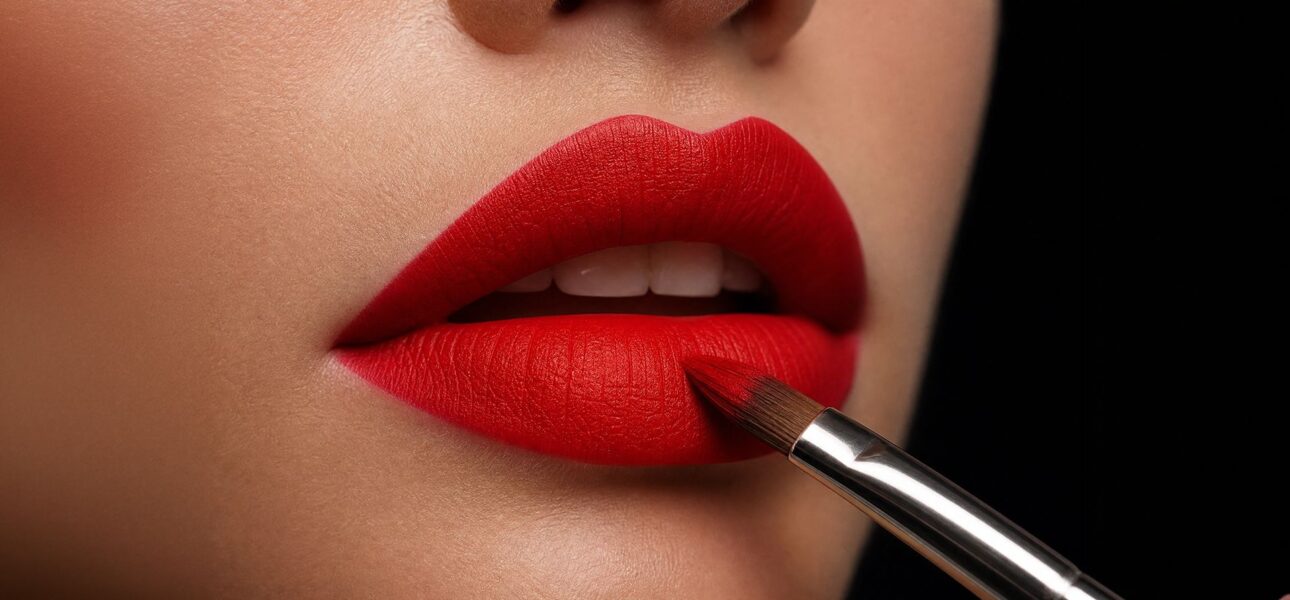
The best cosmetic pigments for lipstick include D&C Red pigments for vivid reds and pinks, iron oxides for nudes and earth tones, lake colors for opacity and bleed resistance, and D&C Red 7 or plant-based pigments as vegan carmine alternatives. The right choice depends on your product format, finish type, and target market’s regulatory requirements.
Lipstick is one of the highest-repurchase cosmetics globally — and color is the #1 purchase driver. Yet behind every perfectly pigmented lip shade is a formulation decision that most consumers never think about: which cosmetic pigments for lipstick were chosen, and why. Get it wrong and you have feathering, fading, or a batch that fails regulatory review in your export market. Get it right and you have a hero SKU that sells itself.
This guide covers everything cosmetic manufacturers need to know: pigment types, oil dispersion behavior, shade vibrancy, bleeding resistance, heat stability, vegan alternatives, and compliance across US, EU, and Indian markets.
Why Pigment Selection Is Critical in Lip Formulation
Lips sit adjacent to mucous membranes. Pigment purity standards are stricter than skin. Your pigment choice directly controls shade payoff, wear time, bleed, and global market access.
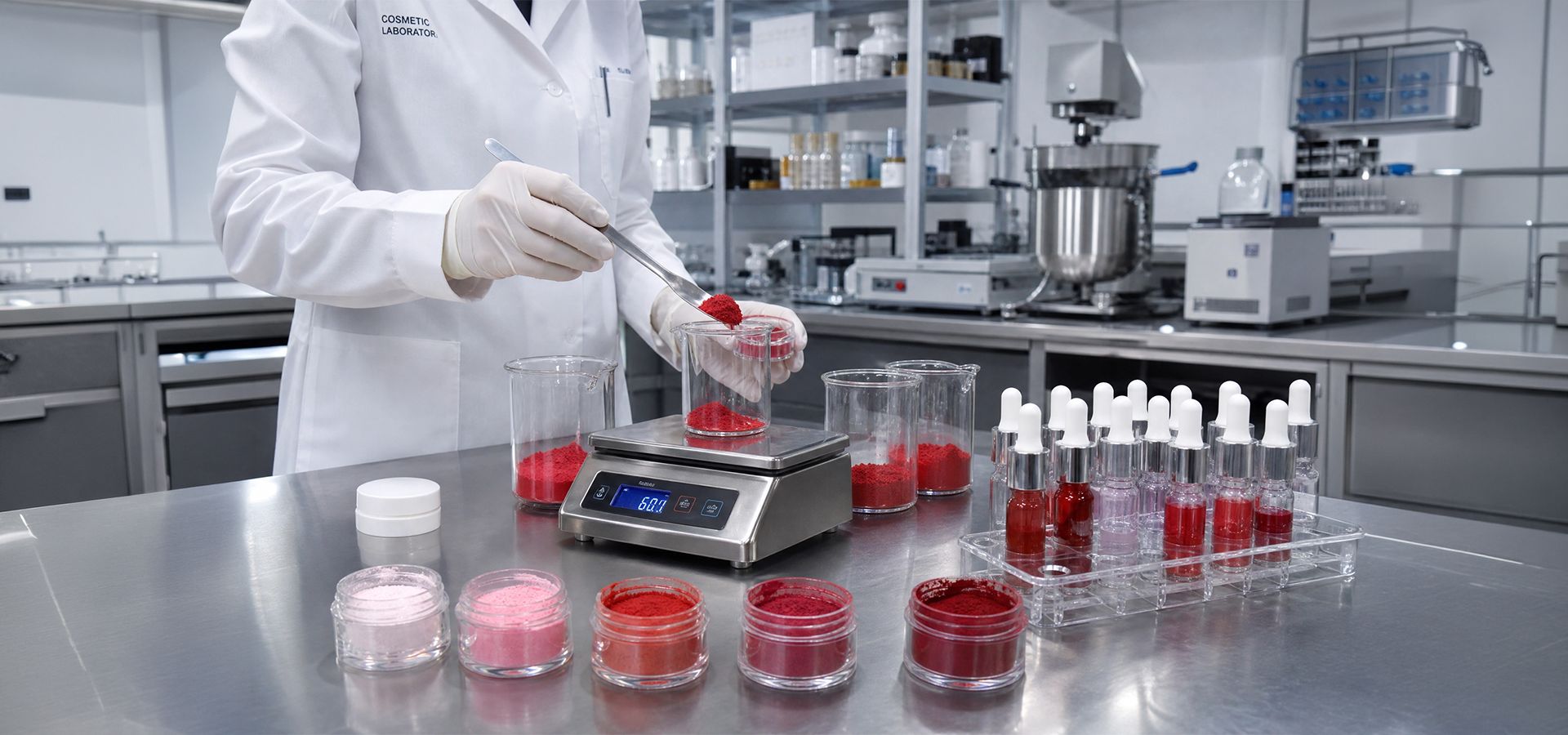
Beyond safety, your pigment decision governs four performance variables manufacturers can’t afford to get wrong:
- →Shade vibrancy — tinting strength at a given load level
- →Bleeding resistance — feathering and migration beyond the lip line
- →Heat stability — holding shade through manufacturing temperatures of 70–90°C
- →Regulatory clearance — lip-approved status varies by market (FDA, EU, CDSCO India)
5 Key Performance Parameters for Lip Pigments
Evaluate every cosmetic pigment for lipstick against these five lenses before finalizing your formulation: oil dispersion, shade vibrancy, bleeding resistance, heat stability, and regulatory compliance.
Oil Dispersion
How evenly a pigment distributes through wax and oil bases. Poor dispersion creates streaky application and batch-to-batch shade drift. Lake colors and pre-milled iron oxides disperse most reliably in anhydrous lip systems.
Shade Vibrancy
Tinting strength and color intensity at low pigment loading. D&C Red toners deliver the highest strength. Particle size directly affects perceived saturation — finer grind = more vibrancy at the same loading percentage.
Bleeding Resistance
Migration and feathering beyond the lip line. Lakes outperform toners here significantly. Insoluble pigment form is the single biggest lever for bleed control — more impactful than wax hardness alone.
Heat Stability
Lipstick is manufactured at 70–90°C during the wax melt and pour stage. Iron oxides are the gold standard for heat stability. Natural plant-based pigments are most vulnerable — many begin degrading above 60°C.
Safety & Compliance
Lip-safe vs eye-safe vs face-safe designations vary by pigment. Heavy metals limits (Pb, As, Hg, Cd) are stricter for lip use. Key frameworks: FDA 21 CFR Part 74, EU Annex IV, and CDSCO India norms.
Types of Cosmetic Pigments for Lipstick — Full Breakdown
Six pigment families cover the full lip color spectrum: D&C Reds (vivid shades), iron oxides (nudes/earth tones), lake colors (opacity + bleed control), carmine (natural reds), carmine alternatives (vegan), and natural cosmetic pigments (clean label).
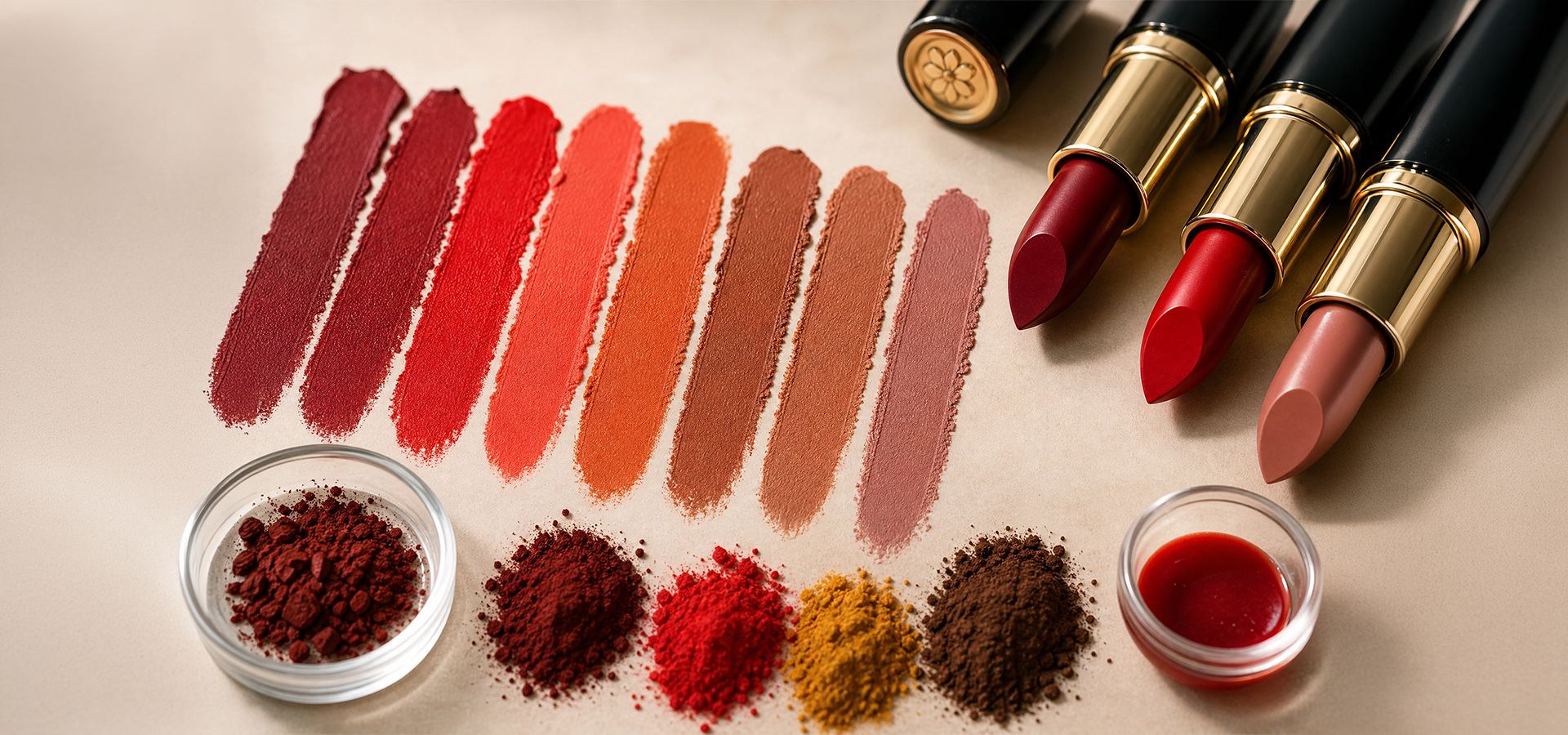
D&C Red Pigments — The Standard for Vivid Lip Color
FDA Drug & Cosmetic designation · Highest tinting strength“D&C” stands for Drug & Cosmetic — an FDA designation confirming the pigment is approved for both drug and cosmetic applications including lip products. Key variants for lipstick include D&C Red No. 6, 7, 21, 27, 30, 33, and 34, each delivering a distinct shade position from warm scarlet to cool magenta.
Iron Oxides — Nude, Brown & Earth Tone Workhorses
CI 77491 / 77492 / 77499 · Globally approved for lip useIron oxides are the backbone of every nude, brown, terracotta, and mauve lip shade. Available in three base colors — yellow (CI 77492), red (CI 77491), and black (CI 77499) — they blend to create the full earth-tone spectrum. Synthetic iron oxides offer exceptional batch consistency and are free from the heavy metal contamination concerns of natural mineral sources. They require pre-dispersion or milling to achieve smooth, streak-free results in high-wax lip bases.
Lake Colors — For Opacity, Depth & Bleed Control
Insoluble dye-substrate pigment · Best bleed resistanceLake colors are produced by bonding water-soluble dyes to an insoluble substrate (alumina or calcium). The result is a pigment that disperses rather than dissolves — dramatically reducing migration and feathering. For long-wear lipstick, full-coverage finishes, and any formula where bleed resistance is non-negotiable, lakes are the professional’s choice. Key options for lip products include D&C Red 6 Lake, D&C Red 7 Lake, FD&C Yellow 5 Lake, and FD&C Blue 1 Lake.
Carmine (CI 75470) — The Traditional Red Standard
Cochineal-derived natural red · Not vegan · Allergen declaration required (EU)Carmine has been the industry benchmark for true reds, berry shades, and deep plums for decades. Derived from the cochineal insect, it delivers a depth and warmth that synthetic alternatives still struggle to fully replicate at equivalent loading levels. Its oil compatibility is good, heat stability is excellent through the manufacturing process, and shade consistency between batches is very high when sourced from quality suppliers. The challenge: it is animal-derived, requires allergen declaration in the EU (“may cause allergic reactions in rare cases”), and is incompatible with halal and vegan certification.
Carmine Alternatives — Vegan-Friendly Red Pigments
Fastest growing segment · Synthetic & plant-based optionsCarmine alternatives are the fastest-growing segment in cosmetic pigments for lipstick, driven by the global rise of vegan beauty certifications and halal compliance requirements. The best synthetic option is D&C Red 7 (Lithol Rubine BCA), which produces a warm red close to carmine — though it typically requires 15–20% higher loading to match carmine’s depth. D&C Red 27 (Tetrabromofluorescein) delivers a brighter, more magenta-leaning red. Plant-based alternatives like radish root extract, black carrot, and beet powder are available but carry significant limitations: most begin degrading above 60°C, shift hue with pH change, and have a shorter shelf stability window.
Natural Cosmetic Pigments — The Clean Label Lip Palette
ISO 16128 defined · Ecocert & COSMOS compatibleNatural cosmetic pigments (as defined by ISO 16128) include naturally-derived iron oxides, mica, manganese violet, ultramarines (for pink/violet tones), beet extract, and annatto. They deliver clean-label positioning required for Ecocert, COSMOS, and organic-certified lip products. The trade-offs are real: lower vibrancy at equivalent loading, heat sensitivity in plant-based variants, pH-dependent hue shifts, and a shorter stability window. The most effective natural lip formulas blend naturally-derived iron oxides and mica as the base, then add plant tints for accent shades where heat exposure can be controlled.
Pigment Form Guide — Which Format Works in Which Base
| Pigment Form | Best For | Oil Dispersion | Opacity | Bleed Risk |
|---|---|---|---|---|
| Toner (pure dye) | Sheer glosses, tints | Good | Low | Higher |
| Lake (insoluble) | Full-coverage lipstick | Excellent | High | Low |
| Iron Oxide | Nudes, liners, balms | Requires milling | High | Minimal |
| Carmine | Classic reds | Good | Medium–High | Low |
| Natural extract | Organic/vegan ranges | Variable | Low–Medium | Medium |
Oil Dispersion — The Make-or-Break Step in Lip Manufacturing
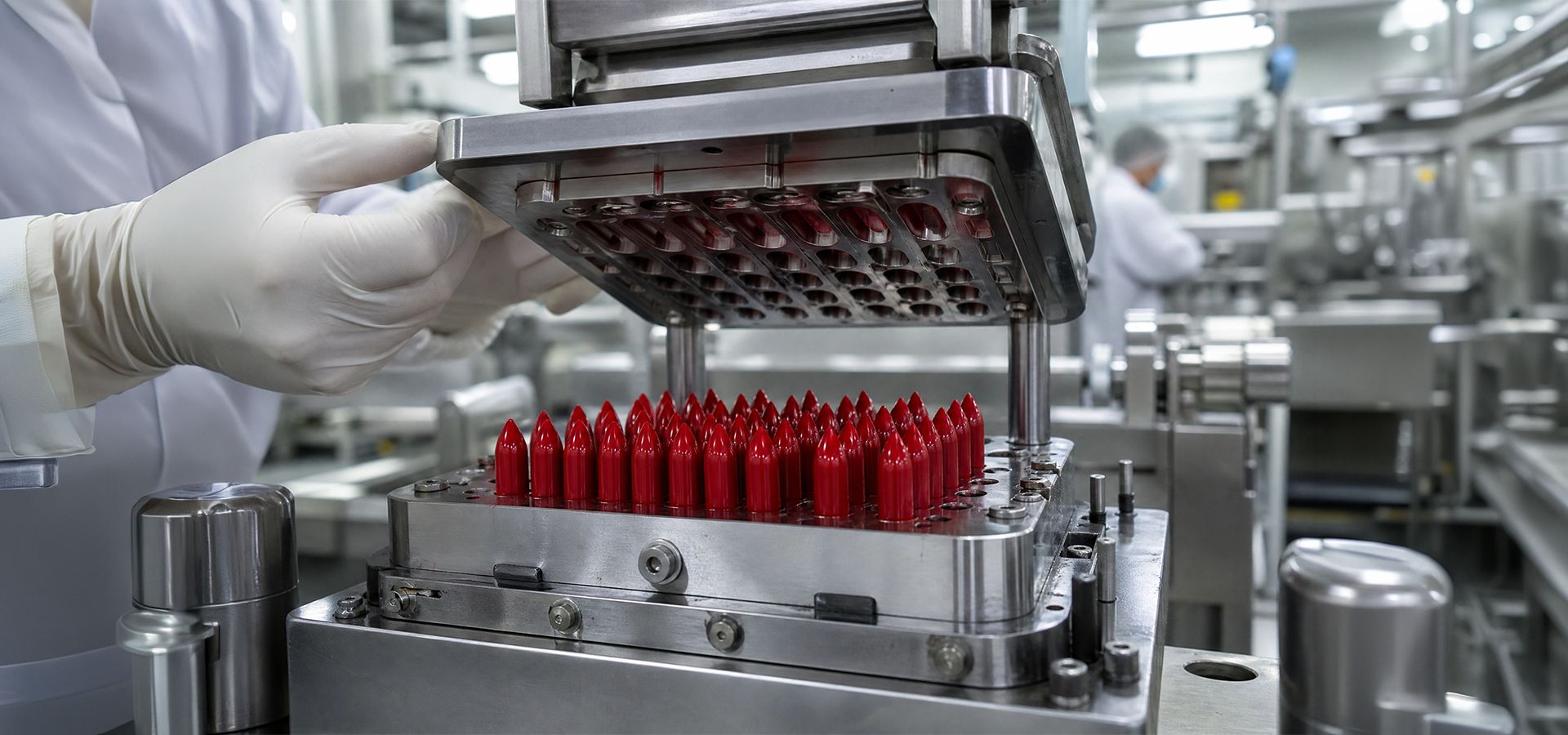
Dispersion quality determines final shade payoff, stability, and texture. The method you choose — hand blending, castor oil pre-dispersion, or three-roll milling — directly correlates with your formulation’s final performance.
Because lipstick is an anhydrous (water-free) formula built on wax and oil, all pigments must distribute evenly through this matrix without water to assist. Poor dispersion doesn’t just look bad — it causes pigment agglomeration, shade shift on aging, and inconsistent payoff between batches. Three dispersion methods are used in commercial production:
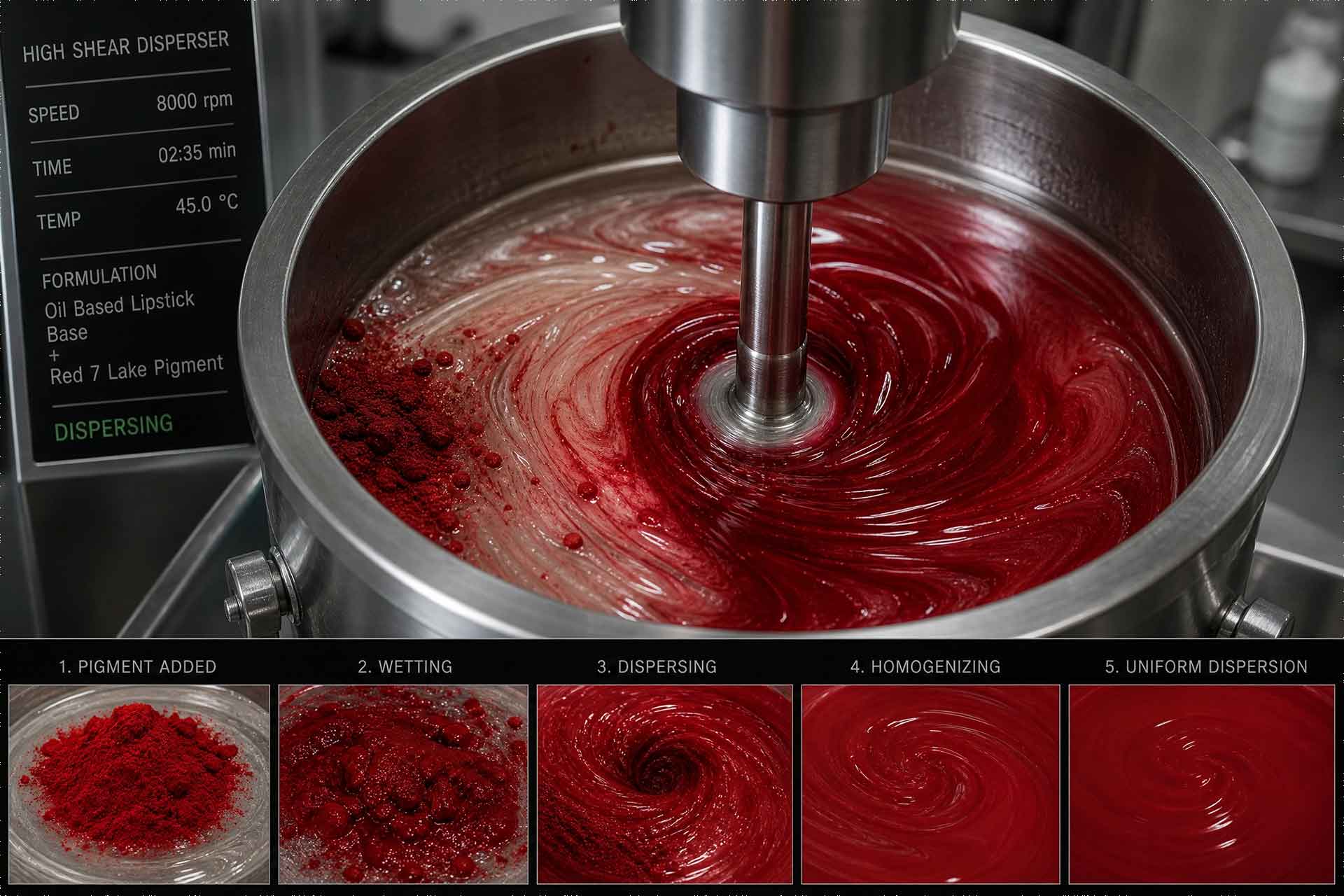
Dry Blending
Direct blend of pigment powder into melted wax base. Quickest but produces lowest uniformity. Suitable only for simple iron oxide shades at low load levels.
Castor Oil Pre-Dispersion
Pigment is ground into castor oil (5–10% of formula weight) before adding to the melt. The industry standard for D&C Red pigments and lake colors — significantly reduces agglomeration.
Three-Roll Milling
Maximum particle size reduction and uniformity. Required for iron oxides, professional-grade D&C Red toners, and any formula targeting premium shade payoff. Adds cost but guarantees results.
Common Dispersion Failures & Fixes
- →Streaking — caused by pigment agglomeration; fix with castor oil pre-grind before adding to melt
- →Shade shift on aging — pH interaction or oxidation; check pigment purity grade and storage conditions
- →Pigment separation — incompatible carrier; switch to castor oil or caprylic/capric triglyceride as dispersion aid
Application Recommendations by Lip Product Type
All four synthetic pigment families work across lip formats. The loading level, dispersion method, and pigment form shift with product texture and wear claim. Vegan formats need a fully carmine-free system.
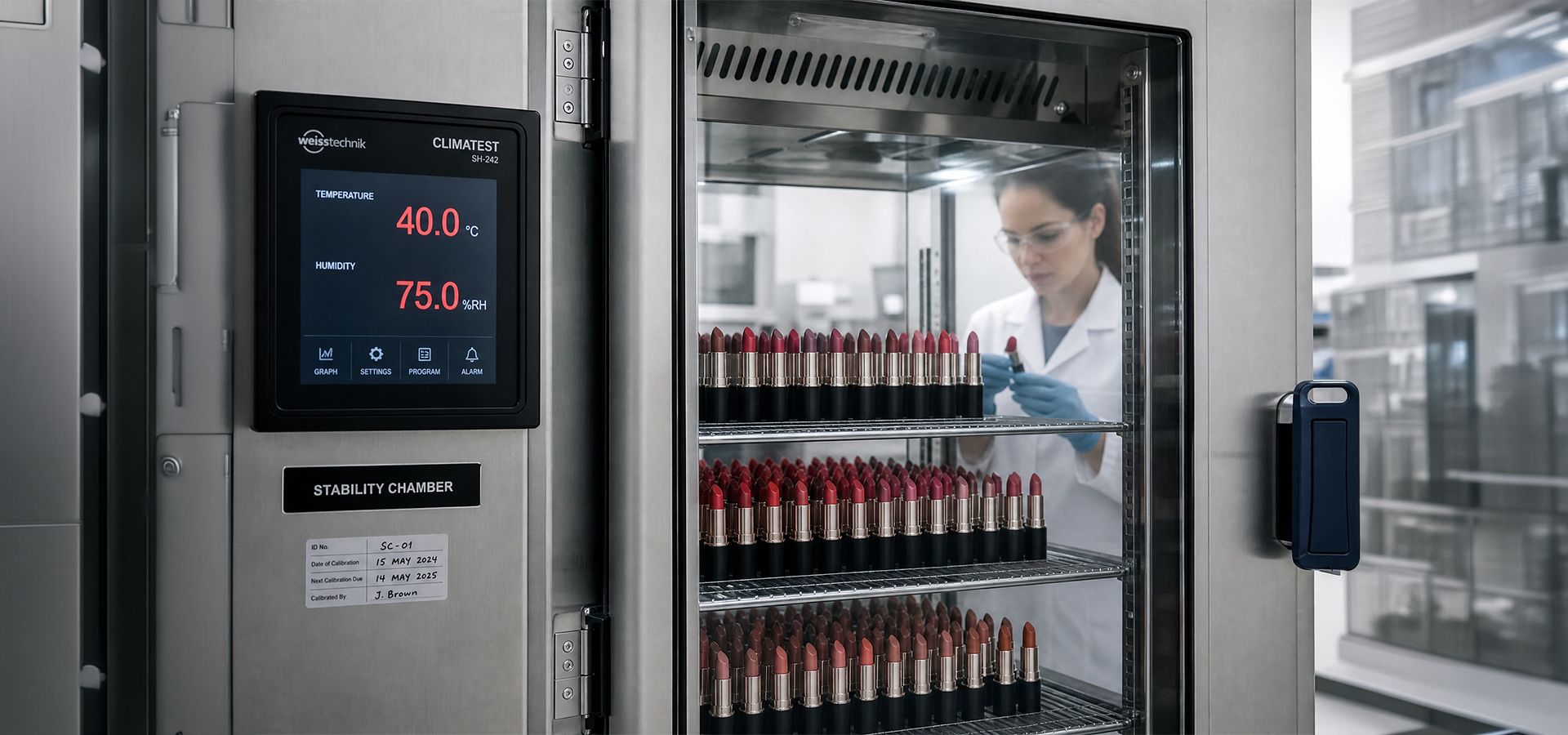
🔴 Bullet Lipstick (Classic & Matte)
Recommended pigment system: D&C Red lake + iron oxide blend
Typical loading: 15–30%
Key note: Use castor oil pre-dispersion minimum; three-roll mill for premium payoff.
💄 Lip Gloss & Tinted Gloss
Recommended pigments: D&C Red toners, transparent iron oxides
Challenge: Keeping pigments suspended in high-oil base
Tip: Castor oil pre-dispersion at 5–10% load.
✏️ Lip Liner Pencil
Requires: Maximum bleed resistance and wax hardness
Recommended: Lake + iron oxide combination
Key note: Higher wax content = tighter pigment lock and zero feathering.
🌿 Tinted Lip Balm
Pigment loading: Low (3–8%), carrier-forward formula
Best pigments: Iron oxides, low-load D&C lake
Clean label option: Mica + beet extract blends.
⏱ Liquid Lipstick (Long-Wear)
Requires: Surface-treated pigments for film-former adhesion
Surface treatments: Silicone or alumina coating
Recommended: Treated D&C Red lake + iron oxide blend.
🌱 Vegan & Organic Lip Color
System: Full carmine-free
Recommended blend: D&C Red 7 + iron oxides + mica + plant-based tints
Certification: COSMOS / Ecocert / V-Label compatible.
Regulatory Compliance — Quick Reference
All four primary synthetic cosmetic pigments for lipstick are globally approved — but labeling requirements and specific CI numbers vary. Verify before finalizing your export formulation.
| Market | Key Regulation | Lip-Approved | Key Note |
|---|---|---|---|
| USA | FDA 21 CFR Part 74 & 82 | D&C + FD&C approved list | Carmine requires allergen label; batch certification required for D&C |
| EU | EC No. 1223/2009 Annex IV | Specific CI numbers permitted | Carmine = “may cause allergic reactions”; some D&C reds restricted |
| INDIA | CDSCO + BIS IS 5621 | Broadly aligned with EU Annex IV | Verify CI numbers against BIS schedule; FSSAI norms for lip-safe classification |
| GCC | GSO 1943 | Codex-aligned | Halal compliance increasingly required; verify carmine status per distributor |
Refer to FDA Color Additives for Cosmetics, EU Cosmetics Regulation Annex IV, and ISO 16128 for natural/organic definitions for the most current approved lists before finalizing export formulations.
How to Choose the Right Cosmetic Pigment Supplier
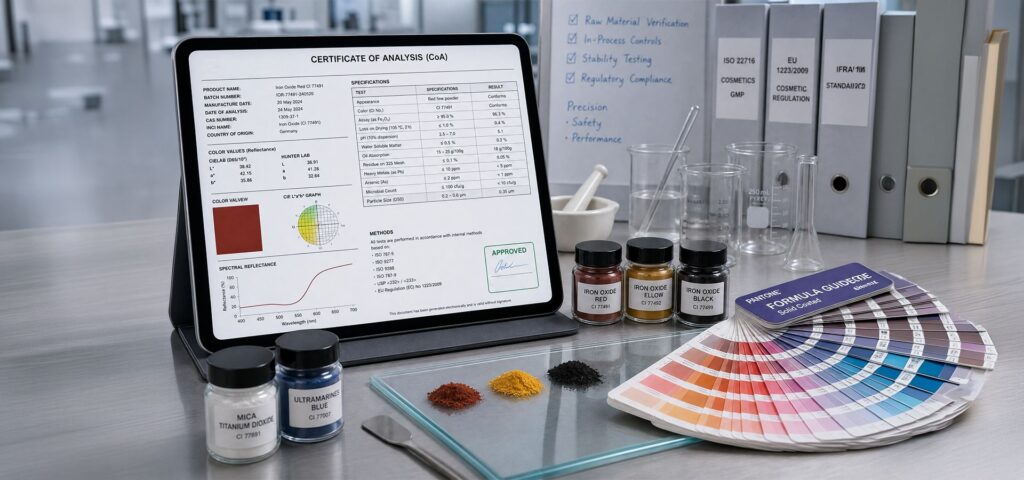
The pigment is half the equation — the supplier is the other half. Require ISO 22716, per-batch CoA with heavy metals data, and pilot samples before any volume commitment.
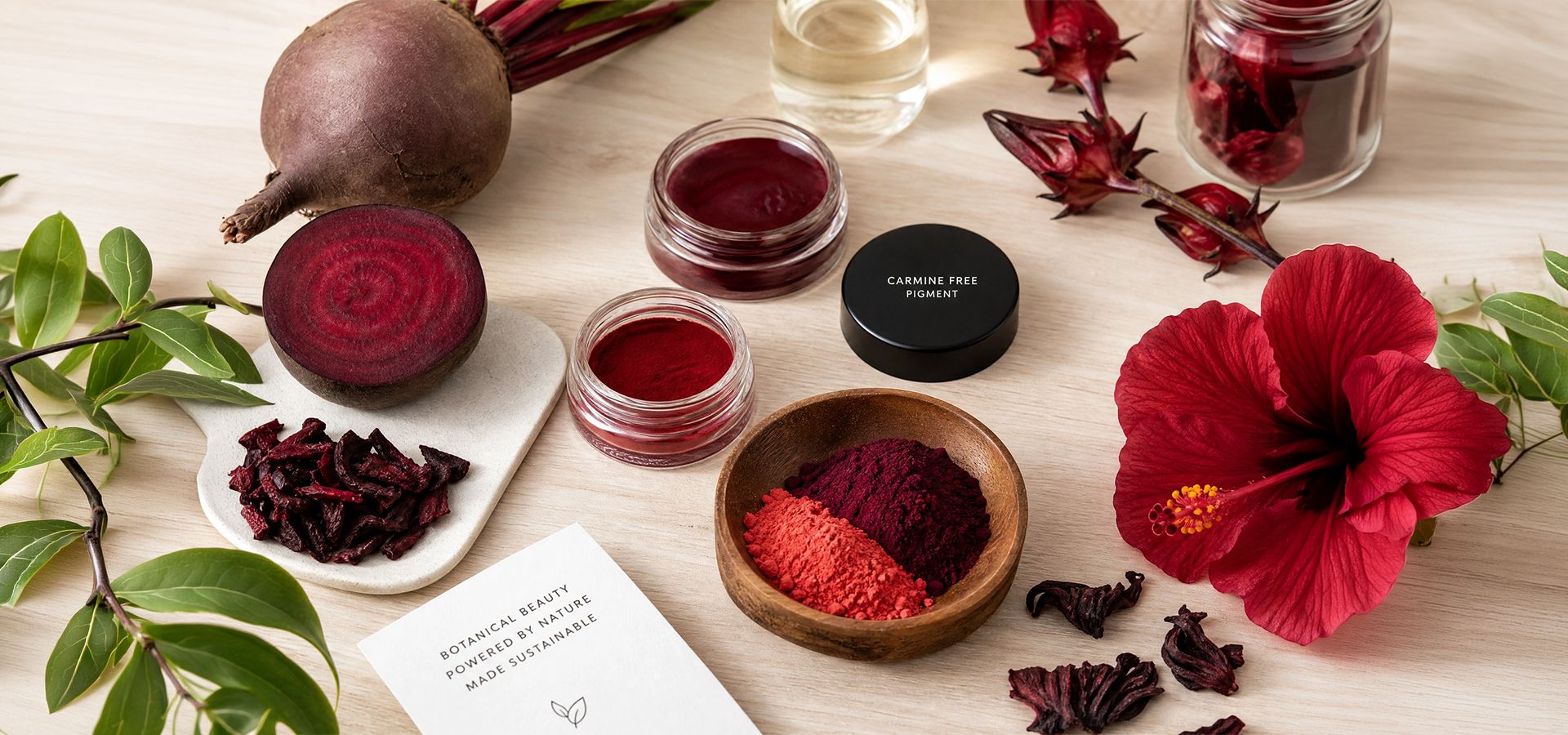
- →Certifications — ISO 22716 (GMP for cosmetics), REACH compliance, FDA registration, BIS certification, HALAL/KOSHER where required for your markets
- →Batch documentation — CoA per batch with purity percentage, heavy metals (Pb, As, Hg, Cd limits), TDS, and SDS sheets for every pigment
- →Particle size data — request D50 (median) and D90 values; critical for predicting dispersion behavior in your specific wax system
- →Technical support — in-house cosmetic formulators who can develop custom shades and provide application guidance for your specific product format
- →Sampling program — willingness to provide pre-production samples and participate in pilot trials before volume commitment
Frequently Asked Questions
What are the safest cosmetic pigments for lipstick?
The safest cosmetic pigments for lipstick are those with a confirmed lip-safe regulatory status in your target market — specifically FDA-certified D&C pigments, iron oxides (CI 77491/77492/77499), and lake colors produced to cosmetic GMP standards with verified heavy metals limits below the regulatory threshold for lip products.
Which D&C Red pigments are best for lipstick?
D&C Red No. 7 (Lithol Rubine BCA) delivers a warm, carmine-adjacent red and is the most widely used. D&C Red No. 6 gives a cooler, more blue-leaning red. D&C Red No. 21 and 27 deliver bright, fluorescent-adjacent pinks and corals. The best choice depends on your target shade position and finish type (sheer vs opaque).
What is the difference between a lake and a toner in lip color?
A toner is the pure dye pigment in powder form — highly concentrated, soluble in some carriers, and prone to migration. A lake bonds the same dye to an insoluble alumina substrate, making it non-migratory. Lakes are the superior choice for long-wear and anti-bleed formulations; toners work well in sheer glosses where translucency is the goal.
Are iron oxides safe for use in lipstick?
Yes — synthetic iron oxides (CI 77491, 77492, 77499) are globally approved for lip use when produced to cosmetic-grade purity with heavy metals below regulatory limits. They are among the most safety-tested pigments in cosmetics. Always confirm the CoA shows compliance with the heavy metals limits specified in your target market’s regulation (FDA, EU Annex IV, or CDSCO India).
What is the best vegan alternative to carmine in lipstick?
D&C Red 7 (Lithol Rubine BCA) is the best-performing vegan alternative to carmine for lipstick. It requires approximately 15–20% higher loading to match carmine’s depth but is heat-stable, oil-compatible, and FDA-approved for lip use. For plant-based alternatives, black carrot extract offers the closest natural red, but requires careful pH and temperature management during manufacturing.
Why does lip color bleed and how can pigment choice fix it?
Lip color bleeds when the pigment form is soluble or semi-soluble — it migrates into fine lines around the lip line via capillary action through the oil phase. Switching from a toner (soluble) to a lake (insoluble) is the single most effective fix. Iron oxides also have zero bleeding tendency. Wax hardness and lip liner application help further but cannot fully compensate for a pigment form that bleeds.
What cosmetic pigment loading is typical in lipstick formulations?
Pigment loading in lipstick typically ranges from 3–8% for tinted balms, 10–20% for sheer and satin finishes, and 20–35% for full-coverage matte formulas. Highly pigmented matte liquid lipsticks can reach up to 40% total pigment load. Always pilot-test at the target loading level — excessive cosmetic pigment can cause formulation brittleness, poor application feel, and texture defects in the finished bullet.
For conventional lip ranges, D&C Red lakes paired with iron oxides deliver the most reliable combination of vibrancy, bleed resistance, and regulatory clearance. Shift to D&C Red 7 + iron oxides + mica for vegan certification. Reserve natural plant cosmetic pigments for premium organic lines where performance trade-offs are acceptable — and always run heat stability trials before scaling production.
Source Cosmetic Pigments for Your Lip Range
Get certified samples of D&C Red pigments, iron oxides, lake colors, and carmine alternatives — plus custom shade matching support from our cosmetic pigment specialists.