Something has shifted in how consumers approach the lipstick counter. Where they once reached for the shade that caught their eye, a growing number are now turning the product over first — reading the ingredient list before they read the shade name. This behaviour change is not a niche trend. It represents a structural shift in beauty purchase psychology, and lip cosmetics is one of the categories where it is most pronounced.
The reason is intuitive once stated: lipstick is an incidental ingestible. The average lipstick wearer consumes between 1.5mg and 4mg of their lip product per day through normal wear. That fact — once pointed out — makes an ingredient list suddenly relevant in a way it never was for a foundation or eyeshadow. The clean beauty movement has made this intuition actionable, and consumers are now making purchase decisions on the basis of it.
At Advik Colors, we manufacture the cosmetic-grade pigments that go inside lip cosmetic colors across the global market. The shift toward clean beauty formulations is not abstract to us — it shows up in our order data, in the formulation briefs we receive, and in the conversations we have with brands who are actively reformulating their lip ranges around clean criteria. This guide draws from that firsthand perspective.
What “Clean Beauty” Actually Means in Lip Cosmetics — The Decoder
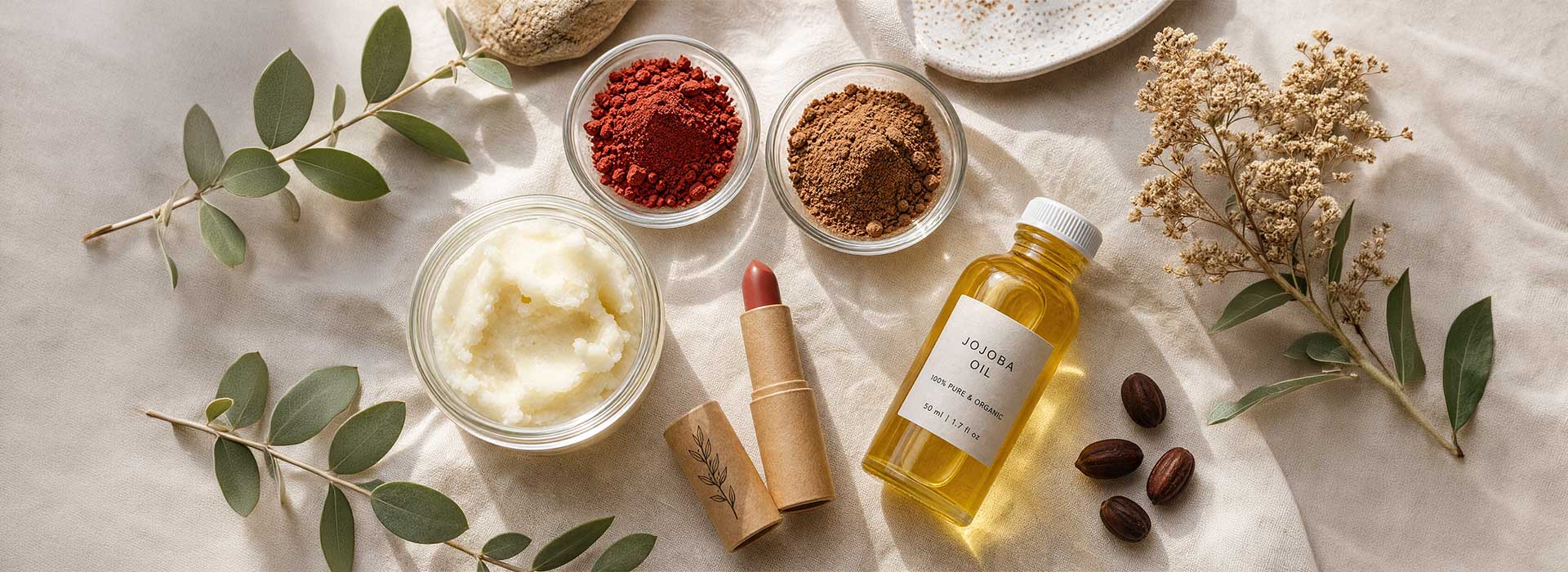
Before examining the trends, the most useful thing any guide to clean beauty can do is address the central confusion: there is no single legal definition of “clean beauty.” The term means different things to different brands, retailers, and consumers — and in lip cosmetics specifically, where multiple overlapping claims compete for shelf space, this ambiguity creates genuine consumer confusion.
Below are the four most common clean beauty definitions applied to lip cosmetic colors — and what each claim actually means in formulation reality.
🌱
Vegan Lip Color
Formulation Reality
Means no carmine (CI 75470) — the cochineal-derived red pigment used in most conventional lipsticks. Vegan reds use D&C Red lake combinations instead. No animal-derived waxes (beeswax) or testing at any supply chain stage.
🚫
Free-From Lip Cosmetics
Formulation Reality
A marketing claim that specific “nasty” ingredients are absent. Common exclusions: parabens, mineral oil, synthetic fragrance, heavy metals above limits. No regulatory standard — each brand defines its own “free-from” list. Retailer standards (Sephora Clean, Credo) provide more consistent floors.
🌾
Natural Lip Color
Formulation Reality
Unregulated unless backed by certification (COSMOS, NATRUE, USDA Organic). Can mean anything from “uses a plant-derived oil as one ingredient” to “95%+ natural origin.” Without a certification logo, the claim is marketing, not standard.
🧪
Non-Toxic Lip Color
Formulation Reality
Completely unregulated — no legal definition exists. Often signals the brand avoids ingredients on self-defined concern lists. A regulatory-compliant conventional lipstick and a “non-toxic” clean lipstick may have almost identical safety profiles. The term is primarily a consumer trust signal.
What matters most for lip cosmetics specifically — because lipstick is an incidental ingestible — is that every colorant used in a lip product is specifically approved for lip use by the relevant regulatory authority in each target market. This standard applies equally to “clean” and conventional formulations. A natural lip color that uses a botanical colorant not approved for lip use is not safer than a conventional one; it is less compliant.
🎨 Advik Colors manufactures cosmetic-grade pigments for clean beauty lip formulations — from certified vegan-compatible D&C Reds to low-heavy-metal iron oxides. Explore our full cosmetic pigments range →
🌿 The 6 Defining Trends
The 6 Defining Clean Beauty Trends in Lip Cosmetics Right Now
🌱 Trend 1 — Fastest Growing
Carmine-Free Formulation — Vegan Lip Color Goes Mainstream
Carmine (CI 75470) is the single most commercially significant target in clean beauty lip cosmetics reformulation. Derived from dried cochineal insects, it has been the go-to natural red pigment in premium and mass-market lipsticks for decades — valued for its exceptional intensity, heat stability, and depth. But its animal origin has made it the focal point of vegan and cruelty-free reformulation demands across the industry.
The scale of the shift is commercially meaningful: vegan and cruelty-free claims appeared on approximately 42% of new global lipstick launches in 2024–2025. This proportion has tripled since 2018. The demand is predominantly driven by Gen Z and younger millennial consumers for whom animal-derived cosmetic ingredients carry ethical weight that outweighs performance arguments.
The practical challenge for brands reformulating carmine-free lip cosmetic colors is that no single synthetic alternative fully replicates carmine’s intensity and stability. The most commercially viable approach uses a blend strategy — combining D&C Red lake pigments to achieve comparable depth and warmth in a vegan-compliant formula.
Vegan-Compatible Replacements
D&C Red 6 Na Salt (C.I. 15850) · D&C Red 27 Al Lake (C.I. 45410:2) · FD&C Red 40 Al Lake (C.I. 16035:1) · D&C Red 28 Al Lake — pinks
Advik Colors — Manufacturing Perspective
For deep reds, our recommended carmine replacement combines D&C Red 6 Na Salt at elevated loading for warmth and depth, with D&C Red 27 Al Lake for cool-toned dimensionality. For pink-to-red ranges, FD&C Red 40 Al Lake at lower loading provides a clean, bright base. The shade match is close but not identical — brands should plan for a development round specifically to recalibrate shade targets when transitioning from carmine.
🚫 Trend 2 — Consumer Perception Driven
Paraben-Free and Preservative-Conscious Lip Formulas
Parabens became the clean beauty industry’s original villain — widely communicated consumer concern, significant retailer restrictions, and a decade of “paraben-free” claims have made their avoidance nearly universal in new lip cosmetic product development. The formulation reality is nuanced: conventional anhydrous lipstick formulas rarely required parabens in the first place, since their wax-oil base does not support microbial growth the way water-based cosmetics do.
The more relevant paraben-free conversation for lip cosmetics is in tinted balms, lip oils, and hybrid formulas where aqueous components are present. These formats genuinely require preservation systems, and the shift from parabens to alternative preservation (phenoxyethanol, vitamin E, natural antimicrobials) is an active formulation challenge in the clean beauty lip category.
Consumer demand for paraben-free lip cosmetics is real regardless of the formulation complexity — and premium retailers have codified it. Sephora’s Clean Beauty standard and Credo Beauty’s Dirty List both restrict parabens across all cosmetic categories, creating a de facto industry standard for brands targeting those distribution channels.
Advik Colors — Original Data
In new lip product development briefs received by Advik Colors in 2025–2026, more than 65% explicitly request pigments compatible with paraben-free formulation systems — making it the second most frequently stated clean criterion after carmine-free/vegan, ahead of even heavy metal documentation requests.
🌾 Trend 3 — Growing with Trade-offs
Natural and Plant-Derived Pigments for Lip Cosmetic Colors
Consumer demand for “naturally derived” lip cosmetic colors is strong and growing — but it collides with a persistent technical reality that the clean beauty industry has been slow to address transparently: natural pigments for lip use carry significant performance limitations that synthetic alternatives do not share.
Understanding this honestly, rather than marketing around it, is the most useful thing a brand or consumer can do when evaluating natural lip colors.
Works Well In
Balms & Sheer Tints
Natural pigments like beetroot extract and hibiscus deliver gentle, skin-compatible color in moisture-forward formulas where deep payoff isn’t required. Light stability and heat sensitivity matter less in balm formats.
Where They Struggle
Full-Coverage Mattes
Heat instability during hot-pour manufacturing, pH-variable hues, UV fading under retail lighting, and batch-to-batch variation make natural pigments technically challenging in high-performance matte lip formulas.
CI 75120
Annatto — Warm Oranges
Plant-derived, approved for lip use in most markets. Produces warm orange tones. More stable than beetroot or hibiscus. Useful in coral and warm nude formulations.
CI 75470
Carmine — Deep Reds
Technically natural, but derived from cochineal insects — not vegan. Highest intensity of any natural lip pigment. The benchmark that plant-derived alternatives are measured against.
💡 Our Honest Take
The clean beauty industry has a communication gap around natural lip pigments. “Natural” is not automatically “better” for a lip cosmetic color that needs to survive a 90°C manufacturing process, 12 months of retail shelf storage, and 8 hours of active wear. Brands that pretend otherwise — using natural pigments in formulas that require stability performance those pigments cannot deliver — produce products that disappoint consumers and erode trust in the clean beauty category. The honest answer is: natural pigments work beautifully in the right format, and poorly in the wrong one.
⚗️ Trend 4 — Emerging Scrutiny
Heavy Metal Transparency — The Next Clean Beauty Wave
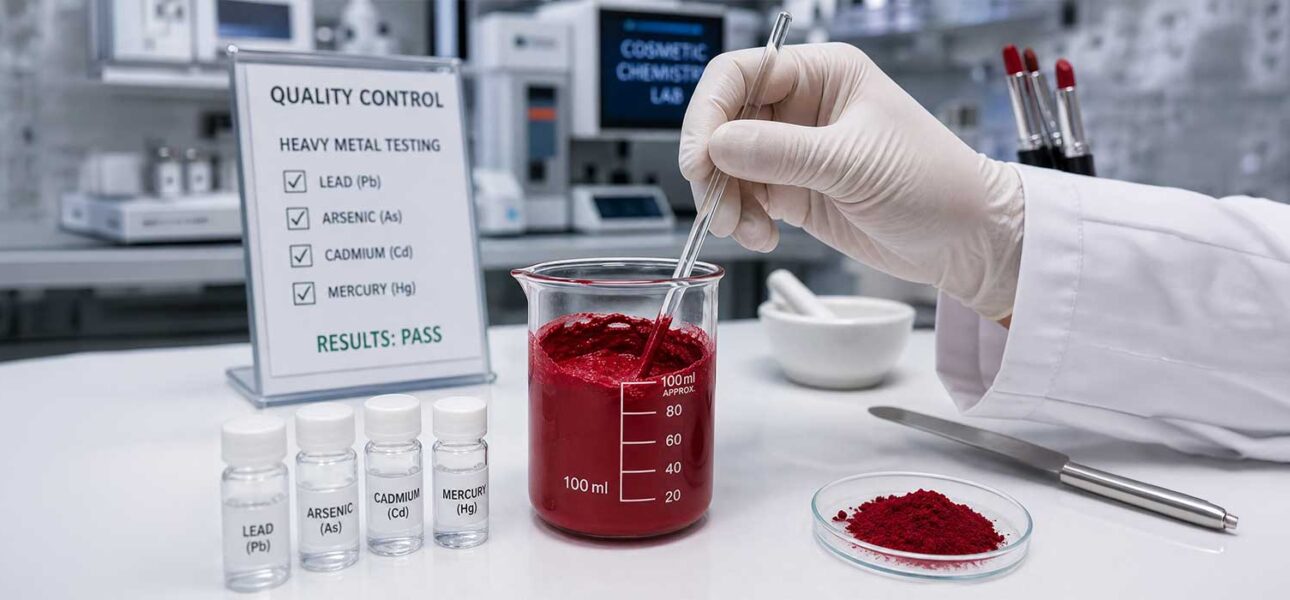
Heavy metals in lipstick became a consumer concern following several published studies documenting detectable levels of lead, cadmium, chromium, and arsenic in commercially available lip products. The regulatory position is measured: trace heavy metals are subject to maximum permitted limits under FDA and EU cosmetics regulations, and compliance at these levels is considered safe. But “within regulatory limits” and “clean” are increasingly separate concepts in consumer perception.
The clean beauty market is now developing a “heavy metal free” positioning that goes beyond basic regulatory compliance — brands are proactively testing and declaring heavy metal levels, publishing Certificate of Analysis data, and differentiating on the basis of certified low-heavy-metal pigment sourcing.
This matters most for lip cosmetics because — as an incidental ingestible — any trace contamination in a lip product has a direct exposure pathway. The sourcing of cosmetic pigments plays a direct role: heavy metal content in iron oxides and other inorganic pigments varies significantly by manufacturing origin. The same CI number from two different sources can have materially different heavy metal profiles.
Advik Colors — Trust Signal
Advik Colors tests all cosmetic-grade iron oxide pigments for heavy metal compliance against FDA 21 CFR and EU Cosmetics Regulation maximum limits. Our certificates of analysis include specific heavy metal data (lead, arsenic, mercury, cadmium) per batch. For brands building clean beauty lip ranges, this documentation is part of our standard supply package — not an optional upgrade. Heavy metal compliance is a baseline supply chain responsibility, not a premium feature.
✦ Trend 5 — Premium Positioning
Minimalist Formulation — Fewer Ingredients, Higher Quality
Ingredient minimalism has become a clean beauty signal in its own right. The consumer logic is intuitive: a lipstick with 10 recognisable ingredients reads as more trustworthy than one with 35, even before any individual ingredient is evaluated. This instinct drives a formulation philosophy that is fundamentally different from traditional cosmetic development — starting from “what must be here” rather than “what can we add.”
For lip cosmetic colors, minimalist formulation means short INCI lists with functional justification for every component. It means transparent colorant declaration — CI numbers visible and understandable rather than buried in a long list. And it means that every ingredient must perform correctly from the start, because there is no room for compensatory additives when the formula fails.
This is where pigment quality becomes more critical, not less, in clean beauty formulation. A minimalist formula with 10 ingredients has no margin for a pigment that requires secondary stabilisers, opacity corrections, or batch-to-batch adjustments. The pigment specification must be tight enough that it performs reliably in a lean formula — which demands higher purity standards from the pigment manufacturer.
Advik Colors — Manufacturing Perspective
Minimalist formulation briefs represent some of the most technically demanding work we support. A brand developing a 9-ingredient lipstick needs pigments with tighter dispersion specifications, more consistent dye content, and better heat stability than a conventional 28-ingredient formula — because there is no safety net. Our high-purity D&C Red and iron oxide grades are specifically suited to minimalist lip formulation where the pigment must carry its full share of the performance requirement.
🌍 Trend 6 — Supply Chain Transparency
Transparent Sourcing — Clean Beauty Beyond the Ingredient List
The most recent evolution of clean beauty in lip cosmetics is the expansion of “clean” from the ingredient list into the supply chain. Consumers and retailers increasingly want to know not just what is in a lip product, but where each ingredient comes from and how it was produced. This extends clean beauty from a formulation standard into a sourcing and manufacturing standard.
For cosmetic pigments in lip products, supply chain transparency means: country of origin documentation, manufacturing facility standards, cruelty-free declarations at every supply chain tier, and third-party certification where available. Brands building clean beauty lip cosmetic colors that carry COSMOS, Vegan Society, or PETA certifications need their pigment suppliers to provide documentation that supports those certifications — not just commercially compliant ingredients.
The sustainable packaging dimension of clean beauty — refillable lip products, biodegradable applicators, reduced single-use plastic — sits alongside clean formulation as part of the same consumer values framework, even though it represents a separate set of product development decisions.
Advik Colors — Supply Chain Position
Our cosmetic pigments are manufactured and exported with full origin documentation, manufacturing standard declarations, and regulatory compliance certificates. For brands pursuing clean beauty certification, we provide the supplier-tier documentation required to support their certification applications — including vegan status declarations, heavy metal compliance CoAs, and cruelty-free manufacturing confirmations.
Clean Beauty Lip Cosmetics by Format — Where the Trend Is Moving Fastest
Clean beauty adoption is not uniform across all lip cosmetic formats. The formats where ingredient transparency is easiest to achieve and consumer expectation is highest are moving fastest; others are following at different rates.
| Format | Clean Adoption | Key Clean Trend | Consumer Profile |
|---|---|---|---|
| Lip Balm & Tinted Balm | ⬆ Highest | Natural pigments, plant oils, vegan claims | All ages; skincare-first consumers |
| Tinted Lip Oil | 🚀 Fastest | Minimal ingredients, natural-origin oil base | Skinimalism-driven; Gen Z |
| Liquid Matte Lipstick | 📈 Fast-Growing | Carmine-free, paraben-free, vegan-certified | Gen Z, millennial |
| Lip Gloss | 📈 Fast-Growing | Vegan, mineral oil-free, plant-derived oils | Gen Z |
| Bullet Lipstick | 〜 Moderate | Heavy metal compliance, vegan alternatives | Millennial, Gen X |
| Lip Liner | ◦ Emerging | Clean reformulation, refillable formats | Premium clean beauty |
What Clean Beauty Means for Cosmetic Manufacturers
Consumer-driven clean beauty trends translate into specific formulation and sourcing decisions for brands developing lip cosmetic colors. The most important insight from our position as a pigment manufacturer is this: clean beauty reformulation is most successful when it starts at the pigment level.
The ingredient substitution framework for clean lip cosmetics follows a consistent pattern. Understanding the cosmetic pigments used in lipstick and lip care products is the essential foundation for any clean beauty reformulation — because the colorant system is where carmine elimination, heavy metal compliance, natural pigment decisions, and vegan certification all converge into specific supplier and specification choices.
📊 Market Signal — Advik Colors Formulation Brief Data
In new lip product development briefs received by Advik Colors across 2025–2026, clean beauty-specific criteria appeared in over 70% of all new lipstick development projects — up from under 30% in 2021. The most common criteria stated, in order: vegan/carmine-free (68% of briefs), paraben-compatible pigments (65%), heavy metal CoA documentation (54%), minimalist INCI list support (41%), and supply chain origin documentation (38%). Clean beauty is no longer a niche brief requirement — it is close to becoming the default formulation context.
The brands succeeding at clean beauty lip reformulation are not treating it as a label-change exercise. They are reformulating from the pigment up — because that is where the real clean claim lives.
Frequently Asked Questions
What makes a lip color “clean beauty”?
A clean beauty lip color typically meets one or more of: being free from specific ingredients of concern (parabens, mineral oil, heavy metals above regulatory limits, synthetic fragrance); vegan (no animal-derived colorants like carmine CI 75470); cruelty-free (no animal testing at any supply chain stage); or natural/organic-origin ingredients meeting COSMOS, NATRUE, or USDA Organic certification standards. There is no single legal definition — each brand or retailer defines their own standard. The most meaningful clean beauty signal for lip cosmetics is regulatory-compliant colorants with documented heavy metal compliance.
Are natural lip cosmetic colors safer than synthetic?
Not automatically. Safety in lip cosmetics is determined by regulatory compliance and ingredient testing, not by natural vs. synthetic origin. Some synthetic cosmetic pigments — D&C certified lake pigments — have undergone more rigorous safety evaluation than many natural colorants. The most important safety indicators for any lip cosmetic color are: specific approval for lip use in your target market, heavy metal compliance below maximum permitted limits, and appropriate testing for a product that is regularly and incidentally ingested in small quantities.
What pigments are used in vegan lipstick?
Vegan lipstick replaces carmine (CI 75470, derived from cochineal insects) with synthetic or plant-derived alternatives. Common vegan-compliant lip pigments include D&C Red 6 Na Salt and D&C Red 27 Al Lake for deep reds; D&C Red 28 Al Lake for fuchsia-pinks; FD&C Red 40 Al Lake for lighter sheer tints; and iron oxides (CI 77491, 77492, 77499) for nudes and browns. Plant-derived options include annatto (CI 75120) for orange-warm tones and beetroot extract for clean beauty balm positioning.
Is carmine safe in lipstick?
Carmine (CI 75470) is approved for lip use by both the FDA and EU Cosmetics Regulation and is considered safe for the general population based on its regulatory assessment. It can cause allergic reactions in sensitive individuals, and it is not suitable for vegan consumers. Brands using carmine must declare it by name on labels in most markets. The primary concern with carmine in clean beauty contexts is ethical — its animal origin — rather than toxicological. Its safety profile as a cosmetic colorant for lip use is well-established.
Do clean beauty lipsticks last as long as conventional formulas?
Yes, when formulated correctly. Longevity in a lip color depends primarily on pigment form (lake vs. dye), pigment load, and the base formula’s film-forming properties — none of which require ingredients that conflict with clean beauty standards. High-quality vegan-compliant D&C Red lake pigments perform equally to carmine-based formulas for longevity and stability. The performance gap seen in some clean beauty lip products is a formulation quality issue, not an inherent limitation of clean ingredients.
What should I look for on a lipstick ingredient list?
For clean beauty lip cosmetics, look for colorants listed as D&C or FD&C certified lake pigments — these are regulated, oil-dispersible, and specifically approved for lip use. Iron oxides (CI 77491, 77492, 77499) are appropriate for nude and brown shades. Titanium dioxide (CI 77891) provides opacity. Be more cautious of very long ingredient lists with undisclosed fragrance complexes; colorants listed without CI numbers; and “natural” claims without certification backing. The presence of a CI number on a colorant is actually a positive signal — it means the colorant has been identified, regulated, and specifically approved.
Conclusion
Clean beauty in lip cosmetics is not a single trend — it is a convergence of six distinct consumer-driven movements: vegan formulation, paraben-consciousness, natural pigment demand, heavy metal transparency, ingredient minimalism, and supply chain accountability. Each is growing independently, and together they are reshaping what a credible lip cosmetic color brand looks like in 2026.
The key insight for both consumers and brands is that clean beauty is not a compromise on performance. High-quality, vegan-compatible lake pigments deliver the same longevity and shade intensity as carmine-based formulas. Minimalist lip formulas with clean-sourced, well-specified pigments perform as well or better than complex conventional ones. The performance gap that some clean beauty products show is a formulation quality problem — and it is entirely solvable.
At Advik Colors, we manufacture cosmetic-grade pigments that support clean beauty lip cosmetic colors across every dimension of the clean brief — from certified vegan-compatible D&C Reds to low-heavy-metal iron oxides with full CoA documentation, supplied to brands who are building the next generation of lip cosmetics with ingredient integrity as a foundation.
🌿
Build Your Clean Beauty Lip Range on the Right Foundation
Vegan-compatible, heavy-metal-compliant, globally certified cosmetic pigments — with the documentation to support your clean beauty claims at every retail tier.